Pa. Department of Health creates online measles information dashboard
Pennsylvanians can now access an online dashboard with measles case data operated by the Pa. Department of Health. The page will be updated three times per week with the latest stats.
Harrisburg, Pa. — The Pa. Department of Health has opened a new online dashboard to provide the public with data about measles cases within the Commonwealth.
Users may use the page to see case details about county, age, hospitalization, and vaccination statistics. The dashboard will be updated on Mondays, Wednesdays, and Fridays at 2 p.m. with the latest available data.
“This new measles dashboard is part of the Shapiro Administration’s commitment to boost public access to information and provide transparency in our work to protect public health,” said Secretary of Health Dr. Debra Bogen. “We continue working tirelessly to contain the spread of this highly contagious virus among people who are not vaccinated. So far this year, we provided more than three times as many measles, mumps, and rubella (MMR) vaccinations in Lancaster County than we did in all of 2025. Through our public health outreach, we are building trust and making connections with people and seeing increased confidence in the MMR vaccine’s ability to protect Pennsylvanians and their community.”
The Department of Health is regularly hosting pop-up measles vaccine clinics, providing more than 600 doses to Lancaster County residents since cases were first identified there in late April. In 2025, DOH gave 179 measles vaccines to Lancaster residents in the entirety of the year.
The Department of Health and its numerous partners are working to increase access to vaccines and improve the information available to the public. This year, DOH-operated state health centers administered more than 1,500 doses of the MMR vaccine to Pennsylvanians.
In late June, DOH issued guidance to healthcare providers enabling them to vaccinate infants as young as six months of age. Infants are particularly vulnerable to the measles virus. Early MMR vaccines are rated as safe for babies and provide moderate levels of protection when measles is spreading in the area.
Anyone who isn’t protected against measles is at risk for infection. Two doses of the MMR vaccine is the best known protection against the measles virus. The vaccine has historically been 97% effective at preventing a person from ever contracting the virus, leading to the disease being declared eradicated in the U.S. in 2000.
The vaccine was introduced in the early 1960s and decreased measles death more than 97% compared to the pre-vaccine era.
Because measles was practically eradicated in the U.S. for more than 20 years, most healthcare providers have not actually treated a patient with the disease. To ensure that Pennsylvanians have the information that they need, DOH is issuing Health Alert Network messages outlining the signs and symptoms of the disease and reminding clinicians to encourage patients to stay up-to-date with vaccinations.
In addition, DOH experts have been hosting both in-person and virtual briefings for over a thousand doctors, nurses, and other professionals to help them identify and treat measles cases.
How measles spreads
This highly contagious virus spreads when a person who has measles breathes, coughs, or sneezes. The virus remains in the air and on surfaces for up to two hours even after the infected person has left the area.
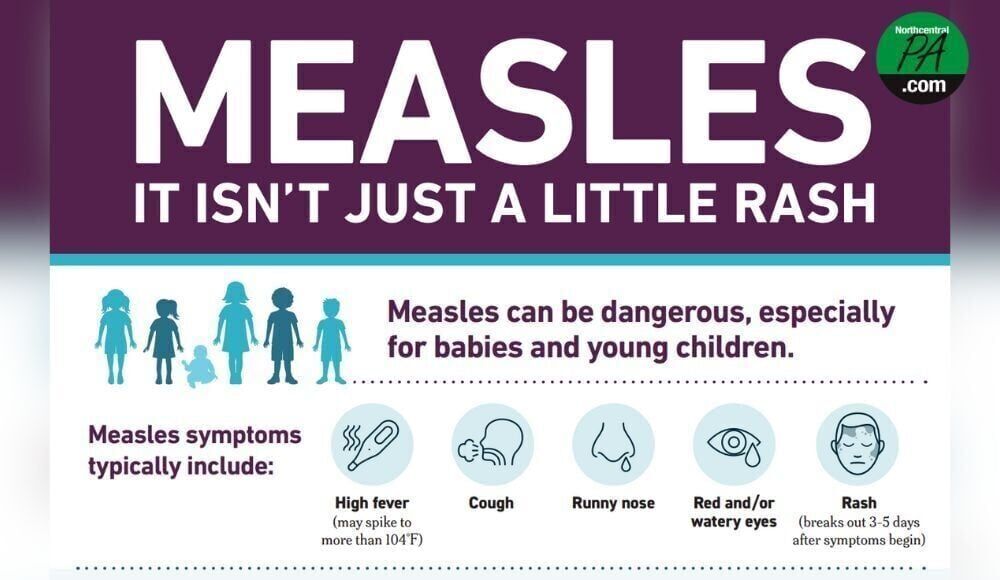
Symptoms to watch for include fever, cough, runny nose, and red, watery eyes (conjunctivitis), followed by a rash that starts on the head and spreads downward. Symptoms can start one to three weeks after exposure. Measles can cause serious health complications, including hospitalization or death.
When DOH is alerted to a new measles case, local public health staff conduct contact tracing to immediately identify contacts and places exposure may have occurred, and to implement necessary public health action, including public notification, to prevent further spread of the virus. The contact tracing team works around the clock to reach everyone who might have been exposed and to ensure people with measles are isolating while contagious.
DOH continues to closely monitor the situation and work with local health care partners to ensure timely notification and testing of any potential cases. Throughout the response, DOH evaluates new public health strategies and partnerships that aim to reduce the spread of the virus, while also providing easy access to vaccination.
People who believe they were exposed to measles and are experiencing symptoms should contact their health care provider or call DOH’s toll-free hotline at 877-PA-HEALTH (877-724-3258).
More information on measles is available at www.pa.gov/measles.
School vaccination rates
DOH currently provides school vaccination data at the county and state level. In August, school-level vaccination information will be available online to give families necessary information to make personal health and educational decisions.