History's Headlines: Let the Justice Bell Ring!
In 1915 women involved in the suffrage movement all over America were fascinated by the creation of the replica of Liberty Bell that included a phrase on its inscription giving women the right to vote equally with men. Created by suffragist Katharine Wentworth Ruschenberger, it toured 5,000 miles all over the country. Its goal was accomplished with the passage of the 19th amendment.

A lot happened in the year 1915. The long peace that had enveloped Europe had become a brutal and bloody war. Aircraft, hailed as a marvel, were now killing machines. And the sinking of the liner Lusitania with Americans aboard her remained a reminder to many that they were not immune from that conflict.
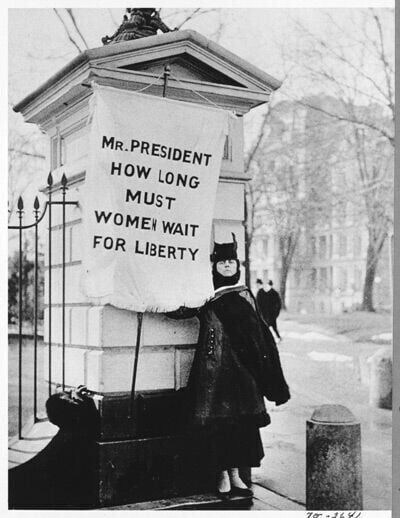
But for many others, particularly in Pennsylvania, the issue that year that consumed many was getting women the right to vote. Not that it was isolated to the Keystone State. Ever since Mark Twain had brought up the issue at a dinner in 1901 the cry “Votes For Women!” had become a groundswell.
Many men tried to shout it down. Former President Grover Cleveland had this to say on the subject. “Sensible and responsible women don’t want to vote,” he remarked in a magazine article. “The relative positions to be assumed by man and woman in the working out of our civilization were assigned long ago by a higher intelligence than that of ours.”
New York had a law that forbid woman to be seen smoking in public. According to historian Walter Lord at a January 1910 White House dinner the wife of the Russian ambassador Baroness Rosen asked President Taft for a cigarette.
“As everyone watched,” Lord records, “the President smilingly surrendered and sent his aide Archie Butt (later a Titanic victim) to borrow one somewhere. Thanks to the orchestra leader, Butt was successful and excitedly wrote the news that night to his sister-in-law Clara. “I am glad to say that the American women did not indulge.”
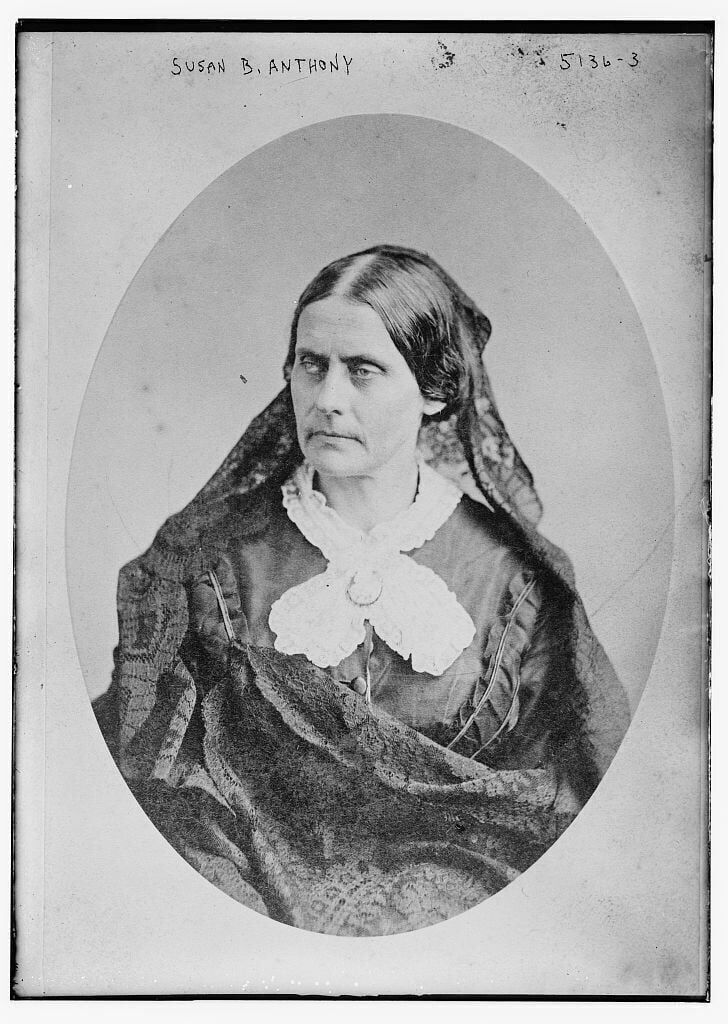
Susan B. Anthony
What the Pennsylvania women’s stand was on smoking is not recorded but since the Civil War a small group of women like Elizabeth Catty Stanton and Susan B. Anthony had been battling for the vote. “After 480 campaigns,” notes Lord, “they could boast only four victories, Wyoming, Colorado, Utah and Idaho.”
With Stanton’s death in 1902 and Anthony’s in 1906 the cause had appeared hopeless. And not every opponent was altruistic. “The timber, beef and especially the liquor lobbies fought hard against suffrage,” notes Lord, fearing women voters would be reformers against the political machines which they controlled through bribery.
With Woodrow Wilson’s arrival on the scene in 1913, many hoped that he would bring White House support for suffrage. But Wilson was in fact innately conservative on this and in many other issues such as race (on coming into office he replaced many Black Republicans with white southern Democrats) and expressed the opinion that women's suffrage was a state issue and should be decided by the states.
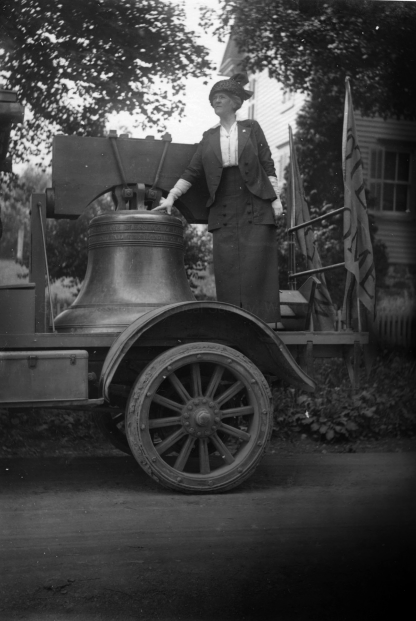
Katharine Wentworth Ruschenberger with the Justice Bell, 1915.
Thus, this was where the issue stood at the start of 1915 when suffragist Katharine Wentworth Ruschenberger (1853-1943) stepped into the picture. From a prominent family, she grew up on a 200-acre farm estate in an 1850s Greek Revival mansion named Strafford located in Tredyffrin Township, Chester County, named after the family’s English ancestors the 1st and 2nd Earls of Strafford. Katharine married Charles Wister Ruschenberger, a descendent of John Wister, one of the first German colonists of the area.
Apparently energized by the Pennsylvania referendum, Ruschenberger decided to make her contribution to the cause. How she decided on a copy of the Liberty Bell with some unique changes is not easily discovered. But in the early months of 1915 she apparently contacted the Meneely Bell Foundry of Troy, New York to make a replica of the Liberty Bell. Cast at a cost of $2,000, it was to have one difference from the original Bell. It was to include the word, Justice.
Thus, it reads: Establish Justice
Proclaim Liberty Throughout All the Land Unto
All the Inhabitants Thereof
Meneely Bell Co.
Troy, NY
MCMXV
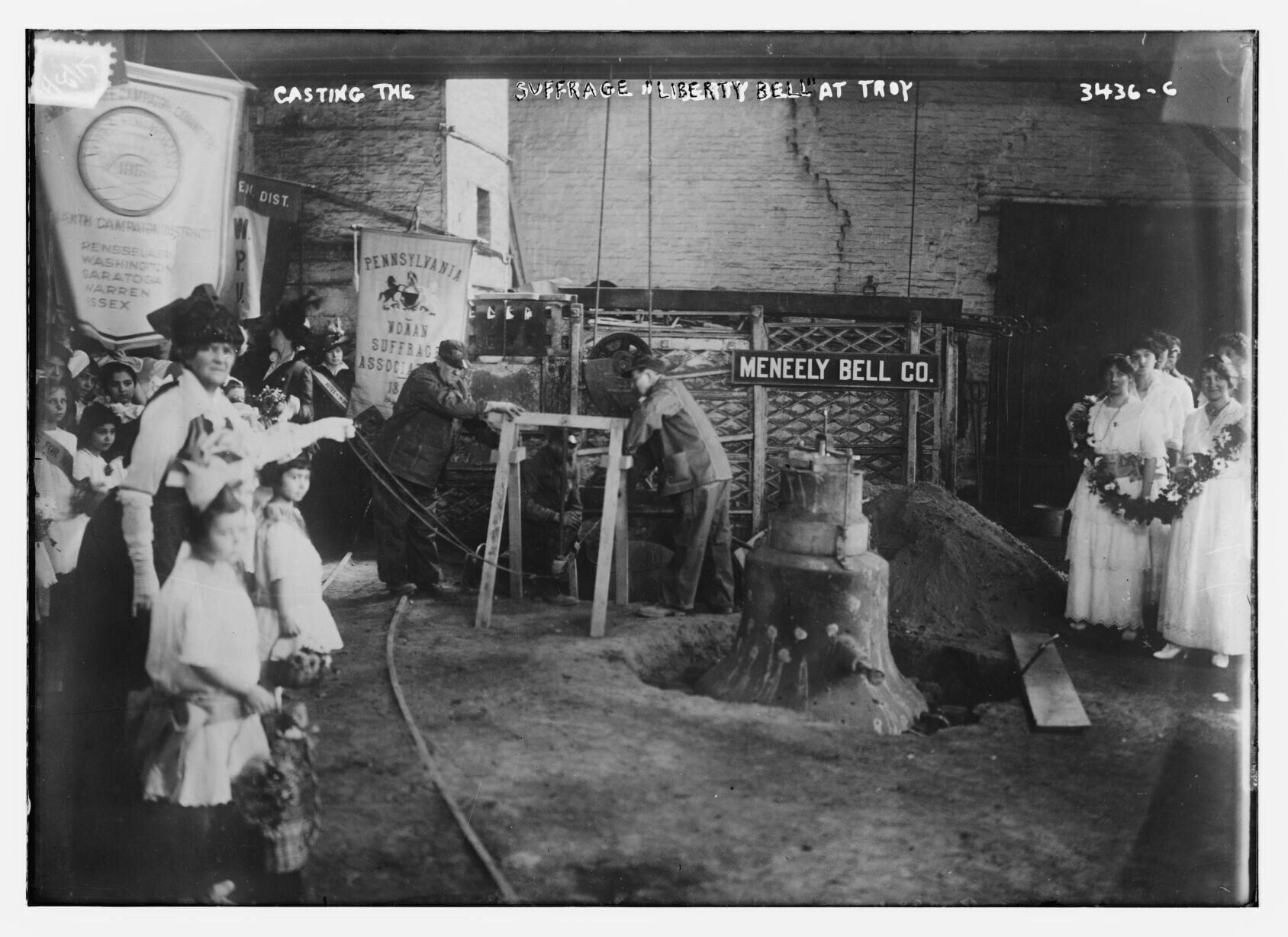
Casting the Suffrage "Liberty Bell" at Troy
With that the Bell began its 5,000- mile tour of all 67 Pennsylvania counties. According to its Wikipedia entry the Bell’s clapper was chained to its side as a symbol of how women were enchained and denied the vote. Ruschenberger, Louise Hall, Ruza Wenclawska and Pennsylvania Women's Suffrage Association leader Hannah J. Patterson were to accompany the Justice Bell that began its journey on June 23, 1915, at Sayre, Pennsylvania.
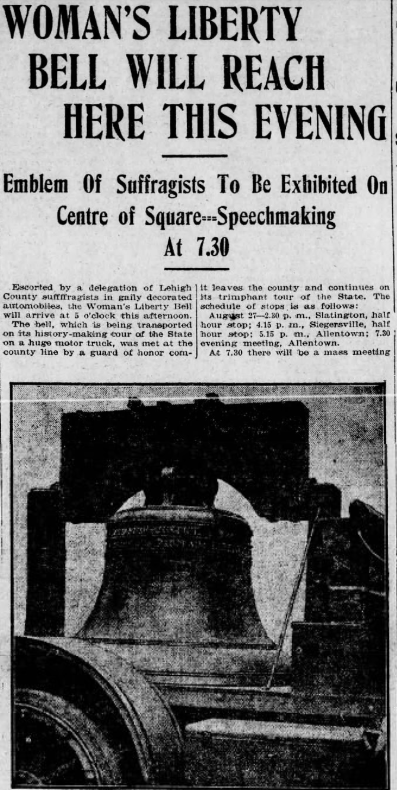
Allentown newspaper article ahead of a stop from the Justice Bell
After an enthusiastic greeting across the state complete with brass bands on October 22, 1915, the Justice Bell arrived in Philadelphia with a Broad Street parade. Also working hard for Black female suffrage in 1915 in Philadelphia were author Francis Harper, a Black writer and Black female journalist Gertrude Busill Mossell.
For all the enthusiasm for the Justice Bell, the vote was not a victory. For: 385,348 (46.37%); Against: 441,034 (53.37%).
It would not be until the passage of the 19th Amendment, which was ratified on August 18, 1920, that Pennsylvania women had the vote.
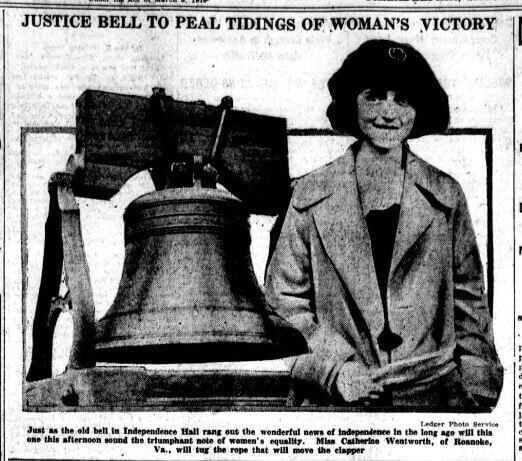
Catherine Wentworth featured in a newspaper article from 1920
On September 25, 1920, the Justice Bell was honored in a special celebration on Independence Square on the south side of Independence Hall.
Before a large crowd, Ruschenberger’s niece rang the bell for the very first time, releasing the clapper before a large crowd. It rang 48 times for the then 48 states.
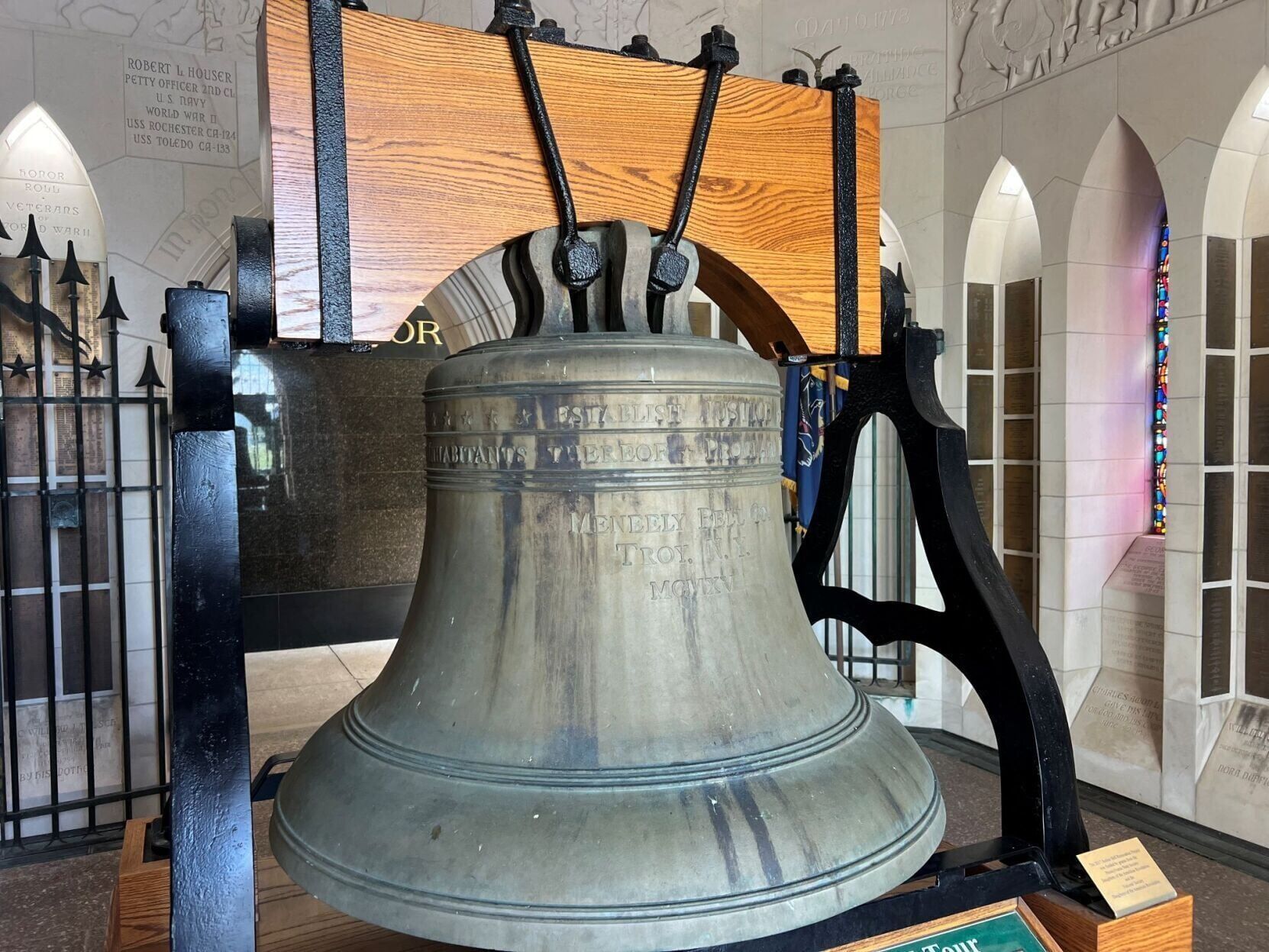
The Justice Bell inside Washington Memorial Chapel in Valley Forge
At Ruschenberger’s death in 1943 it was moved to the grounds of the Valley Forge National Park.
Over the years this relic has remained there largely unnoticed but now for a new generation, a symbol of women’s struggle for justice.