UM fossil collections manager hosts new season of PBS series about Pangea and life on Earth before dinosaurs
UM paleontologist and fossil librarian, Kallie Moore, has come back as a host on the new season of PBS "Eons."
"Eons: Life and Death on Pangea" focuses on the period of time right before the age of the dinosaurs, starting with the formation of the supercontinent Pangea and ending with the largest mass extinction ever, called the “Great Dying.”
One of the four hosts is Kallie Moore, the University of Montana paleontologist and fossil librarian. This is the ninth season of PBS’s "Eons" YouTube series, which has amassed around 3 million subscribers on YouTube since it started in 2017.
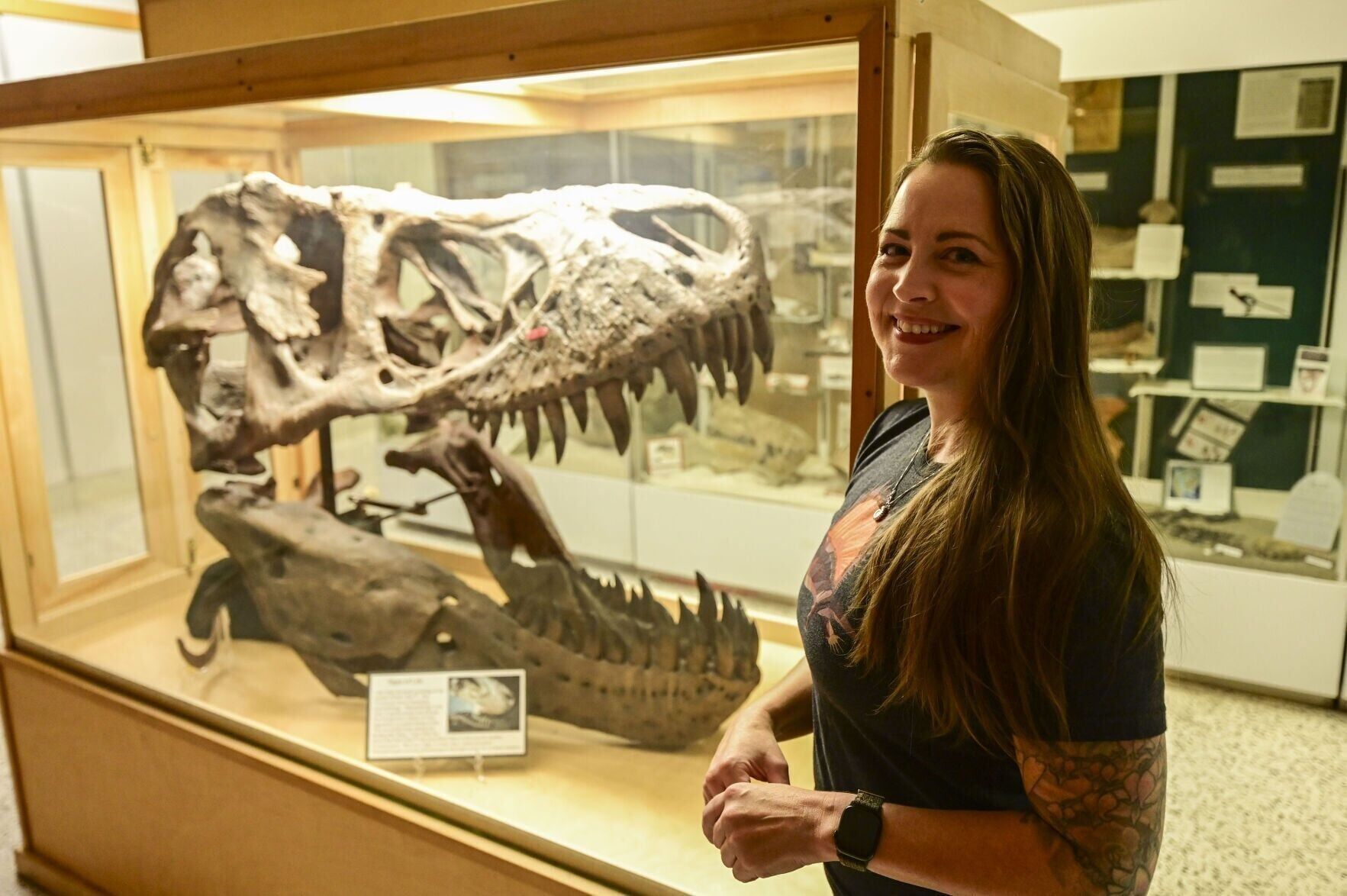
Paleontologist Kallie Moore, pictured in front of a T. rex skull at the University of Montana on Wednesday, August. 5 in Missoula.
“I hope that more people get inspired to learn about our evolutionary history, not just the primate part of it but when we looked like a reptile, or even going back to when we looked like a fish,” Moore said. “Being able to draw these parallels that these aren’t static creatures in the past, they’re part of a never-ending story.”
The new season premiered on July 29 and has three of six 25-minute episodes out that can be found on the PBS website or on YouTube. The first episode focuses on the formation of Pangea, and how life began to adapt to drier climates, making way for the splitting of amniotes into the two lineages that would become reptiles and mammals.
This is the first season that has been broadcasted that gave them the opportunity to make longer, more in-depth episodes. Moore said they are working with Montana PBS to get episodes of the show aired in Missoula and Bozeman.
“If this is your first introduction to "Eons," oh my god, aren’t you lucky,” Moore said about the new season. “I want more eyes on the project because I think it’s really important to understand the history of life on Earth and the changes this planet has gone through.”
The second episode, titled "How Eating Plants Shaped Life on Land," is centered around the Dimetrodon, which was the first terrestrial apex predator. The UM collection has a few archived fossil pieces of Dimetrodons that were found in Seymour, Texas.
“Holding a piece of a Dimetrodon is like holding an ancestor that is 270 million years old,” Moore said. “That’s wild to be able to trace yourself back to that. Evolution doesn’t have an end goal, it’s going to keep going forever and ever.”
Moore started her position as UM’s fossil librarian in 2008 fresh out of undergrad school and has worked on campus ever since.
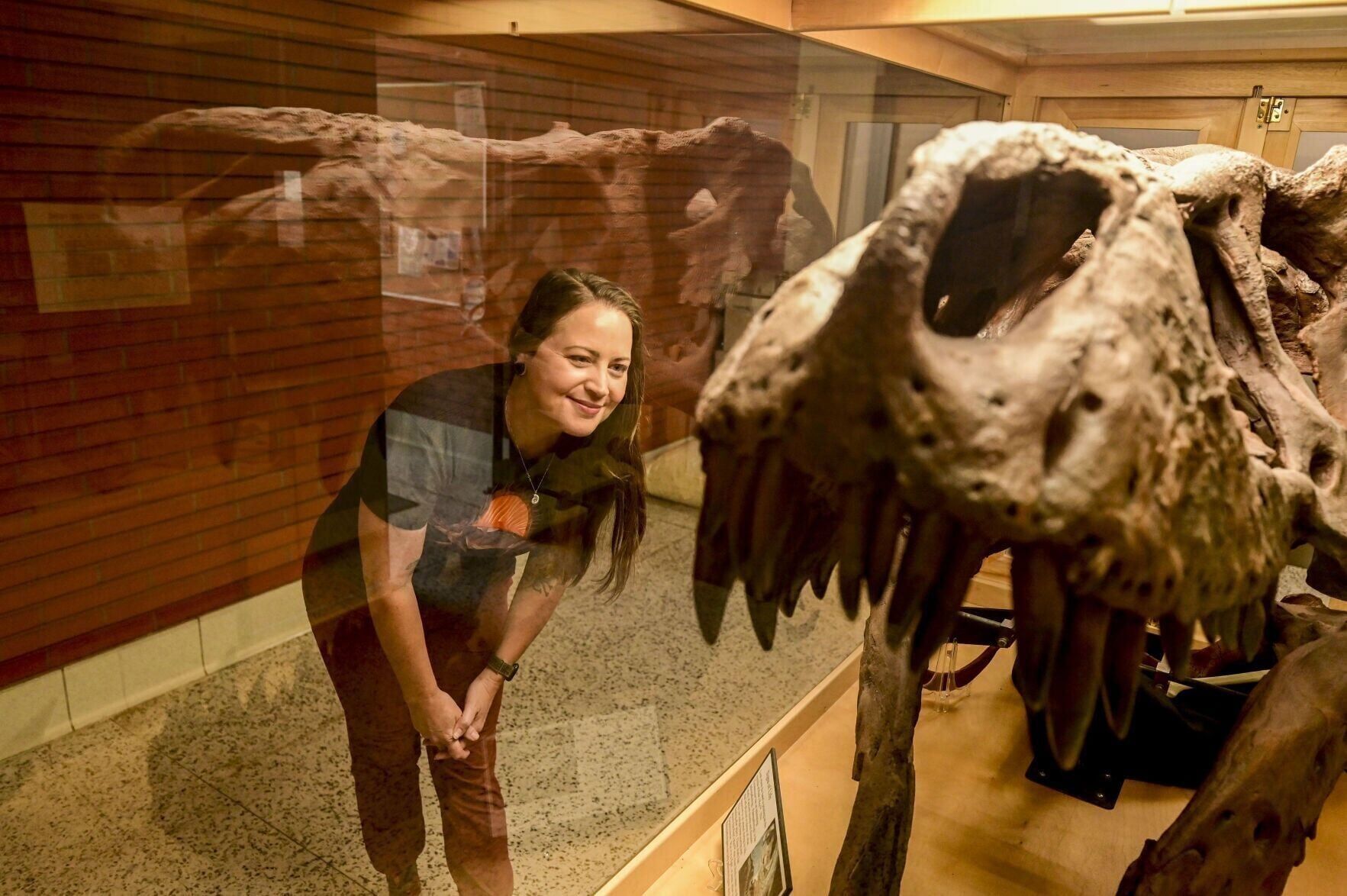
Paleontologist Kallie Moore, pictured in front of a T. rex skull at the University of Montana on Wednesday, August. 5 in Missoula.
In Moore’s time at the university, she moved the fossil collection once after the building where the current Davidson Honors College sits was demolished. The collection will be moved again when the Charles H. Clapp building gets demolished within the next few years.
Moore said that moving forward, she hopes that they will be able to find a good museum display area for the collection in a place that is more accessible to the public. Eventually she wants to get a natural history museum on campus, which could include exhibits from UM’s herbarium and the paleontology center.
While UM does not have a paleontology program, Moore hopes she and the fossil collection can become more involved with classes in the future.
“We don’t have a lot of paleo research going on campus, we don't have classes anymore, there’s no degrees,” Moore said. “This is their [volunteers] only way to get paleo experience and a lot of kids aren’t going to be paleontologists someday. They just have a natural curiosity for fossils or the history of life.”
She has between 10 to 15 volunteers every semester that help her with tasks. This year their work will include helping process around 600 Bear Gulch specimens that are brand new from the Carnegie Museum of Natural History or have been on loan for about 50 years to the University of Michigan.
The Bear Gulch fossils are from an around 325-million-year-old marine deposit in Montana that consisted of fish, crustaceans, sharks and arthropods that were found preserved in limestone, according to Moore. The Bear Gulch fossil collection was partially what drew Moore to come to UM, because the college where she did her undergrad had a similar but slightly younger collection.
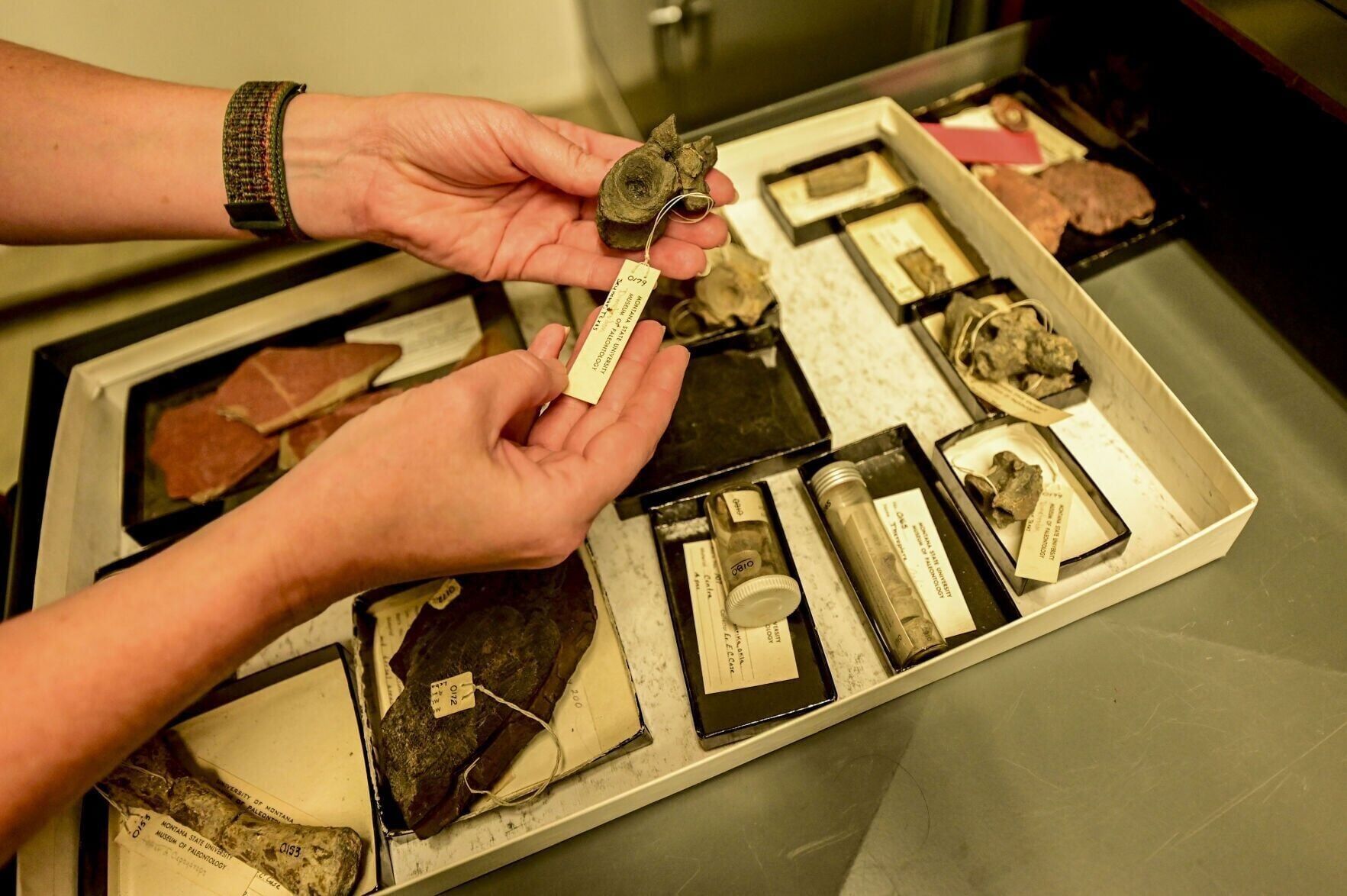
Paleontologist Kallie Moore looks at fossils featured in the PBS YouTube series "Eons" at the University of Montana fossil library on Wednesday, Aug. 5 in Missoula.
“Paleontology keeps me going, I love what I study, and I love what I do,” Moore said. “As long as I stay in the field of paleontology, the field of science communication, I’m going to be happy and motivated.”
Moore started hosting "Eons" after she was scouted by a Complexly executive producer while she was giving a presentation at the local children’s museum. She made an appearance on the educational YouTube show, "SciShow" with Hank Green in 2016 which she said was like her “audition for 'Eons.' ”
Complexly is a nonprofit that was started in 2012 by Hank and John Green, according to their website. Along with "SciShow," they have hosted other largely successful projects like "Crash Course" and PBS "Eons."
Outside of her work at UM and on the show, Moore hopes to eventually write another book. She released her children’s book, titled “Tales of the Prehistoric World” in 2022. The book takes the reader on a tour through eras of life including stories from the Mesozoic, age of the dinosaurs; the Paleozoic, age of the invertebrates; and the Cenozoic, age of the mammals.
“Each time I do something like this I hope I can spark some type of ‘Oh that’s neat’ or ‘Oh maybe I should care a little bit more,’ ” Moore said. “I’ve got hopefully another 40 plus years on the planet, I would rather see it be a more comfortable existence than burn down completely.”
The “Great Dying” during the Permian period, which the new season focuses on, was caused by a rapid change in the climate as a result of greenhouse gasses emitted from volcanic eruptions.
“We can look back at the past and tell you how quickly the climate changed, and we’re on a pace for a rate that has never been seen,” Moore said. “That’s a hurdle to get people over climate denialism. We know the outcomes of other rapid changes in climate, and it’s not good.”
According to the first episode of the new season, the Great Dying wiped out 70% of terrestrial species and 80% of marine species in the blink of an eye.
“The end of the line is the end of the line,” Moore said. “The T. rex is gone, the dodo is gone, the Steller sea cow is gone. If people understand extinction is forever, that might help.”
Moore said that they have already begun working on a new season of Eons but that she hopes they are able to get it renewed for a second broadcast appearance.
“Almost 4 billion years of evolution has led to us,” Moore said. “Knowing I’m just one piece of the thread, it’s incredible to think about all the weird structures and things that have existed before us. Each sliver of time is almost like an alien world.”