'Still here:' Thousands visit Little Bighorn to honor 150 years of history
In 1876, a solider wrote that Cheyenne, Sioux and Arapaho “proved then and there that they were the greatest cavalry on earth.” On Thursday, they proved it again.

A painted horse is pictured at the Little Bighorn Battlefield during the 150th anniversary celebration of the Battle of the Little Bighorn in Crow Agency on Thursday.
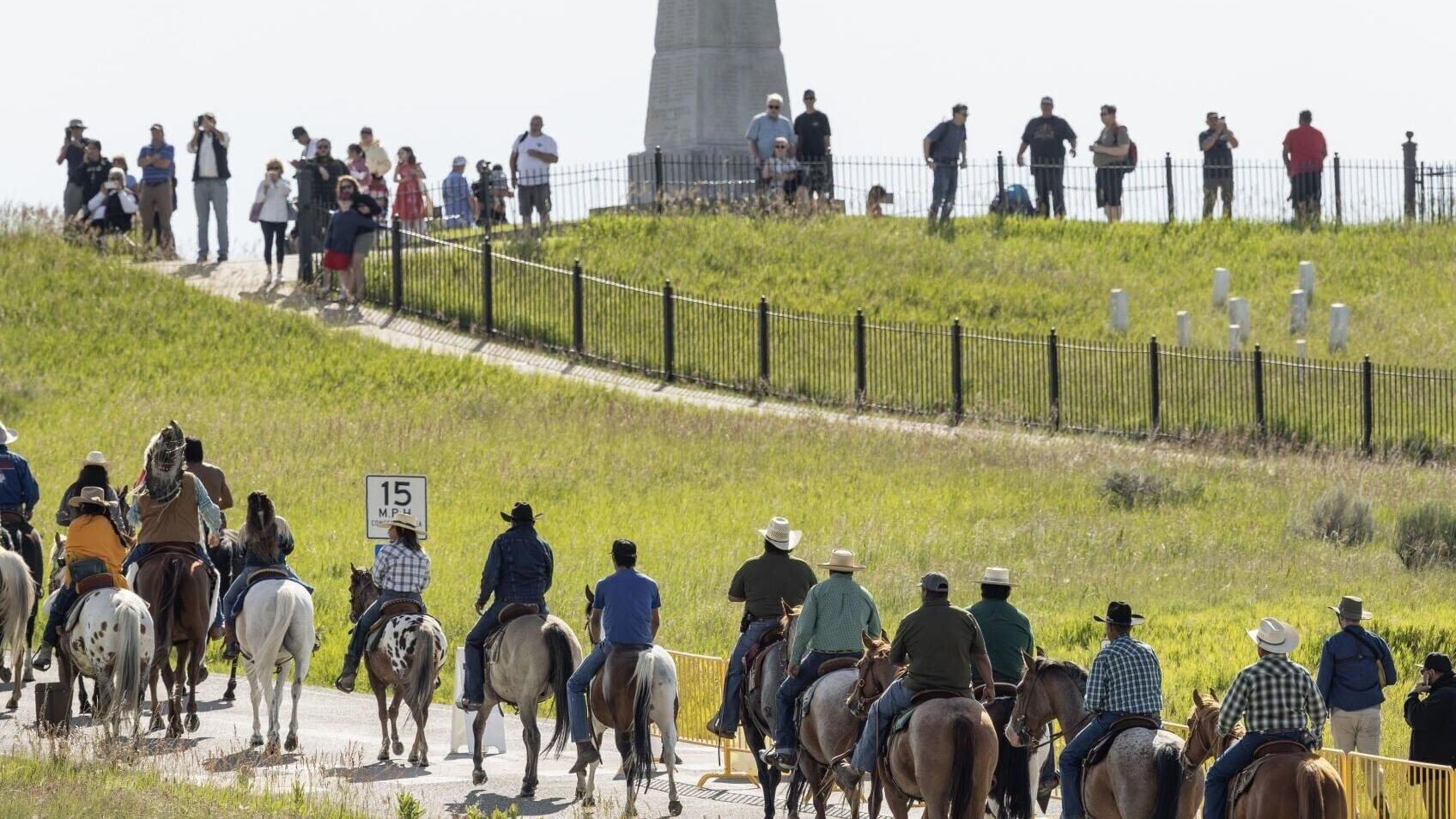
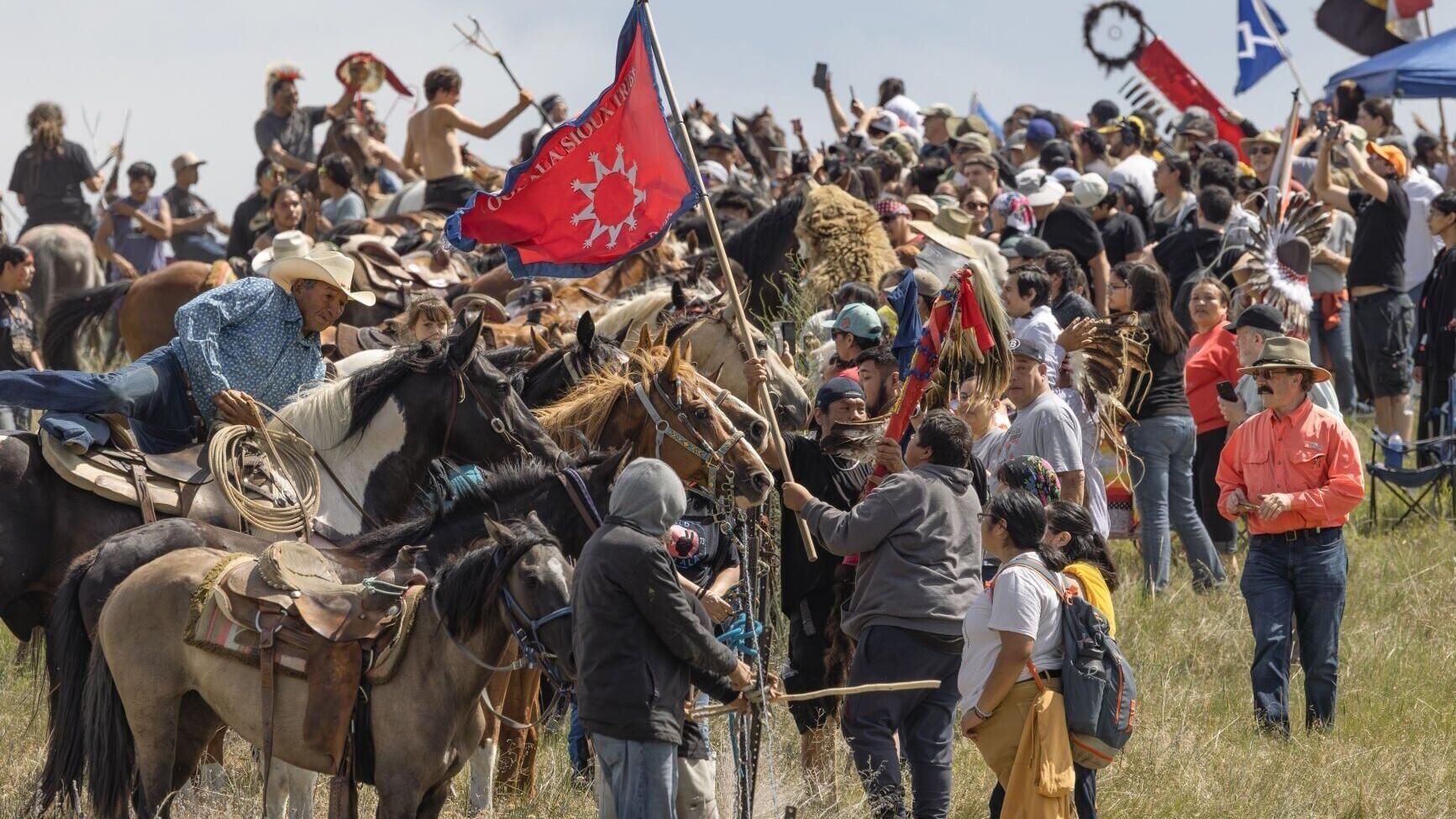
Riders make their way up the hill at the Little Bighorn Battlefield during the 150th anniversary celebration of the Battle of the Little Bighorn in Crow Agency on Thursday, June 25. Nineteen tribes participated in the commemorative horse ride and battlefield charge. The Battlefield will hold a series of historical and educational events through Saturday evening.
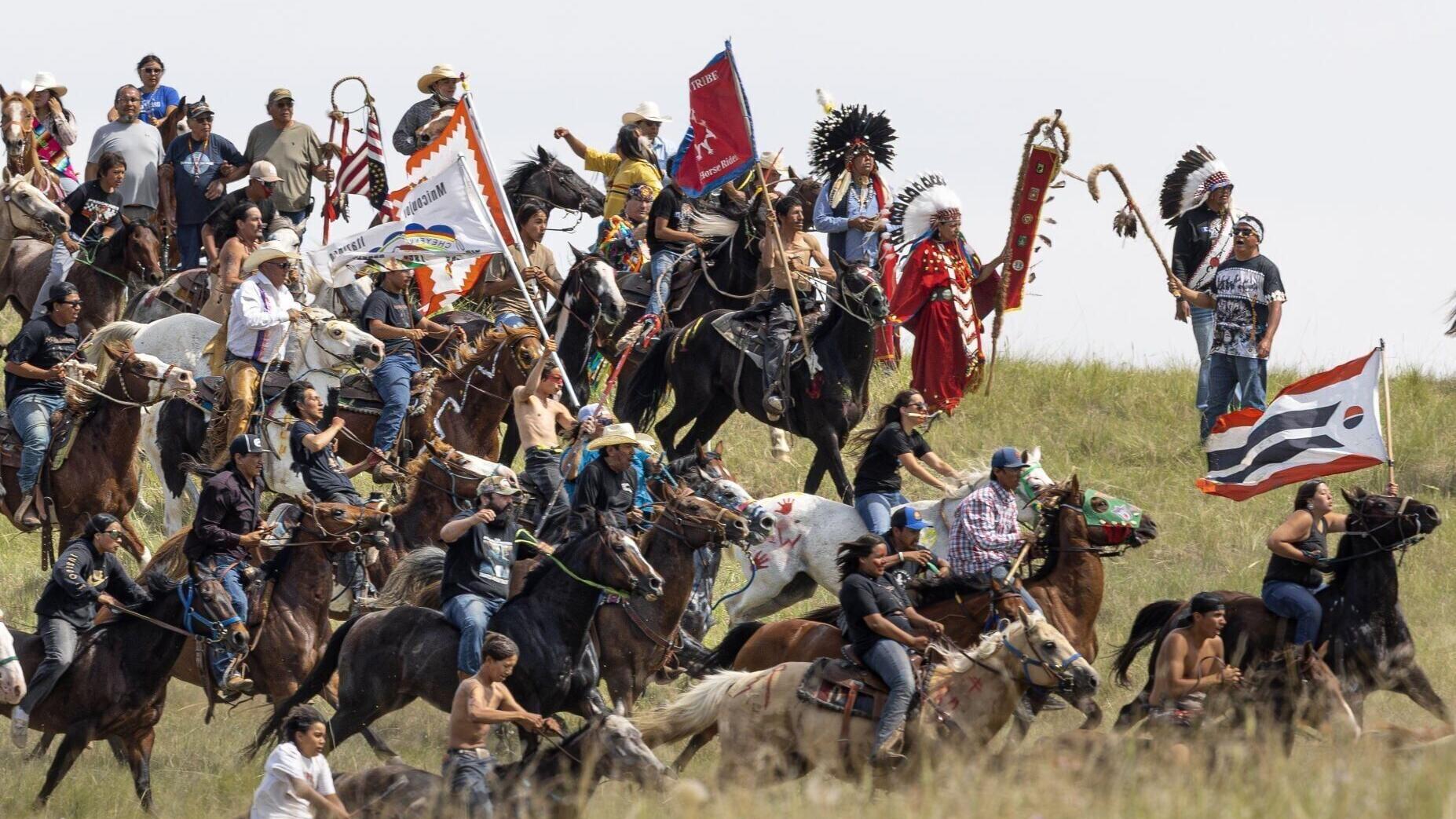
Riders charge the Little Bighorn Battlefield during the 150th anniversary celebration of the Battle of the Little Bighorn.

Attendees view the inside of a teepee at the Little Bighorn Battlefield during the 150th anniversary celebration of the Battle of the Little Bighorn in Crow Agency on Thursday.

Tribal members play at the Little Bighorn Battlefield during the 150th anniversary celebration of the Battle of the Little Bighorn in Crow Agency on Thursday.

The American flag is presented at the Little Bighorn Battlefield during the 150th anniversary celebration of the Battle of the Little Bighorn in Crow Agency on Thursday.
The sunshine broke through the clouds and a commotion of shouts and hoofs beating the earth rose from a hillside to the west.
Just a little over 150 years ago, an officer in the U.S. Army marveled at the skill of those he fought. On the anniversary of one of the most storied events in U.S. and Native American history, a coalition of Sioux, Arapaho and Cheyenne riders stormed the grassy hills outside of what is now Crow Agency on horseback.

In 1876, a captain in the U.S. Cavalry wrote that the people he fought “proved then and there that they were the greatest cavalry on earth.”
On Thursday, they proved it again.

Dozens of riders hit the area known as Greasy Grass to Indigenous tribes but recognized by most visiting tourists as the Little Bighorn Battlefield, cheered on by hundreds more strung along a yellow line of fencing. The mass of riders churned, turning into a spiral of horses, dust and flags.
The spiral surged, heading east toward the monument to the Native American tribes who steamrolled the 7th Calvary in 1876. Just a quick walk from that monument, dug into the hillside, is the spire of stone marking the place where the last of the calvary died, their commander among them.

A staggering effort on the part of the part of nearly 20 tribes, staff with the National Parks Service, educators and historians lined up several days’ worth of sights like Thursday’s reenactment for thousands of visitors journeying to Little Bighorn to mark 150 years since the largest battle of the American Indian Wars.
Several hours into Thursday’s festivities, the energy was kinetic. Lines of people snaked their way around the battlefield’s grounds, at any moment hearing from Indigenous leaders and educators who took the stage to share their thoughts on the battle’s legacy, listening to songs and drums played at the Native American and Custer memorials or watching the riders storming the hillside and parading past the park’s entrance.
'Four hands past noon'
George Armstrong Custer commanded a force that marched into the Montana territory as part of a larger effort to beat back those tribes that refused to be relegated to reservations. Custer, known for his peacocking and reportedly harboring ambitions to run in the 1876 presidential election, brushed off warnings from his scouts, several of whom were with the Crow Tribe, and decided to attack what he assumed was a small camp. That camp turned out to be what some have argued was the largest Native American camp ever assembled.

Though the battle was a decisive victory for the tribes rallying against the U.S. Government’s policies of assimilation and extermination for continent’s first people, there is a wealth of knowledge about its combatants only known through oral histories. On Thursday, a Ute man walked onto a stage assembled on the battlefield to share what he knew of the life of Yellow Nose, a fellow Ute man taken in by the Cheyenne when he was just a boy and who fought as an adult at Greasy Grass. Christopher Tabbee, of the Ute Indian Tribe, spoke on invitation from the Northern Cheyenne and shared his account of Yellow Nose’s experience, an account compiled from conversations with Northern Cheyenne and Ute elders and historians.
“Four hands past noon. Yellow Nose hears shouts. Screaming. And gunshots coming from Sitting Bull’s camp, situated on the east side of the Little Bighorn valley,” Tabbee said, reading from his notes and sharing the story of Yellow Nose at the battle, the way it was told to him.

“Instantly, the horse rider boys on south bench line become aware that the blue coats are attacking the encampments across the river. Yellow Nose’s weary horse finds its way to him. In the midst of all the confusion, Yellow Nose mounts and sees Lame White Man signaling to cross the river at Medicine Tail Coulee. The two and their group of mounted, elite warriors convene and cross the river in the direction of the fleeing blue coats.”
As Tabbee talked, a drum echoed from the hill behind him, where the monolith to the 7th Calvary stood.
“Holy men spoke of this battle days earlier,” Tabbee said. “L Company formed a skirmish line near the top of the hill. Yellow Nose and his elite warriors penetrated every gap unattended in the line, thus annihilating every soldier in Calhoun’s L Company. An army blue coat flagbearer then attacks Yellow Nose head-on on the east side of the battle ridge. Both Yellow Nose and the officer fall off their horses and commence in hand-to-hand combat.
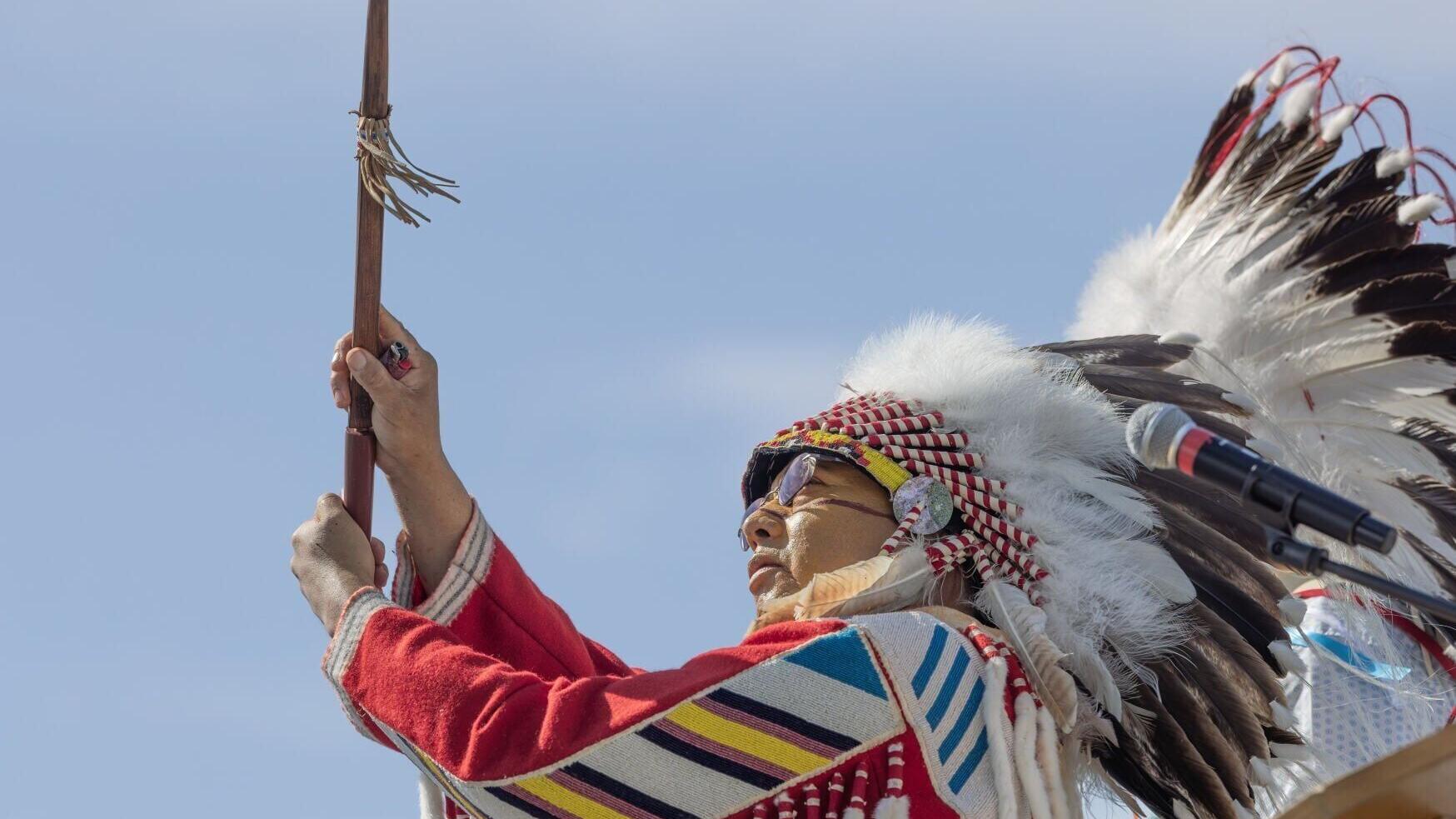
“In the end, Yellow Nose captures the company’s scissor-tailed flag and waves it in victory. The Army is shamed.”
A whoop came from the crowd gathered near the stage.
“While he is fighting the battle to the ridge, a blue coat officer has gotten on his feet and manages to shoot Yellow Nose right in the right side of his face,” Tabbee said. “The pistol discharges and burns and speckles Yellow Nose’s flesh near the right temple of his eye. With a blood-shot eye and blood streaming down his face, the incident adds fury to the rage within him. And mounting his war pony, he makes a short run and turns around with a saber in his hand and runs down the soldier, swiping the back of the man’s skull, rubbing him out.
“Yellow Nose begins to see clear of the smoke and dust at the west edge of the battle. It was here that he began looking for Yellow Hair. Custer. It was here that time seemed to stop, enabling him to reach slowly to his mountain lion quiver case, feeling the notches, the feathers, fetching a strong arrow.

Tabbee took a breath and continued.
“At last, drawing his choice of arrow, pulling it out, placing it carefully, loading the arrow, resting it on his fist as if he were lost in time,” Tabbee said. “One more look at the figure with blonde hair, he draws the bowstring and instantly lets go of the arrow.
“The arrow whistles, twists and turns with a flashing of lightning. The arrow hits its mark in Custer’s throat. The blue coat chief falls to his knees in disbelief. He then falls to his face in the dirt. Yellow Nose knows the battle is over.”
The drums rested, and Tabbee thanked the Northern Cheyenne for the invitation to talk.
Visitors came to the battlefield by the busload, ferried from a parking lot sectioned off by Interstate 90 or from campsites throughout the area, where the visiting tribes had erected tipis for the members to stay in throughout the week. Members of the Crow Tribe offered much of the land where those tribal members were staying.
A part of history
On Thursday morning, Brenda Mitten from the Six Nations of the Iroquois Confederacy in Manitoba woke up in her tipi to the sound of shouting and war whooping. The 73-year-old great-grandmother made the three-day trip from her home in Canada after a dream.

“I do a lot of dreaming,” said Mitten, a Seneca woman and part of the Bear Clan, who was preparing her camera to take photos of the riders.
“I had a dream about Sitting Bull and Geronimo. They were in a little hut that had a wishing well in it. They were on a little hill like this,” she said, pointing toward the hill where the Custer monument stood, “and I walked up there.”
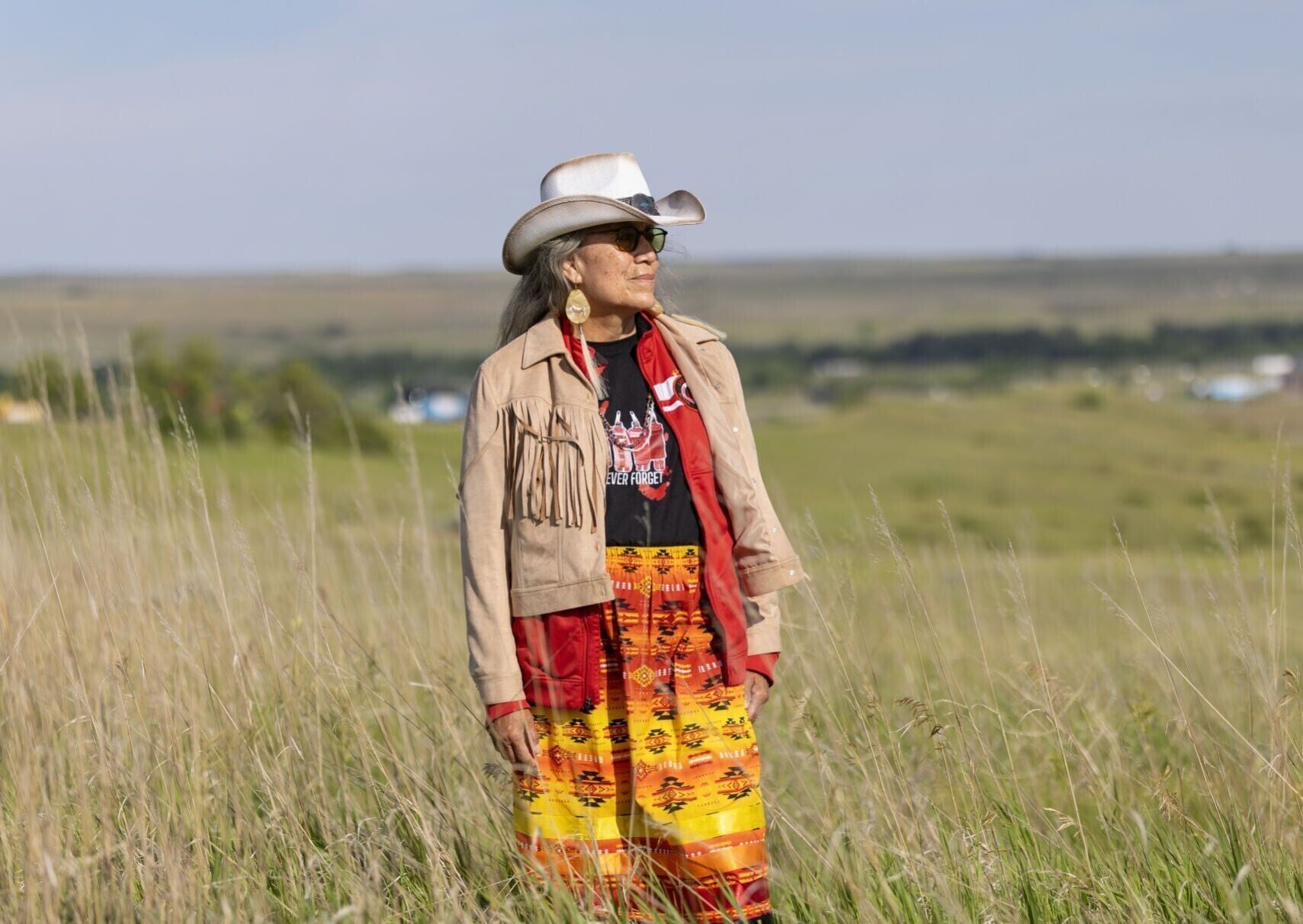
Brenda Mitten from the Six Nations of the Iroquois Confederacy in Manitoba is pictured during the 150th anniversary celebration of the Battle of the Little Bighorn in Crow Agency on Thursday.
Mitten said she casually spoke with Sitting Bull and Geronimo in her dream, as though they were all familiar with one another.
“And I said, ‘What are you doing here?’” Mitten recalled. “And they said, ‘We came because you listen.’”
Mitten relayed her dream to the Lakota Chief Arvol Looking Horse, who told her it was a sign that she had to be at the anniversary. Before Thursday, she hadn’t been to the region in nearly 50 years.
“Besides,” Mitten said, “wherever there’s a crowd like this, I want to be there. And I know it’s going be a part of history.”
Ahead of the opening comments, prayers and the National Anthem, a group of about a dozen people made their way down from Custer’s memorial. One man sang and beat a drum, while another held the white, yellow, black and red flag of the American Indian Movement. Jonathan Old Horse, an Oglala Lakota man and member of the Rapid City chapter of the American Indian Movement, traveled to the battlefield with his son and marched with him down the hill.
Like Mitten, Old Horse said he wanted his son and the younger people with him to be a part of history.
“And for me, as an old guy pushing 60, I wanted to celebrate 150 years of resiliency and victory,” he said.
“Today I feel very proud and humble to be in the place where my ancestors walked and did an amazing thing. And I always want to be thankful for them and what they did. They had the biggest victory, but it came with a price. They were some of the few people who stood up and lived to tell the tale of bloodying the American government’s nose.”

Old Horse has been a part of AIM for the past 16 years. Joining the movement, he said, helped him with the trauma of growing up in a time when the federal government sanctioned removing Native American children from their homes.
“I was taken away as a young boy,” Old Horse said, “I was 25 when I came back. But (joining AIM) was a way to live kind of in that Indian spirit and when I became a leader and all that, it was to give things back to these young ones. To teach that they don’t have to live in that shame and those boarding school type mentalities.”
“I want my son to be proud of who he is. I want him to understand that there’s reasons to be angry but force that anger in a good way and don’t be crazy about it. And remember what our ancestors did on this day,” he said.
AIM rose to prevalence during the 1970s, spreading from Minneapolis. Drawing from the lessons of the Civil Rights Movement, members of AIM engaged in sometimes deadly standoffs with local and federal police in an effort to combat generational oppression.
While the group walking with Old Horse rested at the bottom of the hill, an older man dressed in the blue coat and hat reminiscent of a U.S. Cavalry officer of the late 1800s walked past.
“Hey, is that Col. Custer?” asked a man with Old Horse’s crowd.
The wannabe cavalry officer smiled and shook his head.
“Must be Col. Mustard.”
Still Cheyenne
Thomas Rockroads, a Northern Cheyenne Sundancer, singer and recipient of the Bronze Star for his service in the Vietnam War, was not cavalry. He was airborne. He spent a year in Delta Company with the 173rd Airborne Brigade, starting in October 1969. Dressed in army greens, his black jump boots polished and shining, he carried the flag of the 82nd Airborne Division, the doubles As of the division’s insignia standing for “All American.”

There’s no official record of how many Northern Cheyenne men and women served in Vietnam. Incoming paperwork for the U.S. military labeled almost every enlisted Indigenous person who didn’t say otherwise as “Hispanic,” “Mongolian” or simply “Other,” according to one study of the men who served in the war.
Rockroads, who later spoke on stage of his fighting in Vietnam, was a part of the color guard that marched toward the stage at the start of Thursday’s ceremonies. Behind him marched Army veterans from the Cheyenne River Sioux Tribe, firing off rifle rounds and kicking the blank rounds free with their feet in between dancing to the beat of drums.
With the Northern Cheyenne Tribe’s Vice President Ernest Littlemouth riding on horseback across the battlefield, tribal member Eugene Little Coyote spoke Thursday on his behalf. In his statement to the crowd, Little Coyote quoted the historian George Bird Grinnell.
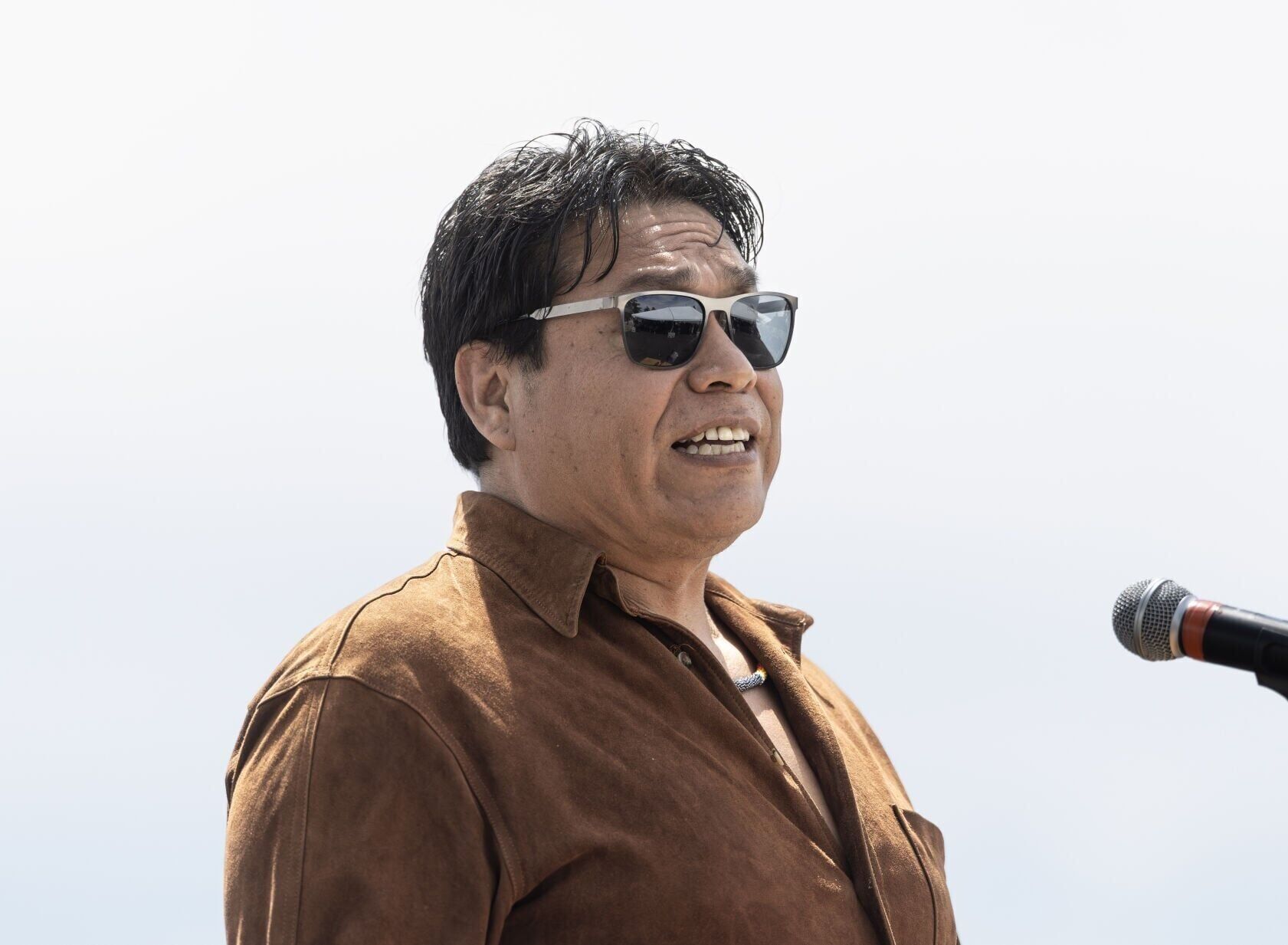
Eugene Little Coyote speaks during the 150th anniversary celebration of the Battle of the Little Bighorn in Crow Agency on Thursday, June 25. Nineteen tribes participated in the commemorative horse ride and battlefield charge. The Battlefield will hold a series of historical and educational events through Saturday evening.
“It was his wish that the Cheyenne would get to tell their own story,” Little Coyote said. “We’re not quite all the way there yet, but we’re sure making progress.”
Little Coyote also emphasized a Cheyenne phrase, Naa Tse-tses-tas, meaning “I’m still Cheyenne.”
“What that speaks to is resiliency,” he said. “Resiliency of our spirit, our existence, in the face of yesteryear’s genocide and ethnic cleansing. But today we’re still fighting against some things. The loss of our culture, our language, our ceremonies. So for my fellow Cheyenne here, Naa Tse-tses-tas. We’re still Cheyenne. We’re still here. We’re still resilient.”