Recent heat wave led to spike in hospitalizations in Billings
The heat wave earlier this month coincided with RiverStone Health recording an exceptional number of people who went to emergency departments in Billings with heat-related illnesses.
The tail end of July is typically the warmest time of the year for Billings, but earlier this month the city's residents experienced the city’s hottest high ever recorded.
Billings joined dozens of other cities this summer in breaking all-time heat records this summer, with temperatures surging to 111 degrees July 12. After 10 days of relatively normal temperatures, Billings is again expected to see highs in the triple digits over the weekend, with the current forecast from the National Weather Service’s site in Billings showing highs staying in the mid-to-upper 90s.
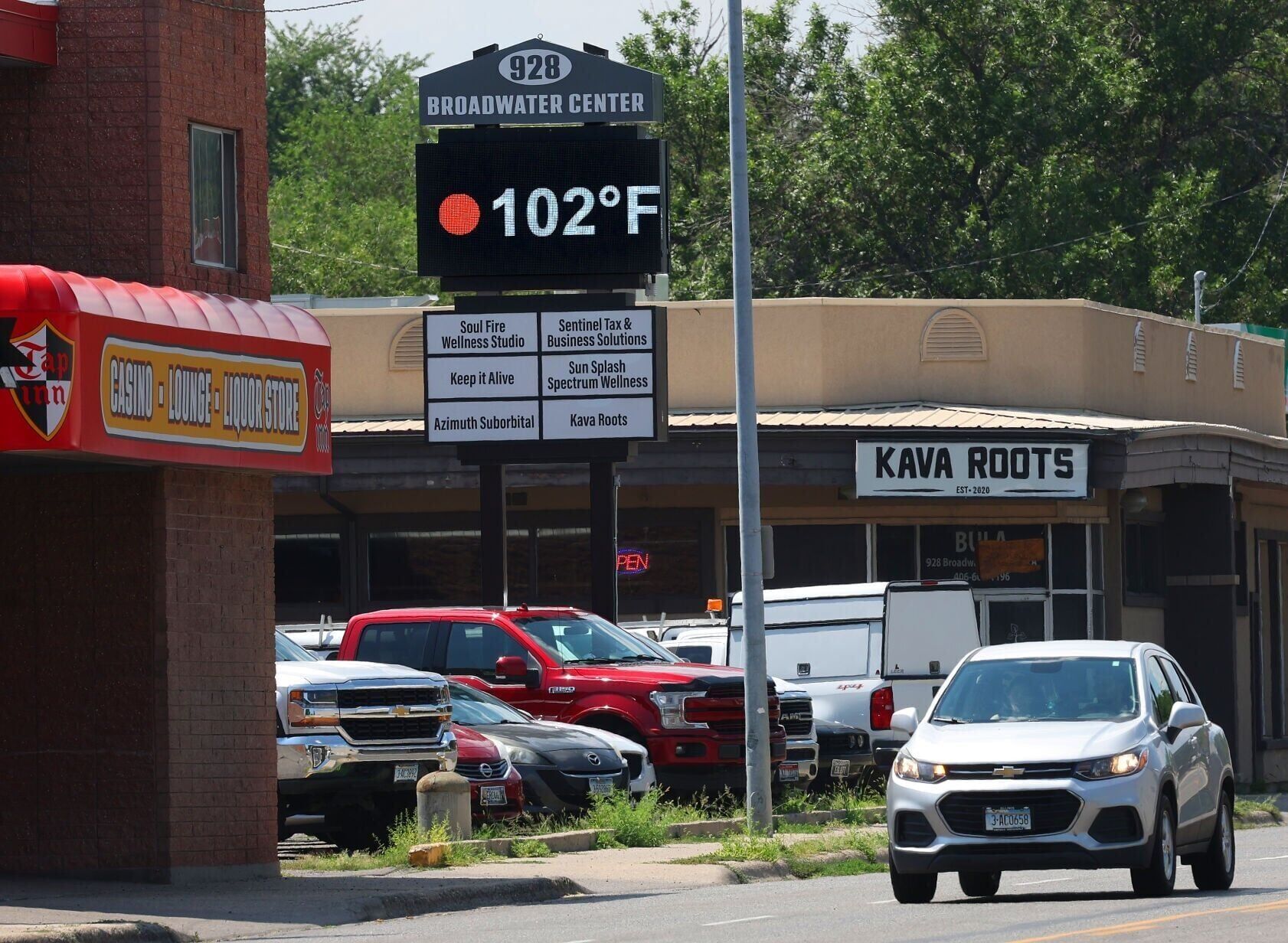
The reader board sign at Broadwater Center shows 102 degrees at 2 p.m. Friday.
Extreme heat is the nation’s deadliest weather hazard, and July's heat wave has so far resulted in Yellowstone County’s public health agency recording an exceptional number of people who went to the emergency departments at Billings Clinic and Intermountain Health St. Vincent Regional Hospital with heat-related illnesses.
“From July 10 through 13, there were 17 (emergency department) visits that were related to heat illnesses,” said RiverStone Health Epidemiologist Taylor Cook.

Billings hit an all-time high temperature of 111 degrees on Sunday, July 12. Boaters and floaters gathered on the Yellowstone River to have some fun while they tried to cool off.
On the weekend of July 12, Billings and the surrounding region fell under what’s known as a heat dome, a mass of high pressure that settles over an area and doesn’t budge. That pressure blots out the potential for precipitation, and the ground beneath it cooks under a cloudless sky. By the end of the weekend, On Sunday, four of five climate sites monitored by NWS Billings saw all-time highs. Billings hit 111 degrees, up by three degrees from the all-time record set 2002. One of the hottest spots in the state was Miles City at a high of 115 degrees, breaking its earlier record-high set in 2012 by four degrees.
The National Oceanic and Atmospheric Administration, of which the NWS is a part, reported that March 2026 was the warmest on record for the contiguous United States. April of 2025 through March of this year now stands as the warmest 12-month span ever recorded for the lower 48 states since 1895, according to NOAA.
For a more global perspective, last year was one of the hottest on record, according to the United Nation’s World Meteorological Association. The WMA, which also monitors indicators of climate change, noted in January of this year that 2023 through 2025 were the hottest three years on record, with ocean temperatures increasing unabated over the past three decades.
On average, 60 people a year go to the hospital in Billings for emergency treatment for heat-related illnesses, Cook said. Those hospitalized over this month’s heat wave included children and those working outdoors.
Older adults are particularly vulnerable during heat waves. A sprawling study conducted by Harvard University’s School of Public Health found that, in the contiguous U.S. from 2000 to 2018, heat waves led to about nine extra deaths among older adults for every heat wave per every 10,000 people. Deaths related to heat took an especially heavy toll on people of color and low-income communities.
Multiple factors can lead to a heat-related illness, but they stem from the body’s cooling system crumbling. When a person’s core temperature exceeds 104 degrees, be it from exposure to high temperatures or exertion in high temperatures for too long, the heat starts degrading internal organs. The onset of hyperthermia, heat stroke, can be fatal if not severely damaging. Extreme heat can exacerbate chronic conditions like long-term cardiovascular diseases or asthma.
“With heat stroke, and I think anything that falls under heat-related illnesses, you’re going to be seeing symptoms like sweating, dizziness, you can became nauseous, or your vision can become blurry” Cook said. “And often what you see is people who go to the emergency department, it might be the primary cause, or it can be a symptom of a larger event like an overdose.”
In 2025, researchers at the Yale School of Public Health likewise conducted a survey of mortality in the United States influenced by the heat, finding that deaths linked to heat exposure increased more than 50% from 2000 through 2020. From 1998 through 2022, 168,530 adults were admitted to hospitals in the U.S. for heat-related illnesses, according to patient intake sample data. A 2021 study published by the peer-reviewed journal BMJ tracked an overall rise in the risk of emergency department visits for younger and older adults amid extreme heat.
Eastern Montana tends to be hotter and drier than the region west of the Rockies, due to its lower elevation and because much of it sits in the rain shadow of the mountains. Missoula’s average high for the month has been 88 degrees, NWS Meteorologist Logan Torgerson said in an interview Thursday, while Billings’ has been 92 degrees. Through the weekend, NWS has placed nearly all of Montana east of the Rockies under weather advisories including red flag warnings, heat advisories and extreme heat watches.
As highs have the potential to eclipse 100 degrees, Torgerson said the humidity is expected to drop. With that dip in moisture will come an increase in fire hazards. On July 22, a grass fire burned up roughly 40 acres near the Four Dances Recreation Area.
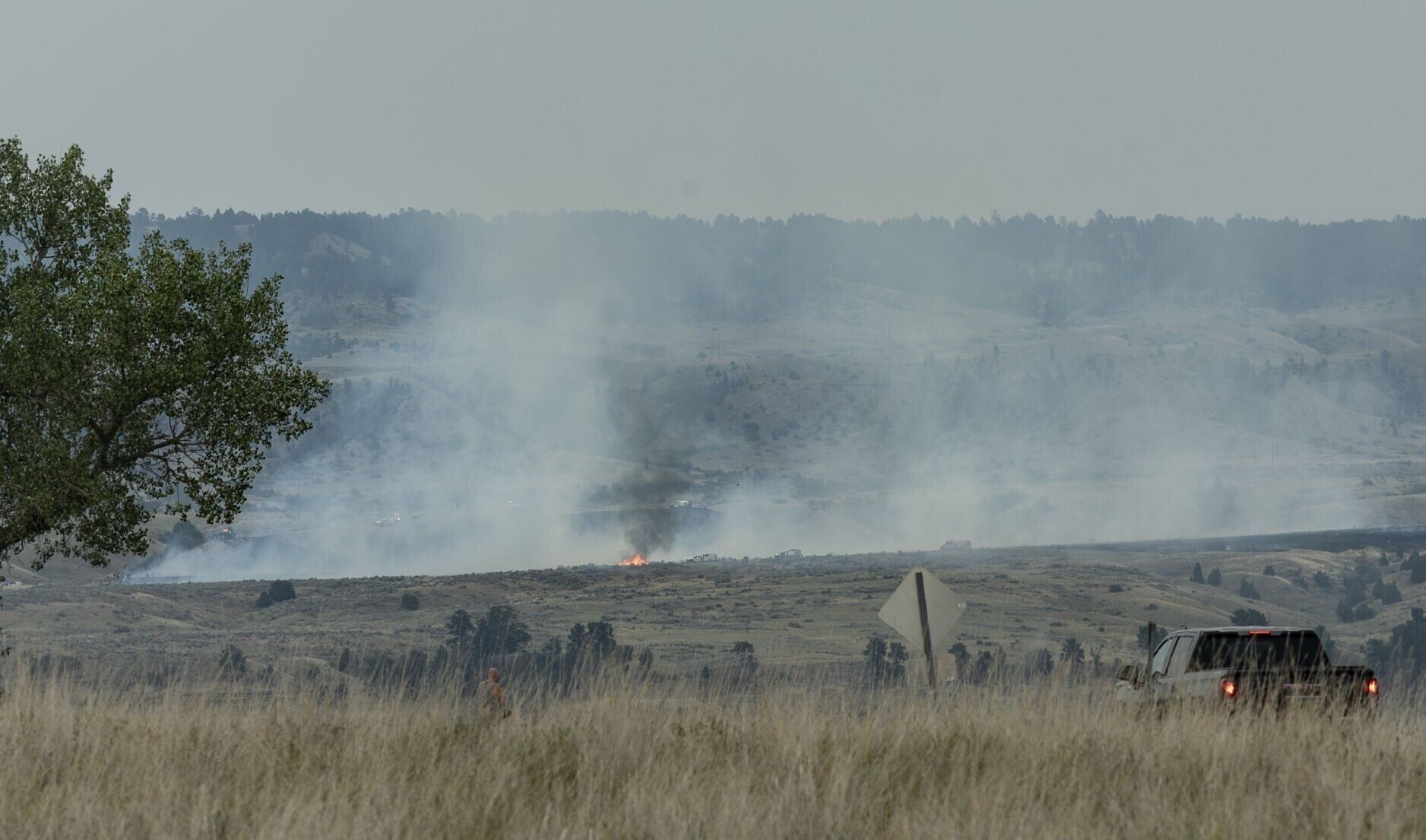
Flames crest the hills in the Four Dances Recreation Area near Lockwood as a wildfire burned on Wednesday evening. The blaze was knocked down later that night.
“After Sunday, it looks like we’re settling into a pattern with temps probably in the mid-to-high 90s,” Torgerson said. “Right now, for Monday through Thursday, we’re forecasting 98 to 96 degrees.”
The NWS site at Billings Logan International Airport has measured 6.76 inches of precipitation for 2026, about 2.5 inches less than what the city normally receives by this time of the year. As of Thursday, Billings and the surrounding region was experiencing moderate to severe drought, according to the U.S. Drought Monitor.
RiverStone Health is currently piecing together a response plan specifically to address extreme heat. Going back to the heat wave earlier this month, once the county’s public health agency was aware of potentially record-setting highs, it reached out to social services and organizations like the Downtown Billings organization to ensure they too were prepared.
“I think we’re always learning lessons because any disease, the way it transmits, whether it’s an infectious disease or a heat-related illness, changes based on the environment,” Cook said. “And as we’re seeing with climate change, every other weekend something new is influencing how someone is effected, be it a bad or good health outcome.”
Homeless outreach services like the Montana Rescue Mission and St. Vincent de Paul opened more space for those looking to get out of the heat, while some businesses downtown had buckets of bottled water on ice. MarCee Neary, program director for the Community Crisis Center on North 30th Street, said the 18-bed facility operated as normal through the heat wave.
“We don’t want anybody dying on the streets, so even though we don’t do any sheltering, we’re always going to do what we can as long as they follow the rules,” Neary said.
She attributed the relative calm in the light of the record heat to the number of services that were available, including the MRM, St. Vincent de Paul, Billings Family Services and the CCC.
“Everyone who came in, we engaged with them,” she said. “Some were lined up with a counselor, and even the few who weren’t quite ready for that, they went to group… We have Alcoholics Anonymous here on Saturday mornings.”
Through the heat wave, Neary said she received texts from those curious about how to assist people in Billings either unhoused or otherwise exposed to the elements.
“Really, just a bottle of water and maybe a light snack just to give them some sustenance,” she said. “It can sometimes be hard to embrace more marginalized people, but life is hard. Sometimes there’s challenges. Sometimes it’s mental health. Sometimes it’s family breakups. We’re all in this together and a little bit of kindness goes a long way.”