Proponents behind Butte-Silver Bow data center initiative submit signatures
406 People First said had submitted enough signatures required for a proposed data center initiative to be placed on November’s ballot, but officials still need to validate the signatures.
Two groups behind a proposed ballot initiative that aims to require two-thirds of registered Butte-Silver Bow voters approve any new data center in the county say they have secured the signatures required, but officials remain concerned about the initiative and are still considering a legal challenge against it.
The group behind the proposal — which they hope will be on November’s ballot — is 406 People First, comprising members of the Butte Watchdogs and Cottonwood Environmental Law attorney John Meyer of Bozeman.
By Friday afternoon, according to 406 People First’s Denise Kelly, the group had collected the 3,652 signatures required for the initiative to be placed on November’s ballot. They were submitted for certification to the Clerk & Recorder’s Office on Monday; a clerk couldn’t confirm whether the validation process would be completed this week. The group needs those 3,652 valid signatures in order for the measure to make the ballot in November.
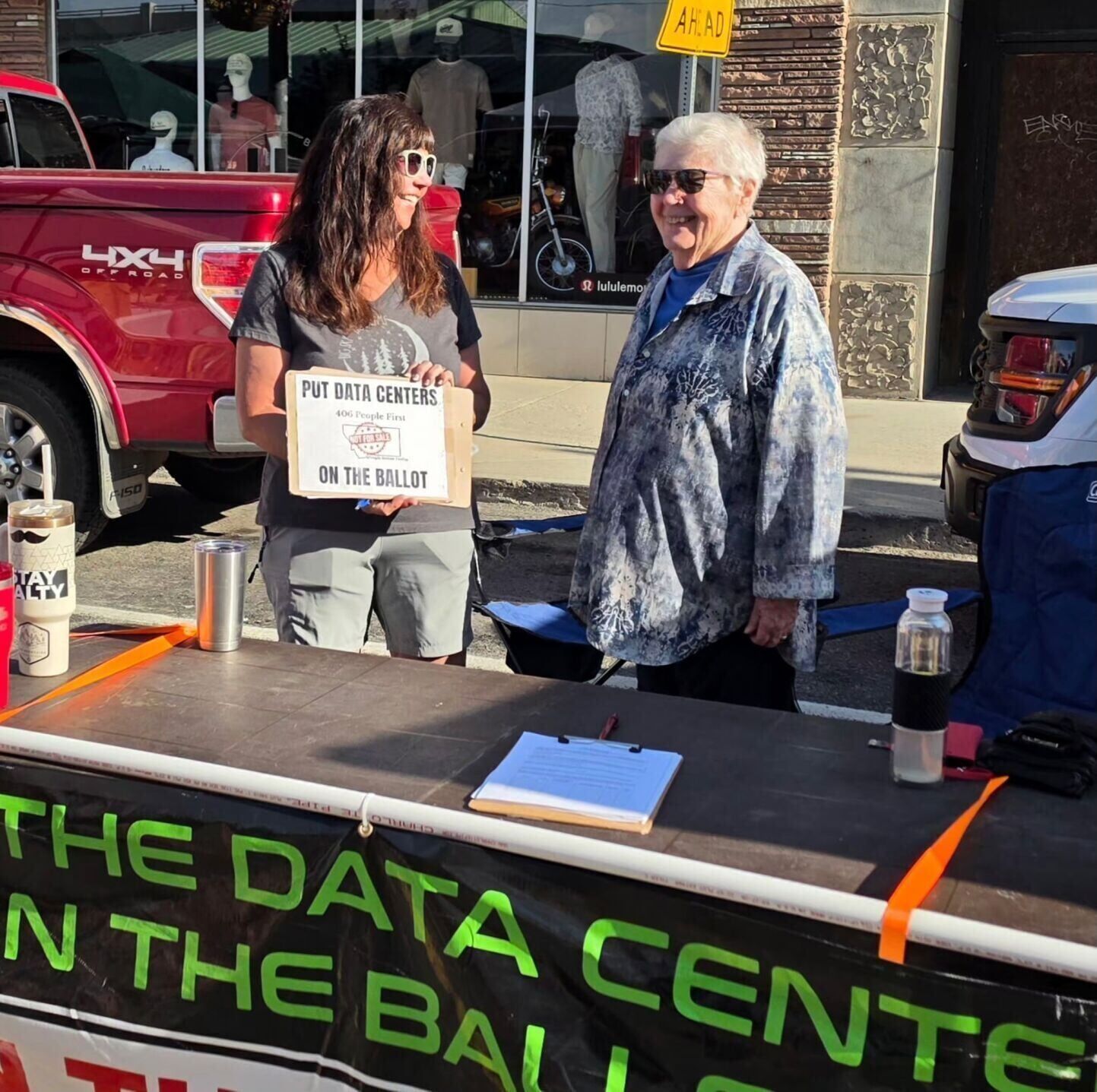
Denise Kelly, left, of 406 People First, speaks with Sister Mary Jo McDonald at the group's petition table for the data center initiative during the Butte Farmers Market on July 25.
While collecting signatures for the measure, Kelly said she found “near unanimous support” from county residents who want to be heard.
“Through that process, we’ve also heard an evolution from some elected officials who realize there are still more questions than answers on data centers,” she said.
The proposal, should it qualify for the ballot, would require a simple majority vote this November in order to pass. Data centers like the one Sabey had proposed have been the talk of Butte for more than a year.
If voters approve the measure as written, which would establish a new ordinance, the Butte-Silver Bow government would be prohibited from authorizing, licensing, permitting or approving any new construction for a new or expanding data center unless two-thirds of all the registered voters in the county approve such a move in a special election — a higher bar than most any other issue on which residents vote. There are currently 23,960 registered voters in the county, according to the secretary of state's office.
That high threshold, as well as legal questions about whether such an initiative is even legally sound — a recent case out of Treasure County found a citizen initiative could not regulate county land-use and zoning requirements established by the Legislature, a decision the Montana Supreme Court upheld — have Butte-Silver Bow officials and residents questioning whether the proposal would pass muster in court.
Butte Watchdog Sister Mary Jo McDonald, who described herself as a friend of 406 People First, was among the first to sign the petition and helped the group collect signatures July 25 at the Butte Farmers Market.
McDonald was adamant about the downside of data centers in the county.
“They would cause more pollution and hurt people nearby,” she said. “A data center wouldn’t be good for the environment.”
Sabey Data Centers recently nixed a buy-sell agreement with Butte-Silver Bow County in the wake of REC Silicon's decision to exercise right of first refusal for land in business park.
From his perspective, Meyer said that any legal challenge to Butte’s data center initiative “should be viewed as a desperate attempt to keep the people from voting.”
He said the county clerk and recorder certifies a local initiative once enough signatures have been collected.
“We are cautiously optimistic that will happen here,” Meyer added.
Butte-Silver Bow Chief Executive J.P. Gallagher, who put together an ad-hoc committee to research the costs, benefits and downsides of allowing a data center to be built in Butte, said there are concerns regarding the “legality and breadth” of the citizens’ ballot initiative. The committee consists of B-SB County residents chosen for their “departmental knowledge” of water, zoning, permitting, tax districts, economic development and record-keeping.

J. P. Gallagher, chief executive of Butte-Silver Bow County, speaks at an open house held by Gov. Greg Gianforte’s Energy Task Force at Montana Tech in Butte on Feb. 25.
“Our responsibility as a local government is to evaluate whether the proposed ballot initiative is legally permissible,” he said in an email Thursday.
On the heels of the Treasure County decision in June, officials have eyed a petition drive underway in Yellowstone County that is similar to Butte’s as grounds for a legal challenge. That petition would also require two-thirds of the county's registered voters to approve any data center. But the county commission there asked the county attorney to challenge the petition in court to find out whether it is legal. The hopeful data center developer in Yellowstone County has pointed to a law passed by the Legislature in 2025 that it says injects more doubt into the legality of such citizen initiatives on data centers.
Gallagher said he believes any ballot initiative and subsequent vote may have far-reaching implications beyond what he says the petition proponents claim.
“The language goes far beyond large data centers and could affect a wide range of businesses, infrastructure and future development,” Gallagher added. He said he also questions if the proposal “aligns with” the Right to Compute Act, the legislation signed into law in April 2025.
The law’s language includes the clause: “Government actions that restrict the ability to privately own or make use of computational resources for lawful purposes, which infringes on citizens' fundamental rights to property and free expression, must be limited to those demonstrably necessary and narrowly tailored to fulfill a compelling government interest."
“Based on the Treasure County Decision, a citizen initiative cannot directly change zoning in Butte‑Silver Bow. Any zoning amendment, map or ordinance, must go through the zoning board, public hearing process, and final adoption by the Council of Commissioners, as required by Montana Code Title 76,” Gallagher said.
He said he has been monitoring both the Treasure County case and the latest lawsuit in Yellowstone County.
Gallagher said regarding any potential legal action involving the petition in Butte: “We will determine our next steps.”
On Tuesday, Yellowstone County officials said they believed a new law, passed in 2025 but which was only discovered by the county last Thursday, which requires signatures for local ballot petitions to be submitted at least four weeks ahead of the certification deadline, meant the deadline for signatures to be submitted there had actually already passed, the Billings Gazette reported.
If that legal determination holds up — initiative proponents there plan to challenge it, the Gazette reported — it could affect whether the initiative in Butte can make November’s ballot in a similar fashion.
Todd Tregidga, associate business professor at Montana Tech, expressed confidence in the Council of Commissioners and opposes the initiative. He asserted it doesn’t belong on the ballot and said he doesn’t want to see voters green-lighting an ordinance change.
“Economic development decisions are very complicated and should not be decided upon using viral social media sound bites that may have absolutely no relevance to a specific project,” Tregidga said.

Dave Sabey, chairman and president of Sabey Data Centers, speaks during a roundtable with Secretary of the Interior Doug Burgum during a visit at Montana Tech in Butte on Feb. 27.
Every project requires significant research, he explained, which differs for each project and location.
“This is why we have elected and paid council members to gather all of the facts, do the heavy lifting, and make decisions that are in the best interest of the community as a whole, knowing full well that disappointment is inevitable for some groups of community members,” he said.
Moreover, Tregidga added, changing ordinances for one project sets a bad precedent: “When governance is a moving target, it adds risk to developing in that location, making it much less attractive.”
Despite concerns coming from the top of the Butte-Silver Bow government, 406 People First hasn’t wavered. Kelly asserted that Butte residents have demonstrated a considerable history of banding together for a common cause.
“We are doing it again and making sure any future data center development happens on our terms,” she said.
Editor's note: This story has been updated to include new information on local initiative law reported by the Billings Gazette on Tuesday.
Jim Luksic is the city editor of The Montana Standard.