American Prairie files lawsuit to halt Bureau of Land Management's bison grazing decision
Calling a Bureau of Land Management decision to bar American Prairie from grazing bison on federal lands "radically and irrationally" departing from precedent, the group filed suit in a Great Falls District Court on Tuesday.
The conservation group is seeking a temporary restraining order and preliminary injunction regarding the agency's May 8 decision that revoked six grazing permits in Phillips County.
Under the BLM's decision, the group has been ordered to remove more than 900 bison from the 63,500 federal acres by the end of September.
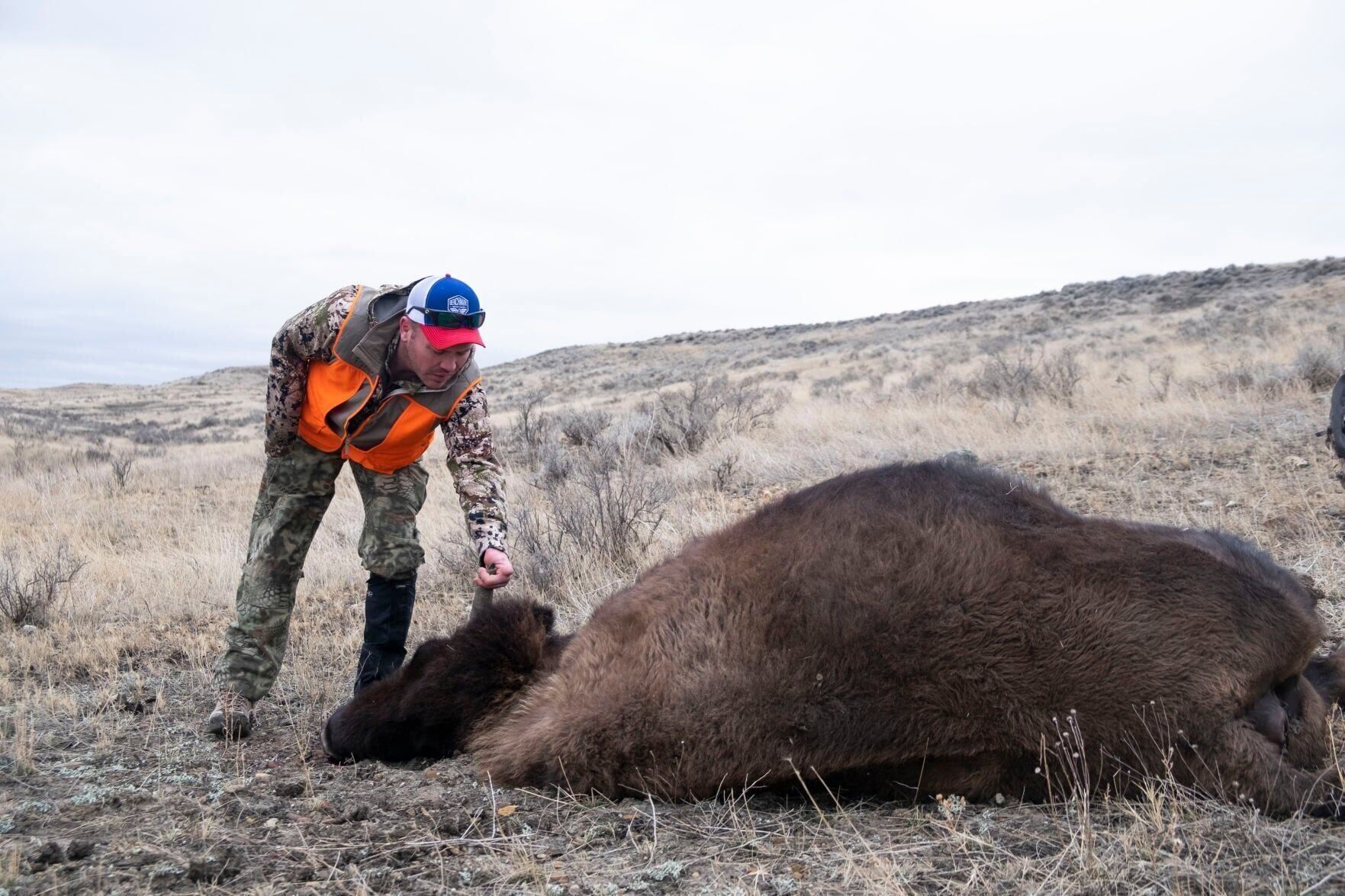
A hunter inspects the bison he shot on American Prairie in 2021.
In the court filing, American Prairie is asking the judge to "preserve the status quo" while considering the "legality of the agency's unprecedented decision, which reversed decades of settled federal practice recognizing bison as eligible livestock under federal grazing law," the group stated in a press release.
"This case is about far more than six grazing permits," Mary Cochenour, attorney for Helena-based Cochenour Law, which represents American Prairie, said in a statement. "The federal government changed its interpretation of well-settled law and effectively rewrote the rules to reach a predetermined result. That is not how the rule of law is supposed to work."
After Secretary of the Interior Doug Burgum intervened, the BLM reversed its own state officials' 2022 decision to allow bison grazing, saying the animals weren't production livestock. American Prairie has grazed bison on other federal allotments since 2005.
Pointing to the 1934 Taylor Grazing Act, a law created to protect federal lands from overgrazing by cattle and sheep, the BLM said American Prairie's herd is for conservation purposes.

Under the BLM's decision, the group has been ordered to remove more than 900 bison from the 63,500 federal acres by the end of September.
The decision was hailed by Gov. Greg Gianforte and his administration, which is moving to enact similar restrictions on state lands. The Montana Stockgrowers Association has also supported the federal about face.
“We continue to stand firm on the fact that bison do not meet the production-oriented livestock requirements established under the Taylor Grazing Act," Raylee Honeycutt, MSGA executive vice president, said in a recent statement.
Honeycutt went on to say the act's original intent was to support "working ranchers, rural communities, and agricultural production.”
This contention was challenged by James Huffman, professor and dean emeritus of Lewis & Clark Law School.
"To whatever extent Congress sought to support the livestock industry, it is clear that it was not the exclusive purpose of the law," he said.
"Both the Multiple Use Act of 1960 and the Federal Land Policy and Management Act of 1976 make clear that unless expressly provided for the public lands are not to be devoted to exclusive uses," Huffman added.
American Prairie unsuccessfully argued that because it sells bison, transfers live bison to tribes for food sovereignty and allows hunting of bison it meets BLM's definition of production livestock.
"For more than 20 years we've demonstrated that bison can be responsibly managed on public lands while improving the health of Montana's prairie,” said Alison Fox, CEO of American Prairie, in a statement. “Our record is clear. This case isn't about whether we've been good stewards — we have. It's about whether the federal government can abandon decades of settled law and change the rules to reach a different political outcome."
The Coalition of Large Tribes expressed its concern about the BLM's decision, joining American Prairie in protesting the ruling.
The group, which represents 50 tribes, said although Burgum attempted to reassure them that tribal bison would not be similarly targeted, the change leaves tribes open to discrimination.
"The final rule must not measure eligibility for federal grazing through a narrow commercial-production lens that fails to recognize how tribal nations live with and care for buffalo," the group said in a statement.
American Prairie called BLM's interpretation of the Taylor Grazing Act "erroneous." The interpretation echoes the comments of Wyoming attorney Karen Budd-Falen, who represented the Montana Stockgrowers when they challenged the BLM's original decision to allow American Prairie to graze bison.
Budd-Falen is now associate deputy secretary for the Department of Interior, which includes the BLM.
American Prairie filed the lawsuit after its appeal to the Office of Hearings and Appeals was denied, its last administrative option.
According to the lawsuit, Secretary Burgum intervened via Deputy Secretary Katherine McGregor to assume jurisdiction in the request for a stay before a judge could rule. The next day the judge dismissed the appeal.
Should American Prairie have to remove its bison from the federal lands, American Prairie said it would suffer "economic and organizational harm," including culling 300 bison from the herd.
Consequently, the legal action also seeks reparation for damages.