Roots Family Collaborative provides support for postpartum moms, families
Amid the Lindsay Clancy trial, the Massachusetts mother accused of killing her three children, the term “postpartum psychosis” has been in the news a lot recently.

The space where Roots Family Collaborative holds its peer support groups.
Amid the Lindsay Clancy trial, the Massachusetts mother accused of killing her three children, the term “postpartum psychosis” has been in the news a lot recently.
But Suzanne Bendick wants mothers and families to know that help is available.
Bendick is the co-founder of Roots Family Collaborative, a nonprofit organization that supports parents from preconception through early parenting.
“Every mother goes through what we call matrescence, which is similar to adolescence,” Bendick said.
Postpartum depression is common. Bendick said one in five mothers have reported experiencing a postpartum mood or anxiety disorder, which doesn’t even account for women that may not feel comfortable sharing about their postpartum struggles.
Women experience a hormonal “roller-coaster” when they get pregnant and have a baby, per Bendick. The drop in estrogen and progesterone that occurs in a women’s body can cause unhappiness in the postpartum period, often called “baby blues.” While this hormone drop happens to every postpartum mom, postpartum depression is a more serious occurrence that sees this sadness extend pass the first few weeks post-childbirth.
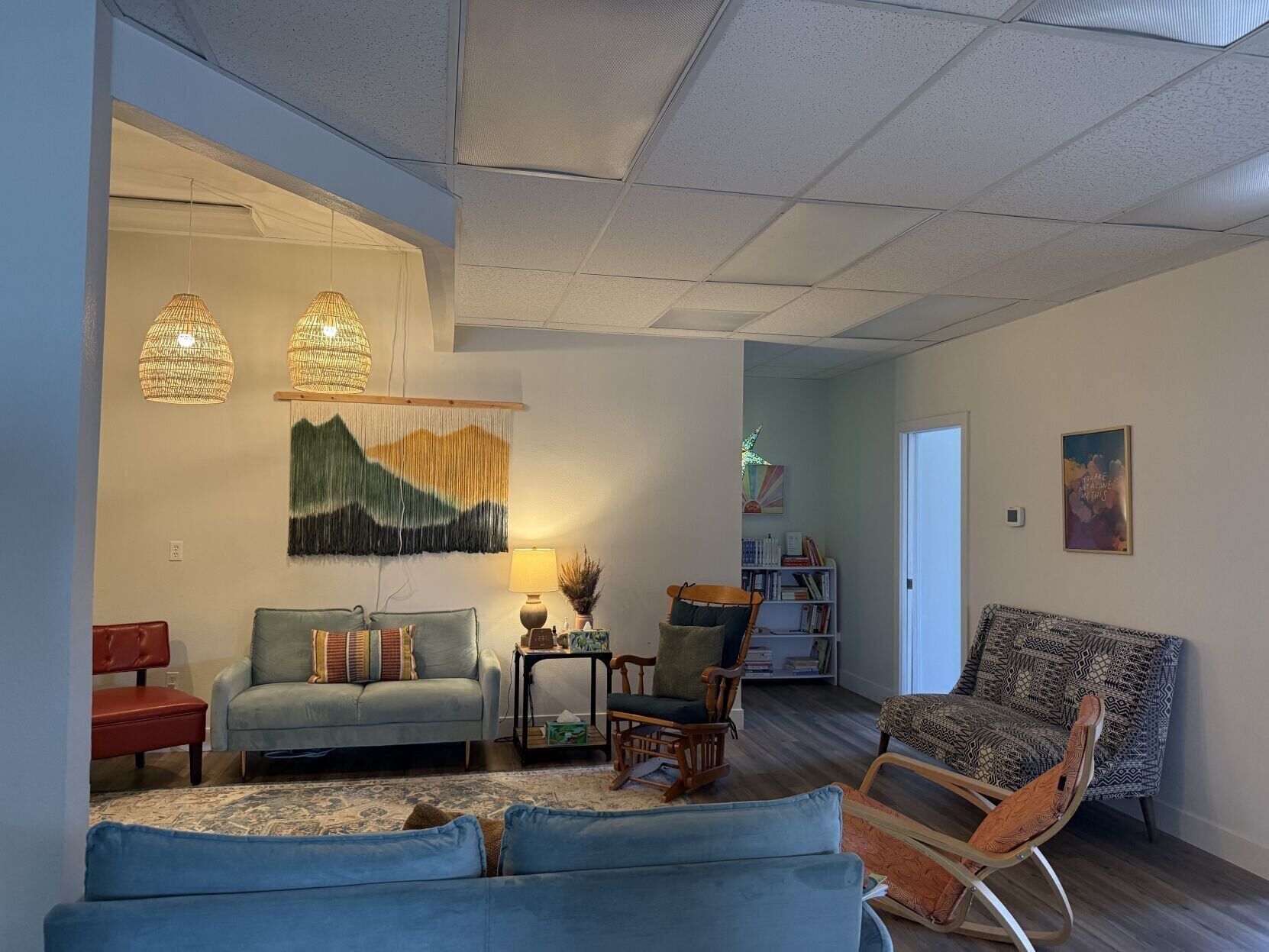
The office where Roots Family Collaborative holds its peer support groups.
On the other hand, Bendick said postpartum psychosis occurs only in the “rarest of rare cases” and is considered a psychiatric illness.
Postpartum psychosis affects one to two out of every 1,000 women, according to the National Library of Medicine.
The NLM states the postpartum mothers experiencing psychosis may have a “delirium-like waxing and waning of consciousness, disorganization and confusion, depersonalization, and bizarre delusions (often concerning the child or childbirth).”
It mentions anxiety, irritability, insomnia and mood fluctuations as other symptoms of psychosis that would likely occur within the first two weeks after childbirth.
Bendick wants people to know that postpartum psychosis is very different from postpartum depression, and that psychosis isn’t linked to depression. It’s also usually treatable.
“What we tell people at Roots is that if you don’t feel like yourself, tell somebody, tell your provider, tell your partner, tell your therapist,” Bendick said.
Roots Family Collaborative, located at 1716 W. Main St. #8d, provides several support groups for different stages of parenthood, from fertility support to groups for moms with kids at any age.
Its most frequently-meeting support group is called Blossom Mom, for moms with babies under one year old. The groups holds two sessions a week at their Bozeman location, along with a weekly Zoom session and two meetings in Big Sky and Livingston.
Roots also has a dad’s groups, a group for Spanish-speaking moms and a new fourth trimester group for moms who are immediately postpartum, which will start meeting this fall.
All the group leaders have gone through extensive training and have lived experiences that align with the topic of their group.
Resource coordination is a big part of Roots’ work. Every year, the organization puts together a resource guide of professionals that can support families in the perinatal community. These professionals include mental health professionals, OBGYNs, midwives, lactation consultants and more.
It also focuses heavily on community awareness, through events like Moms Like Me, a dynamic music and storytelling event for mothers.
Roots started almost ten years ago and now hosts Moms Like Me, which celebrated its 10th anniversary in March.
After struggling with early motherhood years ago, Bendick became a postpartum doula and a lactation counselor to help moms with similar struggles.

The children's space at Roots Family Collaborative.
She met Molly Melzer, one of the other co-founders, and they recognized that there was support for young children in the Bozeman area but not for the mental health of parents. They then recruited Kerry Williams, who had nonprofit experience, and started talking to different professionals to figure out how to provide missing services to parents.
As for the Clancy trial, Bendick hopes that moms seeing information about the trial on social media know that there are support systems for them. She was glad to hear that people have been reaching out to the Help Center for immediate mental health support.
“I sort of hate the sensationalized postpartum psychosis cases,” Bendick said. “I wish there was more research and training and awareness around what is available for moms because I think these kinds of things have a tendency to scare people into a little bit of a frenzy.”