New exhibition surfaces Indian boarding school records
On Friday evening, the Cascade County Historical Society’s history museum in Great Falls will open a new exhibit on an Indian boarding school that operated near Cascade, Montana, from the middle of the 19th century to the early 20th century. It’s the History Museum & Research Center’s first major exhibition built around historical records recently donated by a Roman Catholic religious order.
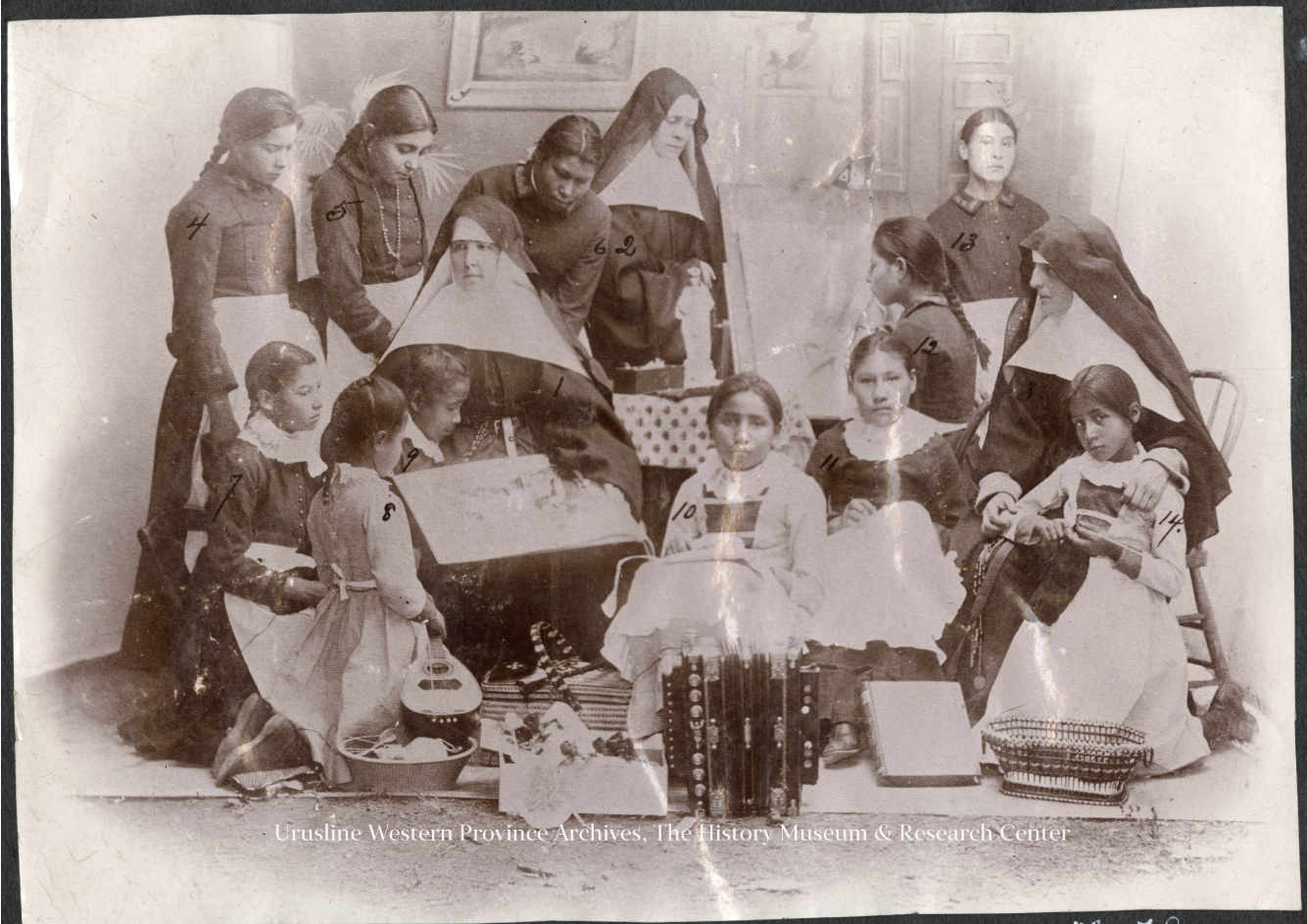
TOP: A photograph from the Ursuline Sisters’ collection shows nuns with Native American children, circa 1900. ABOVE: The exhibit “Voices of Our Ancestors: The Records of St. Peter’s Mission Boarding School” opened at the Great Falls History Museum & Research Center on Aug. 21.
On Friday evening, the Cascade County Historical Society’s history museum in Great Falls will open a new exhibit on an Indian boarding school that operated near Cascade, Montana, from the middle of the 19th century to the early 20th century. It’s the History Museum & Research Center’s first major exhibition built around historical records recently donated by a Roman Catholic religious order.
In the 1860s, Catholic Jesuit priests established St. Peter’s Mission boarding school in north-central Montana to promote Catholicism within the Blackfeet Nation. In 1884, a Catholic bishop in Helena invited the Ursuline Sisters, a Roman Catholic religious order, to join the Jesuits and establish a school for girls at St. Peter’s. Eventually, the Jesuits withdrew, leaving the Ursuline Sisters to run the school.
From the 1800s to the 1970s, the federal government coerced Native American children nationwide to attend boarding schools run by the government or religious institutions with the explicit mission of assimilating students. Indigenous children at these schools were punished for speaking their languages and practicing their cultures. They were emotionally, physically and sexually abused. Some children died at Indian boarding schools and were buried in unmarked graves. St. Peter’s was one of at least 16 Indian boarding schools that operated in Montana. Thousands of Indigenous children from tribes across the state attended the school, which closed in 1918.
THE STORY OF THE RECORDS
Nuns, said Sister Dianne Baumunk, provincial superior of the Ursuline Sisters Western Province, are notorious recordkeepers.
“We used to have a habit of keeping a journal for each of our places — our homes, our schools, and lists of students and pictures, all kinds of things,” she told Montana Free Press by phone Tuesday. “We have that tradition, but are we really good at it? Do we organize it? Not so much.”
Until recently, a room in the Ursuline Centre in Great Falls housed dozens of boxes filled with thousands of historical documents dating back to the 1880s. The records detailed the nuns’ day-to-day lives in photos, yearbooks, journals and information about the Indian boarding schools they helped run, including St. Peter’s Mission.
Researchers and members of the public could make appointments to comb through the records, but the facility’s hours were limited, and the documents weren’t well labeled or organized.
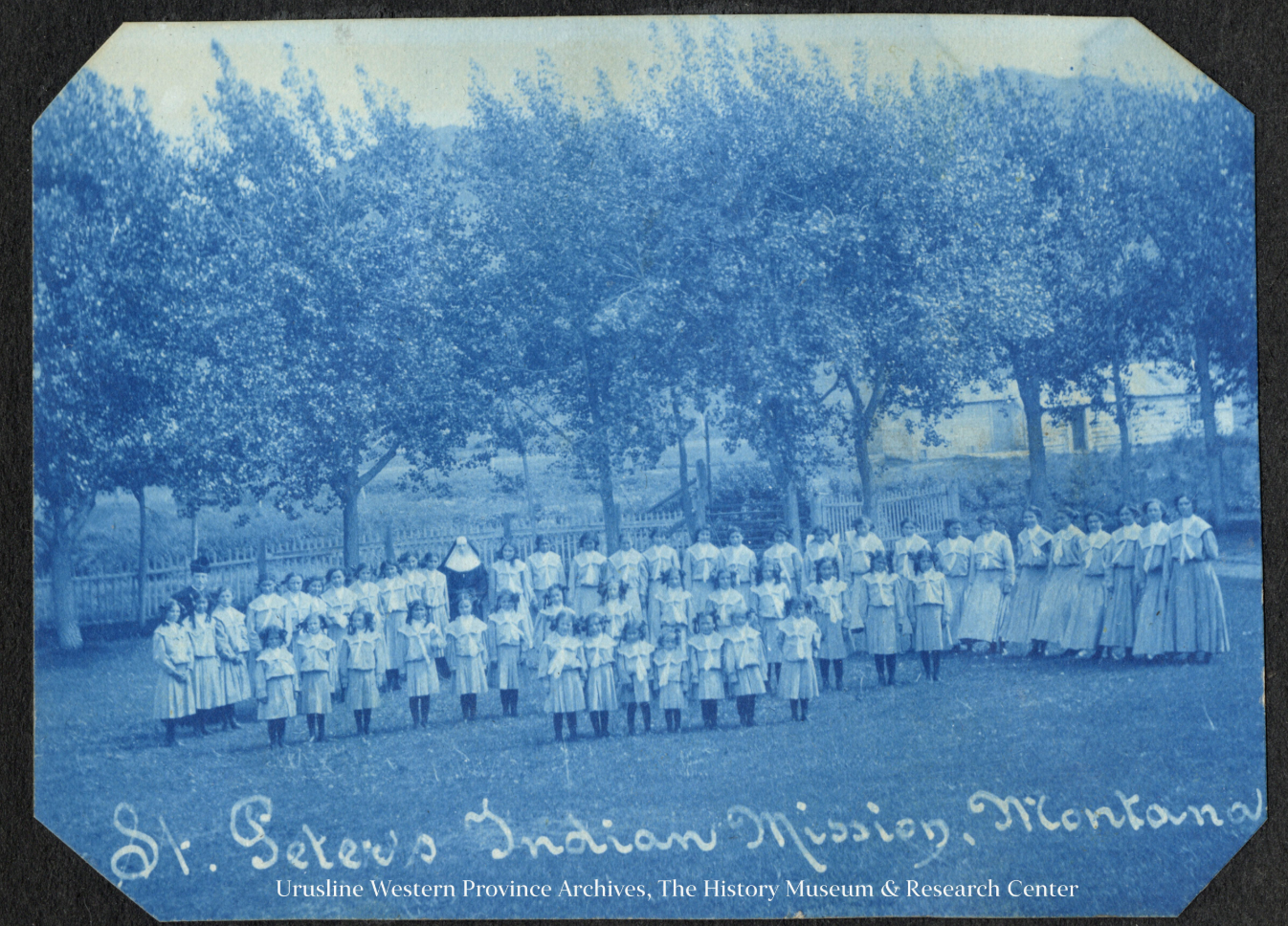
Children in identical clothing line up with an Ursuline Sister on the grounds at St. Peter’s Mission in 1911.
In 2023, after the Ursuline Centre was sold, and with fewer Ursuline Sisters remaining in Great Falls, the Western Province needed to find a new home for the records. Two other Ursuline provinces in the United States, facing a similar predicament, had loaned their historical documents to Boston College, which houses religious archives from groups nationwide. The sisters in the Western Province chose to lend their records to the history museum in Great Falls, a decision that required approval from the Ursuline Sisters’ mother house in Rome.
“We decided it was more important for the Native people in Montana, and everybody in Montana, to have access,” Baumunk said. “They’re not going to run off to Boston to check out pictures and books that have their family name.”
Once the loan was approved, in 2023, history museum employees, Ursuline nuns and volunteers loaded hundreds of boxes of historical documents into a moving van and drove them across town. Since then, museum staff and volunteers have been organizing, digitizing and cataloging the material, prioritizing documents from Indian boarding schools at the sisters’ request.
Jimmy Grant, a historian and curator who researches child deaths at Indian boarding schools, said the museum’s work has made the records more accessible. Now, search aids including narratives detailing the contents of each box and summary descriptions of folder contents help organize the material.
“It makes it a lot easier to see what’s there,” Grant said. “Otherwise, you’re kind of just looking for a needle in a haystack when you’re conducting research.”
NEW ACCESS
Mary Lynn Lukin, who is Blackfeet, grew up hearing stories of her grandfather’s time in boarding schools. Her grandfather, Brian Connolly, attended Carlisle Indian Industrial School in Pennsylvania, Holy Family Mission east of Browning and St. Peter’s Mission outside Great Falls. According to family lore, he ran away from each institution. Connolly’s siblings also attended St. Peter’s Mission, and Lukin remembers being told that one of them, a 4-year-old child named Nora, died there.
“I was curious what happened,” she said. So, last spring, after learning that the records were accessible, Lukin, 81, drove 126 miles from Browning to the Great Falls history museum to explore the archive. She eventually volunteered to help museum staff catalog the records, and said she has since “put over 300 hours in at the museum.”
Lukin found in the records a program from a music performance listing her grandfather’s two sisters, Mary and Rose, and the instruments they played at the time. She saw that in some documents the nuns had misspelled her relatives’ names and misidentified their tribe, labeling them Cree rather than Blackfeet.
Grant, one of the first researchers to access the records after they were moved to the museum, found information about Lukin’s relative Nora. Lukin said documents described the 4-year-old child’s headaches in the weeks before she died.
Deaths, Grant said, were generally more common at off-reservation boarding schools like St. Peter’s because it was difficult for school officials to send children home. Sometimes, he said, by the time family members received notice about a sick child from school officials, it was too late.
“In an institutional setting, things like tuberculosis and other diseases spread pretty quickly, and you see a lot of records relating to that,” he said. “A lot of the records are really tough to read. Reading about starvation, reading about famine time when the sisters were wondering how they would feed the children and themselves.”
Lukin said she can tell from the documents that people at the school cared about Nora.
“The notes from the ledgers indicate that people just loved to hear her speak,” Lukin said. “That was, for me, really rewarding, and a way of just understanding what happened to her.”
Lukin also found a photo of her aunt holding a cake on her 5th birthday at Holy Family Mission, a boarding school that operated east of Browning. The photo, she said, illuminated the complicated reality of the schools, where children may have experienced moments of joy and celebration alongside abuse and even death.
“The bottom line is there isn’t just one story,” she said. “There’s lots of stories.”
THE EXHIBIT
The exhibition, titled “Voices of Our Ancestors: The Records of St. Peter’s Mission Boarding School,” opens at the Great Falls history museum on Friday, Aug. 21, at 6 p.m. and will remain open for one year.
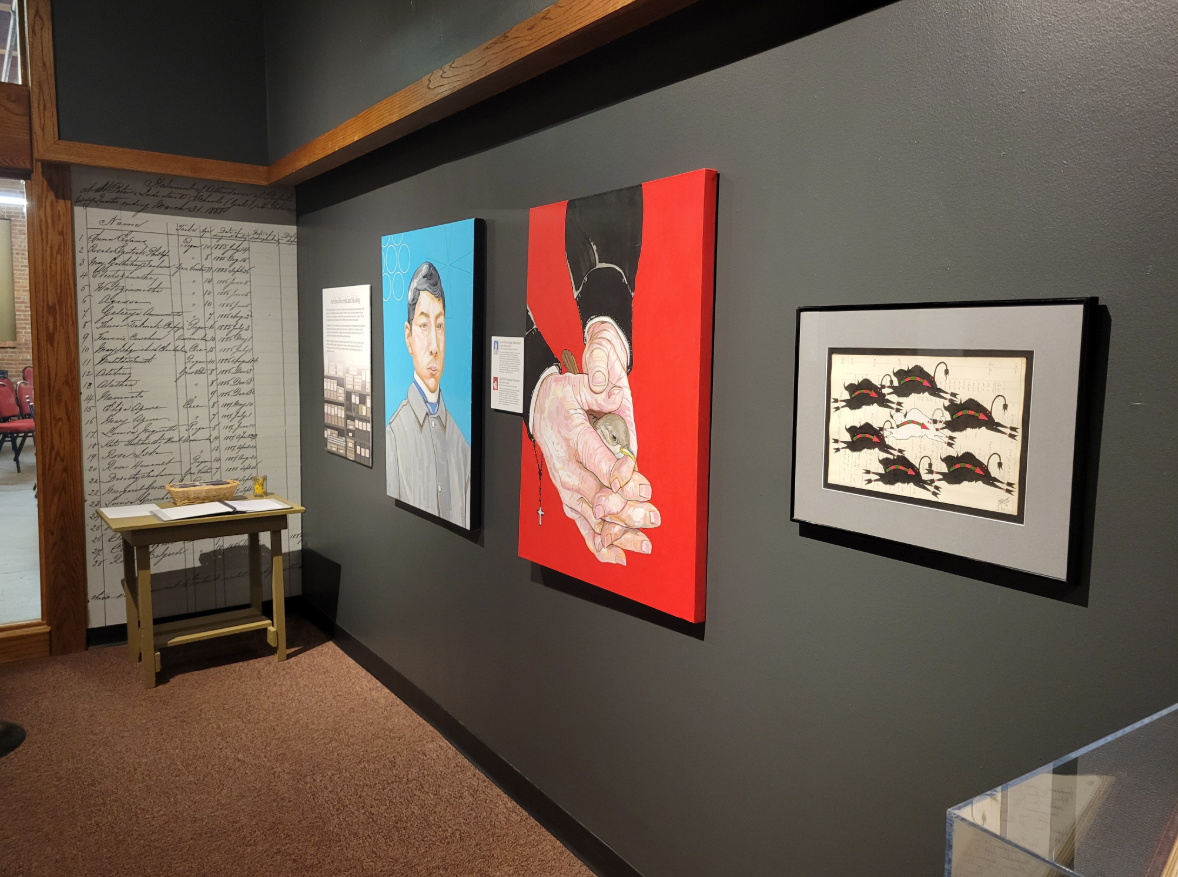
The exhibit “Voices of Our Ancestors: The Records of St. Peter’s Mission Boarding School” opens at the Great Falls History Museum & Research Center on Friday, Aug. 21, 2026 at 6 p.m.
Grant, who curated the exhibit, said it includes photographs and historical documents that describe what students learned, what chores they did, what songs they performed, the arrival of unusual visitors and the sight of a new smokestack near Great Falls. The exhibit features musical instruments played by St. Peter’s students, a bed from a mission dormitory, a chair carved by nuns and contemporary paintings by Blackfeet artist Louis Still Smoking. Each section of the exhibit, Grant said, highlights the story of a child, or the descendant of a child, who attended the school.
“The story of St. Peter’s is oftentimes presented from the sisters, who certainly survived great hardship to come out to Montana to establish the mission,” he said. “But this particular exhibit is trying to give an Indigenous voice to the story.”
One goal of the exhibition, Grant said, is to educate the public about the existence of the records and encourage people, especially descendants of boarding school survivors, to use them to “locate the story of their ancestors.”