Four paddlers on pace to beat the Missouri River speed record by more than a week
They plan to complete a 2,341-mile journey that started in Montana in fewer than 25 days, although it's taking a toll.

Missouri River Speed Record 2026 paddlers travel along the river Thursday near Arrow Rock. The team began its journey June 23 in Three Forks, Mont.
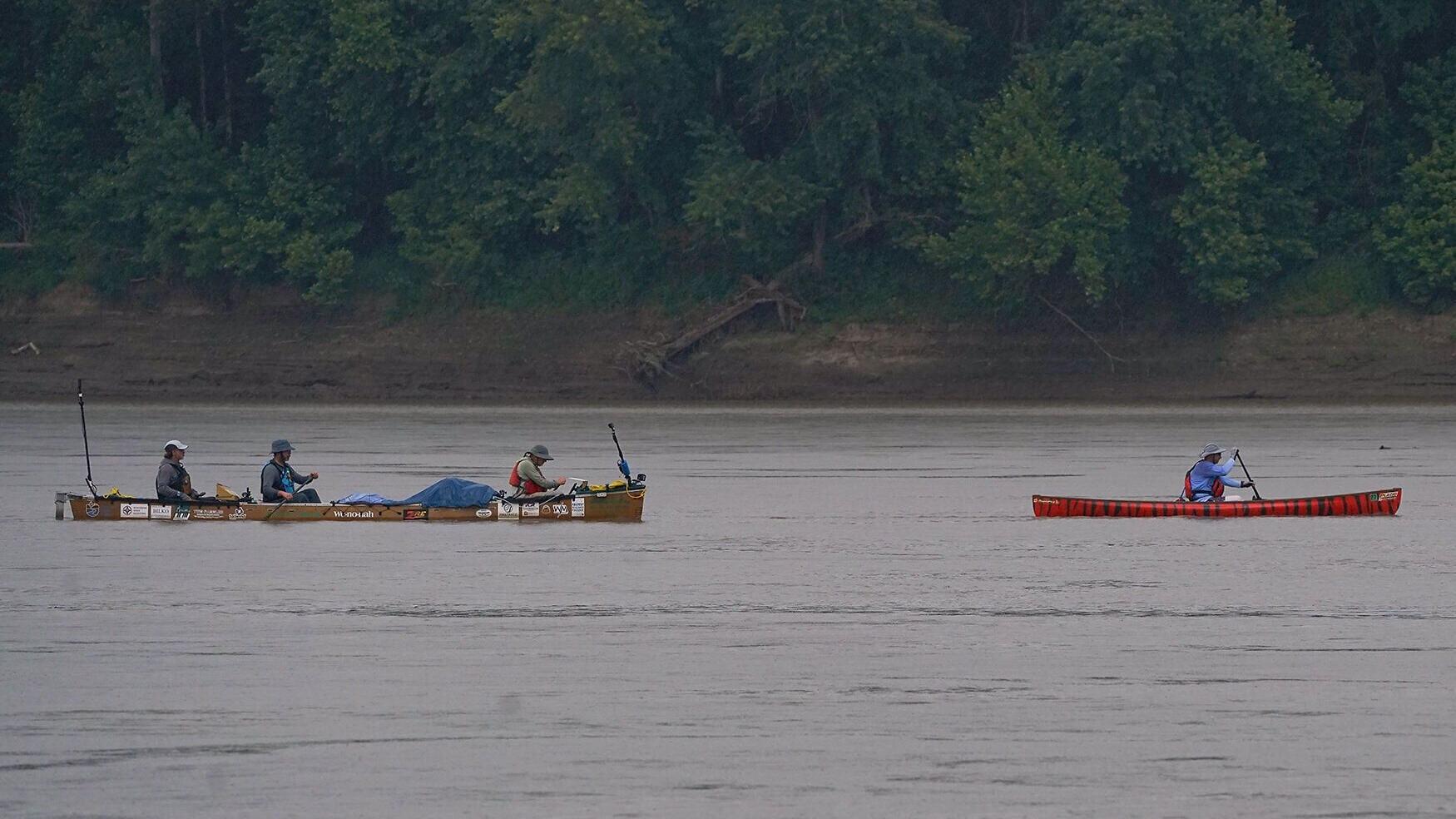
Missouri River Speed Record 2026 paddlers travel along the Missouri River on Thursday near Arrow Rock. The paddlers aim to break the record for traveling the 2,341 miles of the Missouri River the fastest.
Four Minnesota paddlers racing down the Missouri River are on pace to break a speed record set just weeks ago and potentially complete the 2,341-mile journey more than a week faster.
Scott Miller, Lad’a Zednik, Scott Duffus and Curt Leitz are expected to reach St. Louis, where the Missouri and Mississippi rivers meet, in fewer than 25 days, according to support crew leader Mindy Kragness.
“They’ve made a lot of gains in the last day or two and are on track for sure to break the record,” Kragness said Thursday as she and her crew began to set up camp at Cooper’s Landing.
The team is chasing a record set July 3 by Pete Larson of Ballwin, who completed a solo, unsupported paddle of the Missouri River in 32 days, 6 hours and 7 minutes.
Larson broke a record that stood for 46 years. In 1980, Verlen Krueger and Steve Landick completed the journey in 33 days, 18 hours and 45 minutes.
Now, less than two weeks after Larson reached St. Louis, the Minnesota team is on the same home stretch. Maintaining a pace of around 6 mph through the final stretch would give their team a strong chance of shattering the record, Kragness said.
Their projected finish time continues to fluctuate based on paddling speed and stops along the way, but the team expects to finish on the Illinois side of the Mississippi River either late Friday night or early Saturday morning.
Weather, injuries and extended stops on shore are still the biggest threats to the record. As a result, the paddlers have spent nearly the entire journey in motion on the canoe, only stopping briefly once each day to interact with the shore team.
Otherwise, they rotate between paddling, resting and sleeping positions aboard the canoe, stopping on occasion to switch places.
After thousands of miles of river, Kragness said the pace is taking its toll.
“They’re holding up, but they’re definitely tired,” she said. “They’re really starting to show their exhaustion.”
One paddler began experiencing swollen feet and ankles, she said. A nurse traveling with the crew has been monitoring his condition. The crew has also supplied the paddlers with ice collars to wear around their necks to cope with the summer heat.
“At this point they’re ready to be done, it’s kind of like a horse getting into a barn,” Kragness said.
Each paddler has experienced mental highs and lows on the journey, but Kragness said the four-person team has provided its own built-in support system.
“Not all four have been down in the dumps at the same time,” she said. “Usually you can have other paddlers kind of spend some time talking up the person to get them past that point.”
Fatigue as been a minor setback compared to the other logistical issues the team has tackled. High winds during a storm on Lake Oahe forced the canoe to shore where paddlers relied heavily on emergency equipment built into the heavily modified boat. A support boat also took on water and was at risk.
The team’s specially outfitted support vehicle also developed mechanical issues in Great Falls, Montana, shortly after they started. The vehicle had been equipped with storage for much of the support crew, forcing them to improvise and find alternative ways of moving.
“That’s one thing you can always count on — that things are going to go wrong,” Kragness said.
The support crew begins preparing meals between 5 and 6 a.m. each day, packing 24 hours of meals into dry bags for each paddler. Rough estimates bring each paddler’s daily intake to 5,000-6,000 calories. The meals are made up largely of oats, eggs, pasta, potatoes and protein.
Supplies travel from base camp in a shuttle vehicle that then links up with the rover team, a vehicle traveling alongside the paddlers on land. From here supplies are handed out when the paddlers stop on shore or are ferried by support boats.
As the team moves deeper into Missouri, Kragness said friends, family and members of the paddling community have increasingly gathered along the river to cheer them on. The support has given the four exhausted paddlers a much- needed boost as they enter the final stretch.
Before beginning the journey, paddler Scott Miller said breaking the record would be “just the cherry on top of a sundae. If we break the record, that’s really cool, but if we don’t, we’ll still have an awesome experience.”