'A giant magnet': Thousands come to see history in motion as Big Boy thunders through Missouri
Union Pacific's only working steam engine pulled into Hermann on Monday on its cross-country tour for the America250 celebration
Long before you can see Big Boy No. 4014, you can hear its whistle. And wherever it stopped this week in Missouri, the whistle from the world’s largest operating steam locomotive drew a crowd of thousands.
Spectators erupted into cheers as the train rolled around a bend. They raised their phones to capture a million pounds of steel rolling down the tracks. And they were blown away when the deafening blast announced that the train had pulled to a stop.

Visitors from across Missouri take photos as Big Boy No. 4014 makes a stop on Monday in Hermann. Hundreds of people traveled to the town of 2,200 to see the train.
It was sweltering when Union Pacific’s Big Boy No. 4014 pulled into Hermann at 2:15 p.m. Monday on its cross-country tour for the America250 celebration. After making a journey east to Philadelphia for Independence Day, the train is now returning home to Wyoming through Missouri, Kansas and Colorado.
It left St. Louis on Monday morning, made a whistle stop in Pacific, another one in Hermann that afternoon, then moved on to overnight in Jefferson City before heading to Kansas City on Tuesday.
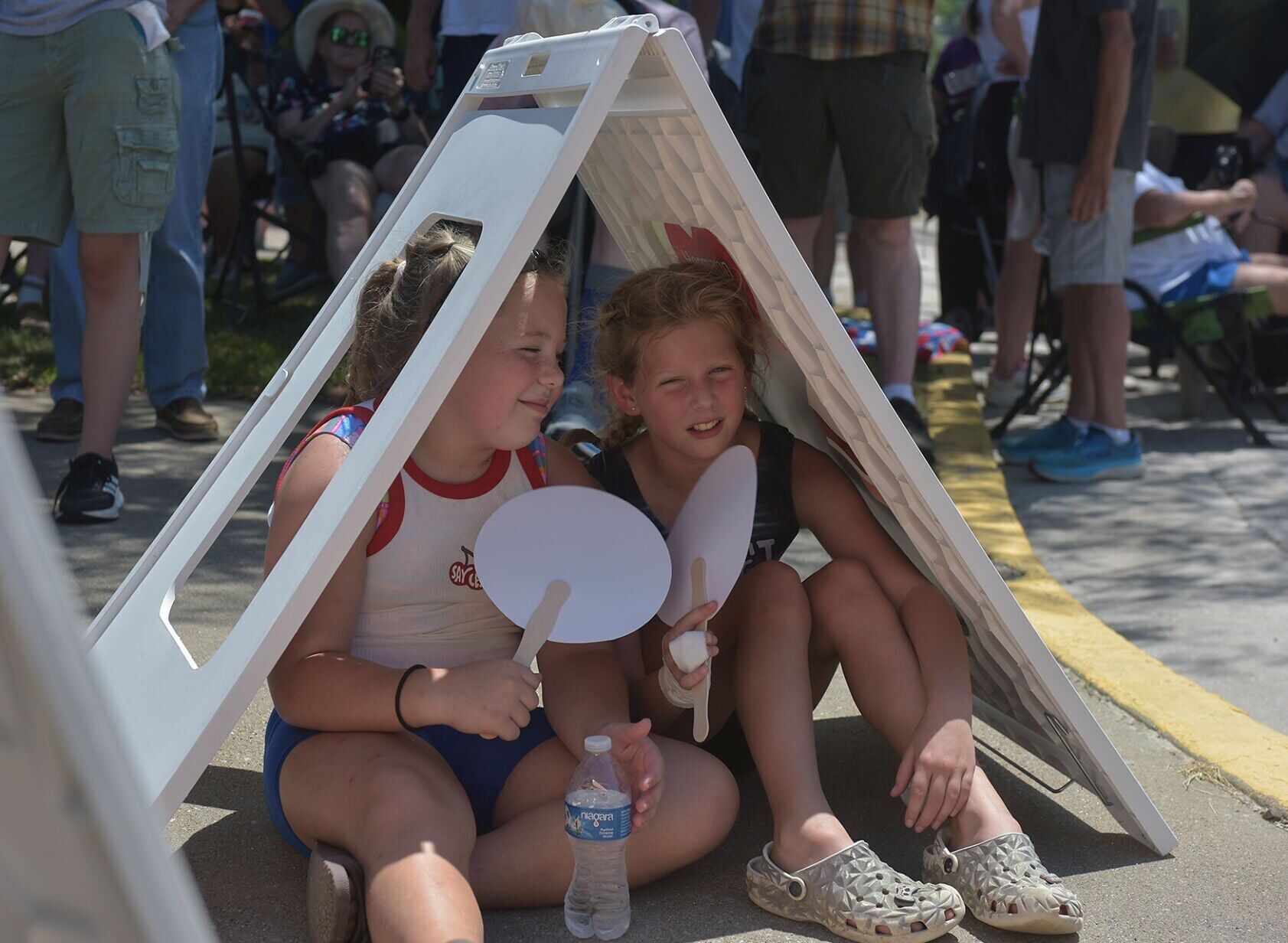
From left, Genna Zelch, 10, and Arabella Velasco, 11, sit in the shade while waiting for Big Boy No. 4014 to arrive on Monday in Hermann. Several first responders were on scene anticipating the high temperatures, which caused some people to overheat and faint.
For Jeff Wilmes, a lifelong trainspotter and IT professional in St. Louis, the experience was worth the 95-degree heat. Monday was his seventh time seeing Big Boy since its restoration in 2019.
“It’s an impressive sight stationary, but to think that something that big can get up to speed?” Wilmes said. “That’s impressive.”
Big Boy represents something larger than the spectacle of seeing the enormous engine move, he said.
“It’s an American thing to haul that much freight,” he said. “I mean, that’s what built us.”
These big steam locomotives were designed during World War II to haul freight over the steep grades of the Wasatch Mountains between Wyoming and Utah. Of the original 25 Big Boy engines, only eight still exist, and 4014 is the only one still in operation.
Aiden Drohr, a curatorial assistant with the National Museum of Transportation in St. Louis, said he has been fascinated with trains his entire life. He is familiar with the locomotives that helped build America’s railroads, but he said visitors always struggle to comprehend the size.
“They say, ‘Wow, that’s all one engine?’” Drohr said. “I’m like, ‘Yeah that’s the whole thing.’”

Still, seeing a museum piece and watching an “alive” steam engine are completely different experiences.
“You get sounds, you get smells that you can’t experience around any other type of machine,” he said.
Repeating that experience required restoring a locomotive with a history of hauling freight more than a million miles before spending decades on display in Pomona, California.
Union Pacific reacquired No. 4014 in 2013, years after the locomotive was retired from regular service and had moved to Cheyenne for restoration. Ed Dickens, Union Pacific’s chief steam locomotive engineer, and his team spent 2½ years taking the locomotive apart and rebuilding it.
“It had a lot of rusty parts, worn-out parts,” Dickens said. “We took it completely apart and made it new again. And now it runs like the proverbial Swiss watch.”
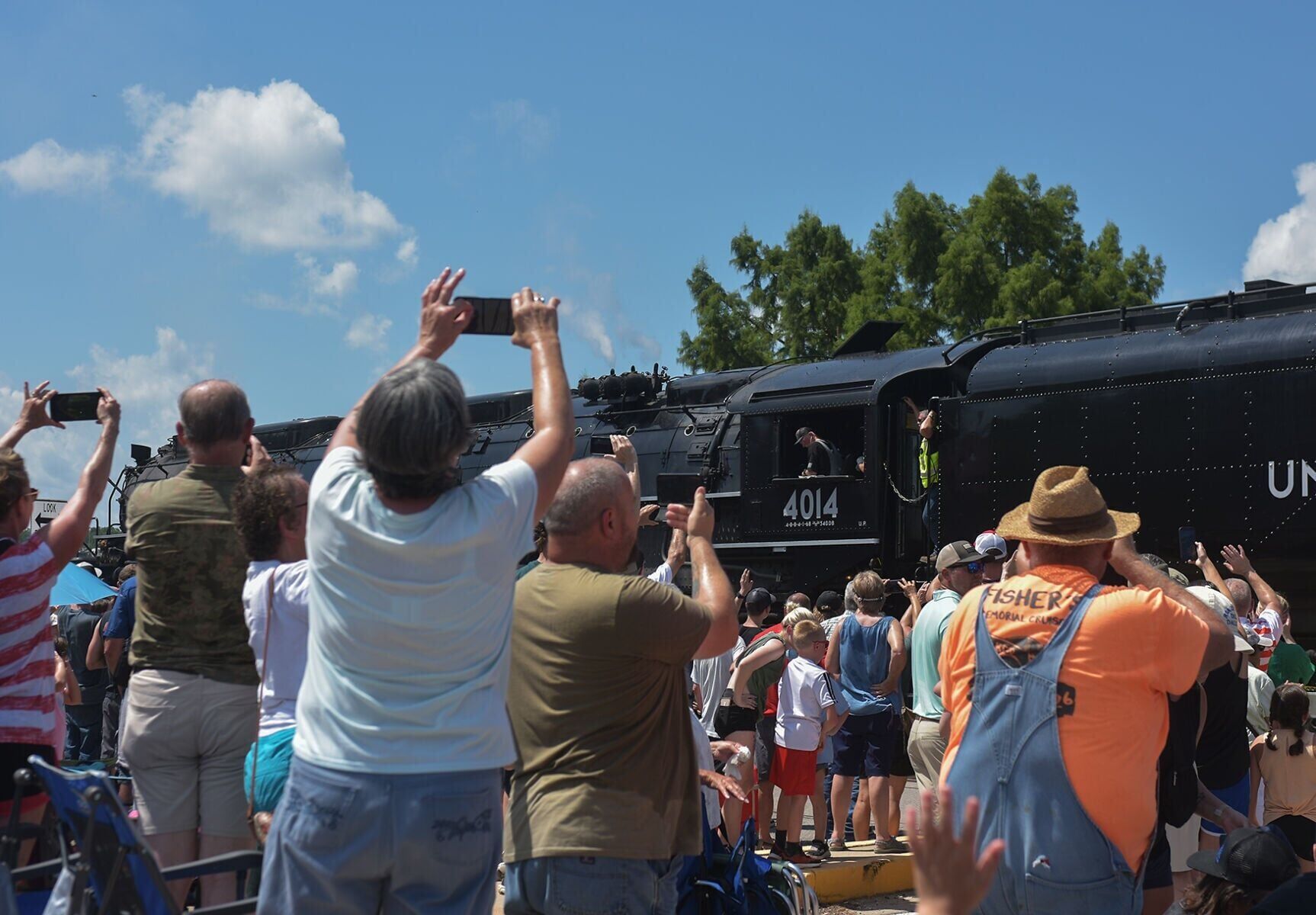
The crew on Big Boy No. 4014 wave to the crowd before departing Monday. After a 25 minute long stop, the train left Hermann to head to Jefferson City. After spending the night in Jefferson City, Big Boy will head to Kansas City for public viewing in Union Station.
The elegant way the train moves continues to fascinate spectators, he said.
“The size of the locomotive, the power, its animated appearance when it’s running and, of course, the beautiful sound of that whistle,” Dickens said.
Operating the locomotive also means returning to the work conditions of the steam-engine era. Even while spectators suffered through the Missouri heat and humidity Monday, Dickens joked that he was “actually cooling off” when he stepped outside the cab.
“It’s pretty hot because this is 1940s technology,” he said. “Our grandmas and grandpas did this kind of work years ago. They didn’t have any expectations that they would be comfortable.”
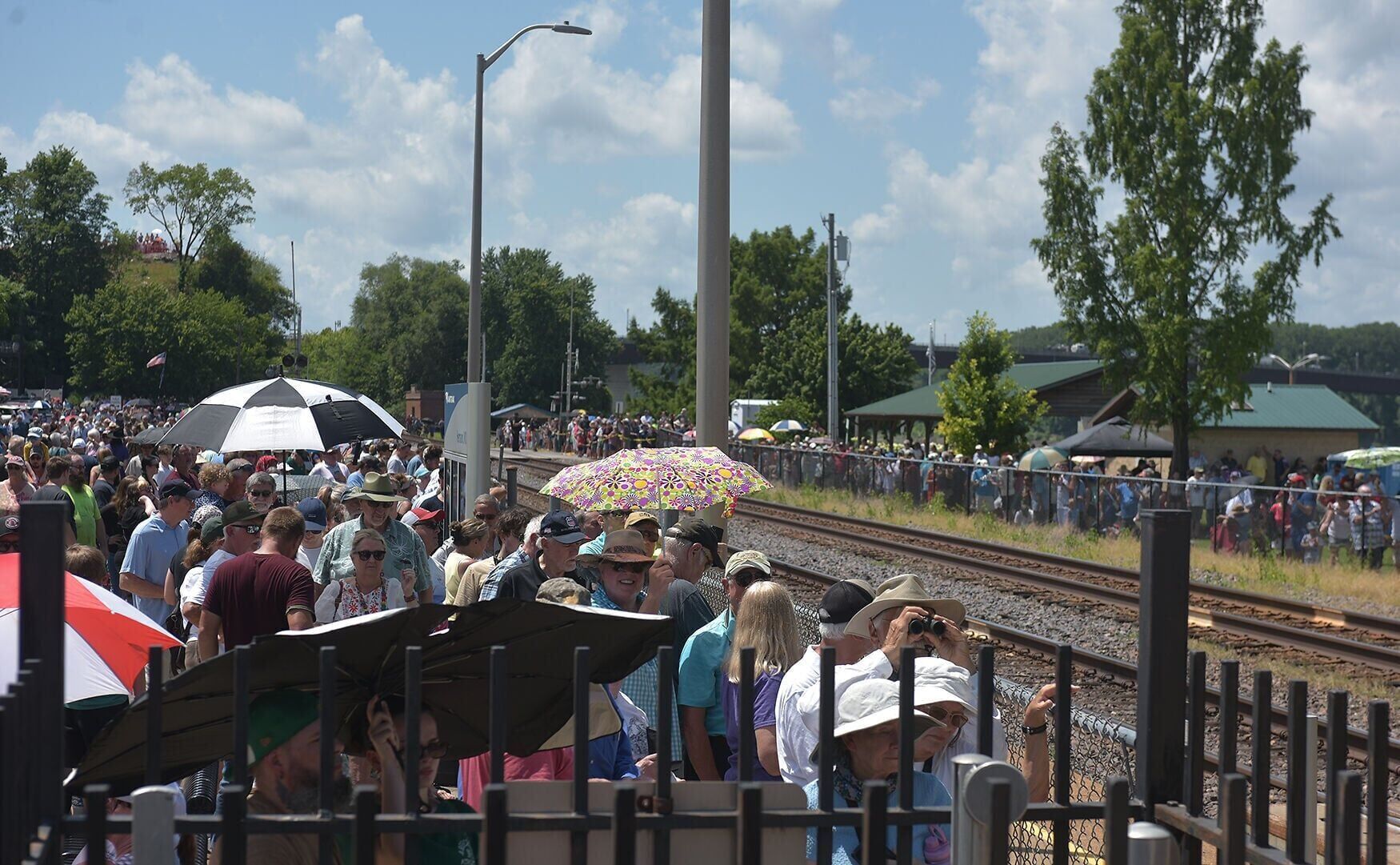
A crowd surrounds the train station on Monday in Hermann. To avoid the direct sun and heat, people used umbrellas and portable fans and kept to the shade.
Despite the weather, crowds packed the tracks Monday for whistle stops in Pacific and Hermann. For Dickens, these scenes have become familiar during the weeks of traveling across the country with 4014.
He compered the train to a “giant magnet” drawing spectators wherever it traveled.
“It’s emotional, it really is,” he said. “We see people cheering, they’re waving, everybody’s happy.”
Wayne Woodrum, a Richmond Heights resident who traveled via bicycle on the Katy Trail to see the locomotive, offered his own take on the machine.
“It’s the biggest thing since the Titanic,” he joked as he pointed to the crowd.
For Brian Lock of Washington, Missouri, the size of the crowds reflected something deeper than fascination with an old machine.
“It’s more than just a train,” he said. “People see their history.”
Drohr has observed a similar response in the Big Boy 4014 excursion across the United States.
“I think a lot of people kind of recognize it as this great American icon,” he said. “It was the largest locomotive ever built, one of the largest locomotives built in this country and it’s still the biggest operating engine in this country.”
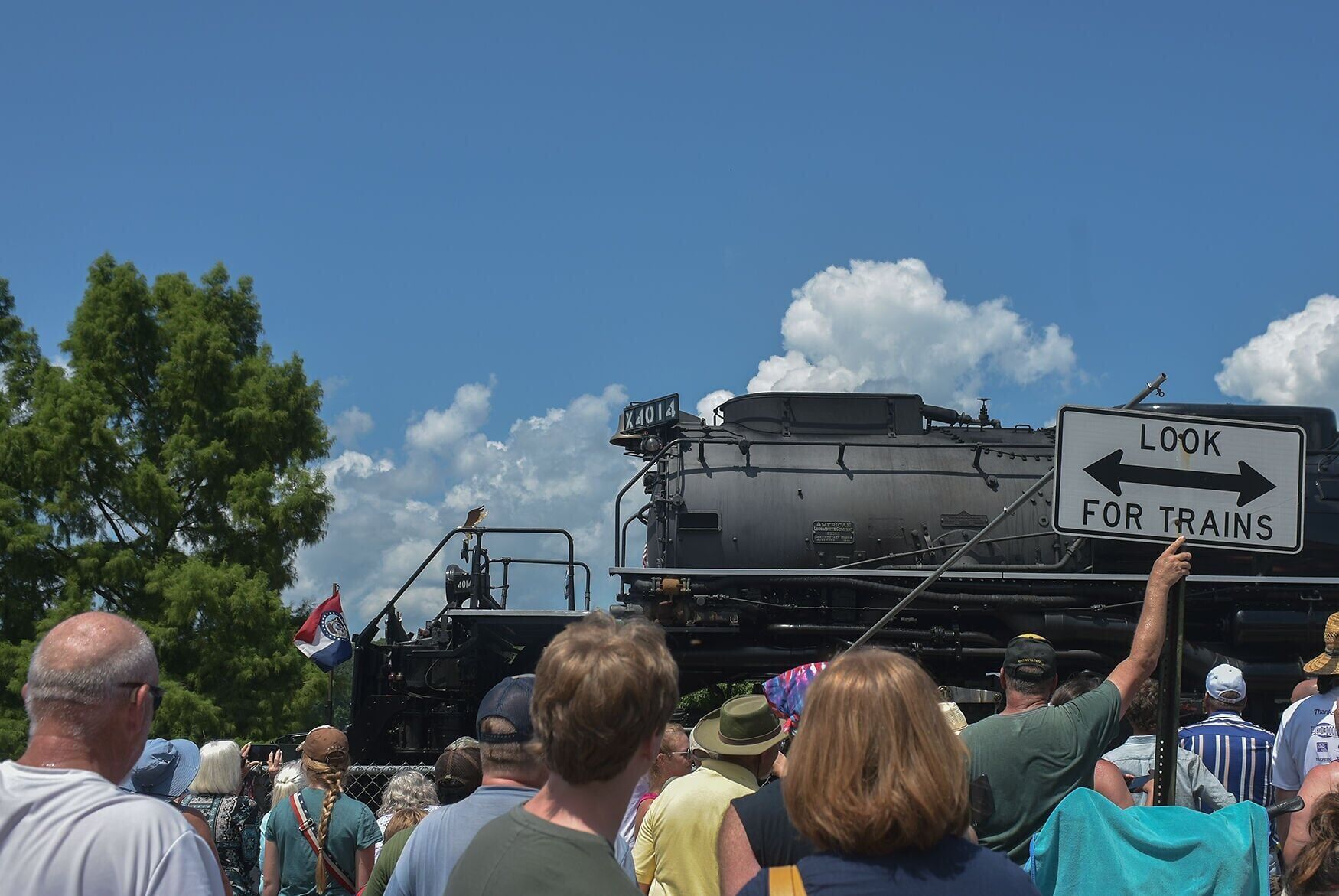
Crowds gather around Big Boy No. 4014 on Monday in Hermann. Traffic was congested before and after the showing, which lasted about 25 minutes.
More than eight decades after the first Big Boys were built, No. 4014 no longer hauls freight across the mountains. But the locomotive still connects people in an important way.
Preserving railroad history is about preserving how our country developed, Drohr said. Railroads once tied communities and industries together at speeds previously unimaginable, carrying people and goods across the nation.
Today, that connection still matters.
“The railroad was the internet of its day,” he said.
The locomotive makes a whistle stop Tuesday at East Street Crossing in California, Missouri, from 10 to 10:15 a.m. It arrives in Kansas City with public viewing in Union Station from 5:30 to 8 p.m.