Working in the shadows: Strong culture drives Missouri's top-ranked women's javelin squad
Missouri women’s javelin has risen to No. 1 nationally through depth, culture and a process-driven approach. The Tigers continue their push for dominance this week at the NCAA Track and Field Championships West First Round in Fayetteville, Ark.

Mizzou javelin thrower Valentina Barrios prepares to throw at the Southeastern Conference Outdoor Track & Field Championships on May 14 in Auburn, Ala. Barrios earned her first career conference championship with a throw of 191 feet, 3 inches, and is looking to win her second consecutive national championship.
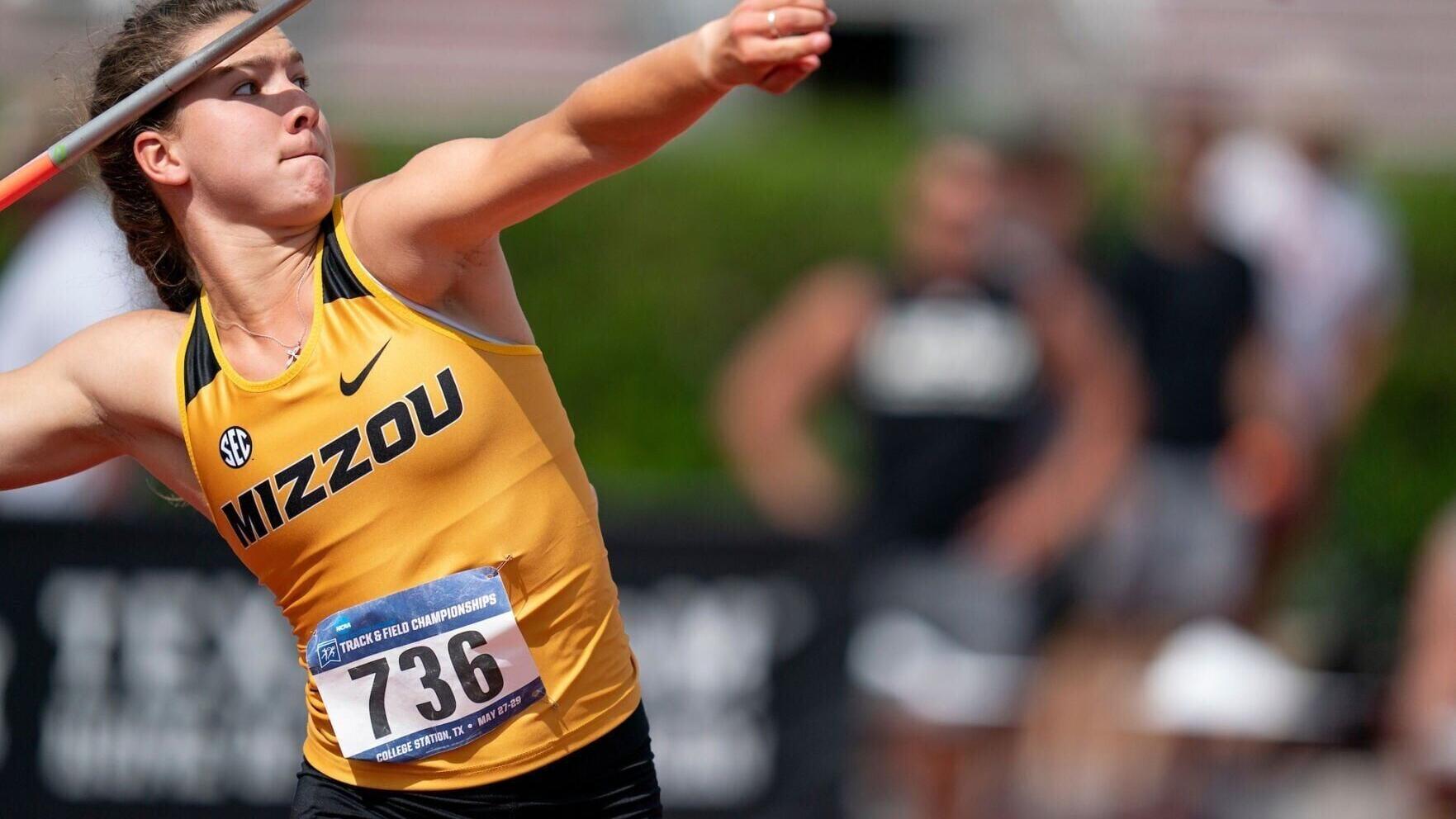
Mizzou’s Skylar Ciccolini throws in the 2021 NCAA West Preliminary Round meet in College Station, Texas. Ciccolini, a graduate student who is currently ranked No. 4 nationally, attributes the javelin squad’s success to a strong team culture.
For nine straight weeks, the Missouri women’s javelin crew has sat atop the national rankings.
The group has been nationally recognized over the past few years, but this season it has reached a new high. It enters this week’s NCAA Track & Field Championships West First Round — which began Wednesday in Fayetteville, Arkansas — ranked No. 1. The women’s javelin unit begins competition at 2 p.m. Thursday.
Over the past couple of years, Missouri has built one of the top women’s javelin programs in the country.
Missouri track and field coach Brett Halter attributes the program’s growth to the quality of athletes who choose Missouri over other schools in the recruiting process.
He said the college-town feel of Columbia is what attracts the majority of recruits.
“It’s a cool experience to be able to walk off campus and go down to all the coffee shops and boutiques and pizzerias right there next to campus,” Halter said. “That’s unique. A lot of other schools don’t have that.”
Graduate student Skylar Ciccolini said the environment the squad has created plays a vital role in its overall success.
“It’s always a good time,” Ciccolini said. “We have a very diverse mix of personalities within the group, but when we’re all practicing together, it just helps lift people up.”
Missouri has seen production from multiple athletes near the top of the national leaderboard, including Valentina Barrios and Ciccolini. Barrios, the reigning NCAA Outdoor women’s javelin champion, is ranked No. 3 nationally after taking home the SEC Outdoor women’s javelin title with a throw of 191 feet, 3 inches. Ciccolini’ 188-6 throw at the Drake Relays has her ranked No. 4 nationally.
The depth extends further, through throwers such as Val Galligan, Lexi Craig and Morgan Cannon, among others, giving Missouri one of the deepest javelin rosters in the NCAA. Cannon and Galligan will be joining Barrios and Ciccolini at the NCAA West First Round.
Group culture a strength
But inside the program, athletes and coaches point to the culture surrounding the group as the real foundation behind the sustained success.
“I think the girls’ success is really linked to how focused they are on the process,” Ciccolini said. “Are you focused on the little things every day? Making the right choices? That’s the key to their success.”
That process-oriented mentality has become central to the program under Halter, who has spent decades helping build Missouri’s throws program.
Halter said that, unlike other throwing disciplines, javelin requires a highly specialized training structure because of the physical toll it places on athletes.
“Javelin throwers are like starting pitchers,” Halter said. “You’re not throwing hard every day.”
Because of the rigors of the throwing process, Missouri’s athletes train through carefully planned rotations built around throwing sessions, lifting schedules and recovery work. The structure helps athletes manage the strain that comes with one of track and field’s most physically demanding events.
“It’s an event that’s very hard on your body,” Ciccolini said. “You’ll feel like you’re running into a concrete wall sometimes, and then, all of a sudden, you’ll have a breakthrough.”
That reality has forced Missouri’s athletes to lean on one another throughout the season.
Ciccolini described the group as “fun, controlled chaos,” where teammates constantly compete while also supporting each other amid injuries, setbacks and long stretches of training.
“We’re all very competitive people,” Ciccolini said. “There’s always somebody who’s going to be better than you at something, and that naturally pushes everyone.”
Halter believes that internal competition, combined with strong leadership throughout the group, has elevated the entire room.
“It’s important to have your best athletes as leaders,” Halter said, “not necessarily vocal leaders, but people who steadily execute, don’t complain and just keep doing the work.”
Halter does not like to take credit for the team’s success, deferring to the athletes.
“You know, the secret to success is getting athletes that are better than the coach, right?” Halter said. “The athletes put in all of the hard work, you know. I don’t. I just watch”
Sustained success
The consistency throughout the group has allowed Missouri to sustain its national ranking for much of the outdoor season rather than rely on isolated performances. Week after week, the Tigers continue placing multiple throwers near the top of the standings across the country.
For Halter, who took over as head coach 16 years ago, the ranking itself serves more as validation for the athletes than as a final accomplishment.
“Track and field works in the shadows,” Halter said. “These athletes don’t do it for attention. They do it because they love the process and they want to become the best at what they do.”
That process has also helped create a uniquely connected group.
Ciccolini said the team’s closeness has remained one of the defining characteristics throughout Missouri’s rise to national prominence.
“Honestly, every one of my teammates has either pushed me or supported me when I needed it,” Ciccolini said.
Now, after years of development, recruiting and steady growth, Missouri’s women’s javelin group enters NCAA competition as the top-ranked squad in the country. The program looks to continue its success and possibly own back-to-back national championships.
And while the rankings reflect the results, those inside the program believe the identity behind them matters more.