'Wheelchair basketball really saved his life': Chadwick finds inspiration through hoops
After a tissue disorder known as Ehlers-Danlos Syndrome confined him to a wheelchar, Skyler Chadwick struggled to find motivation. Wheelchair basketball helped get him out of bed and into the game.

In the fall, Skyler Chadwick will begin playing wheelchair basketball at Mizzou. He describes this chapter in his life as, “a short-term dream that I plan on turning into a long-term dream.”
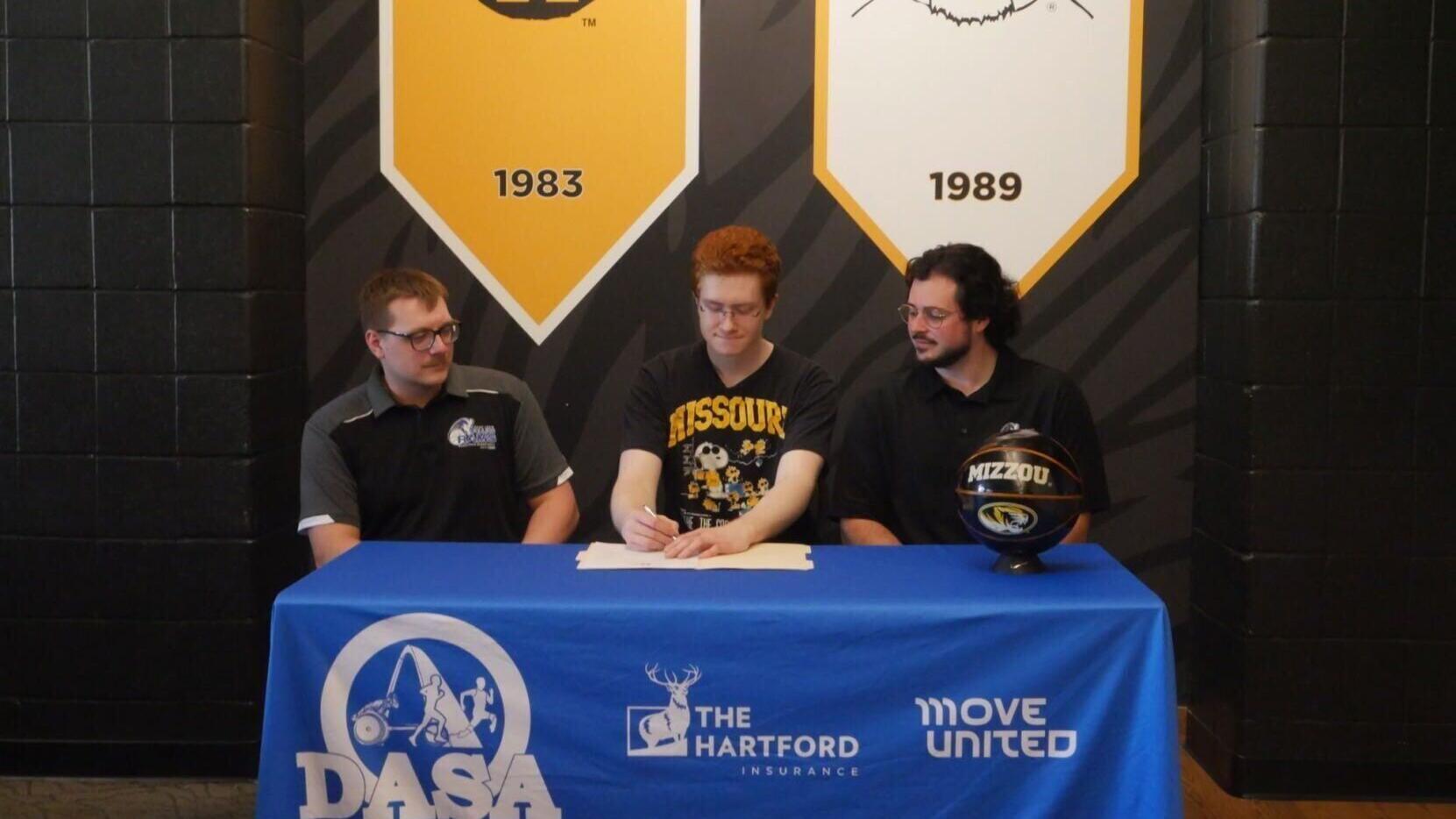
From left, Rolling Rams head coach Tyler Buysse, Skylar Chadwick and Koda Inman-Ahlstrom. The three developed close personal relationships when Chadwick played on the Rolling Rams.

Skyler Chadwick poses on the MizzouRec center courts where he will play in the fall. Chadwick’s late stepfather, Chuck Graham, was influential in helping to start the team over 20 years ago. Graham was also the person who got Chadwick involved in the sport and he encouraged him to stick with the sport.
Eight minutes after she dropped her son off for his first wheelchair basketball tournament, Kate Graham received a call asking to pick him up. Six years later, she watched as he committed to Mizzou to continue playing the sport that saved his life.
Skyler Chadwick struggled with a number of physical challenges throughout his childhood. At age 9, the complications drastically increased. Around that time, Chadwick was diagnosed with Ehlers-Danlos Syndrome, a group of tissue disorders that can produce a number of dangerous symptoms ranging from motor-function problems to organ issues. For Chadwick, the syndrome confined him to a wheelchair.
Living in a wheelchair was a difficult adjustment. Chadwick was unable to perform everyday tasks, and lost motivation to even leave his bed most days.
“I would get up, I would go to the bathroom, I would lay down for 12 hours, and I would just repeat that process,” Chadwick said.
In addition, the mental toll of his condition weighed deeply on him.
“We kind of thought once we got an answer we could start some sort of treatment,” Kate Graham, Chadwick’s mother said. “Then as it hit him, like this isn’t going to get better, this is going to get worse, he became more and more depressed, and his mental health was really, really bad. I would say that wheelchair basketball really saved his life.”
It was Chadwick’s late stepfather, Chuck Graham, who got him involved in the sport. Graham, a longtime Democratic state senator from the district that includes Columbia, was confined to a wheelchair himself starting at age 16 due to a car crash. Graham was a major booster of wheelchair basketball.
Graham played collegiately at the University of Illinois. As his political career advanced, he continued to fight to enhance accessibility for those with disabilities.
Graham was elected to the Missouri House of Representatives in 1996 and the State Senate in 2004. Graham helped with the writing of the Americans with Disabilities Act (ADA) and served as Missouri Coordinator for the ADA Project, helping promote awareness and improve access for disabled persons.
Graham helped lobby for a grant to help found the wheelchair basketball team at Mizzou. Now, it is a highly competitive club sport i{span}n the Intercollegiate division of the National Wheelchair Basketball Association. {/span}
“Chuck came in right at the beginning of things being at their worst,” Kate Graham said. “I canceled our first date because (Chadwick) ended up in the hospital, so it was about the time that all of this had hit. Sky wasn’t doing anything and he was asking me to get him something and Chuck was like, ‘There’s a spare wheelchair right there. Get in it and you figure it out.’ ”
Slowly, with coaching from his stepfather, Chadwick started to improve his ability to navigate with the wheelchair. By 12, he participated in his first wheelchair basketball camp.
“We dropped him off and he called to be picked up in eight minutes,” Kate Graham said.
Graham pushed his stepson to stick with the sport. Having never played basketball of any sort, Chadwick worked with his stepdad to learn the intricacies, along with how to navigate life in a wheelchair.
Another factor in Chadwick’s success was his proximity to Mizzou. Growing up, he often traveled to St. Louis for tournaments. Practices, however, could often be held at the MizzouRec center, where the university team practices. Players from Mizzou often assist in coaching the local kids.
Sometimes, four-time paralympic gold-medal head coach Ron Lykins makes an appearance.
It was at these sessions that Chadwick developed a relationship with many members of the team and coaching staff.
“These recent, like, two years, I’ve been more devoted to this sport than ever, so I can’t exactly say it’s like a long-term dream come true, but it’s definitely a short-term dream that I plan on turning into a long-term dream,” he said.
Chadwick’s dedication to the game developed over three hour practices starting at 5:30 in the morning. Improving every day through a gritty workout regimen led by his coach, Chadwick eventually earned a spot on the Mizzou wheelchair team.
“Sometimes we just do shooting, we’ll do knockout drills, we’ll do just individual free-throw shooting with conditioning in between,” Chadwick said. “Sometimes we’ll just do conditioning. Every practice is different.”
One thing that doesn’t change is his effort level.
“He gets these blisters and then they break off. By the time he’s done with a tournament, he’s just bleeding,” Kate said. “I was like, ‘This is the kid that, you know, was picked up in eight minutes, and now he’s just got 11 broken blisters on his hand and he’s still going.’ It changed him.”
The improvement became obvious to the team, which offered him a spot. Before moving to campus this fall, Chadwick had to undergo a pair of surgeries designed to improve his functionality and control the symptoms of Ehlers-Danlos. He remains grateful for the opportunity and has planned out his recovery time to get cleared for the beginning of the season.
“He worked those surgeries around a wheelchair basketball schedule, so he played a high school varsity tournament on Jan. 3 and 4,” Kate Graham said. “Then, he had his first surgery on Jan. 6, healed for six weeks, and did the varsity like four days after he was cleared to play again.
“As soon as they could get him in after that, he had the spinal fusion, so that he can be cleared in order to play for Mizzou’s first tournament.”
Chadwick will continue to play on the courts he grew up practicing on, and build on the relationships with the staff that developed him into the player he is. He will in turn be asked to help lead the program his stepfather worked so hard to help build.