Should You Buy, Sell or Hold Serve Robotics Stock Post Q2 Earnings?
Can SERV overcome its Q2 setbacks as new partnerships and diversified revenues reshape its growth prospects?
Serve Robotics Inc. SERV reported weak second-quarter 2026 results on Aug. 6, with both earnings and revenues missing the Zacks Consensus Estimate by 15.9% and 8.5%, respectively. The company’s loss widened year over year, while revenues increased sharply from the prior-year quarter. Shares of Serve Robotics have declined 17.8% since the earnings release, reflecting negative investor sentiment toward the weaker-than-expected results and reduced 2026 revenue guidance.
Digging Deeper Into SERV’s Q2 Results
Loss per share stood at 80 cents, compared with 36 cents in the prior-year quarter, while revenues of $3.24 million increased 404.4% year over year. Fleet services revenues rose 598.5%, while software services revenues increased 199%. Daily active robots averaged 792 during the quarter, up 395% from the prior-year quarter.
Furthermore, Serve Robotics lowered its 2026 revenue guidance, reflecting a weaker outlook for the year. The company also reduced its non-GAAP operating expense outlook as part of its efforts to align costs with the revised plan. (read more: SERV Q2 Loss Wider Than Expected, Revenues Increase Y/Y, Stock Down)
Shares of Serve Robotics have tumbled 55% year to date (“YTD”), underperforming the Zacks Computers - IT Services industry, the broader Zacks Computer and Technology sector and the S&P 500 Index, as shown in the chart below.
SERV Stock's YTD Price Performance
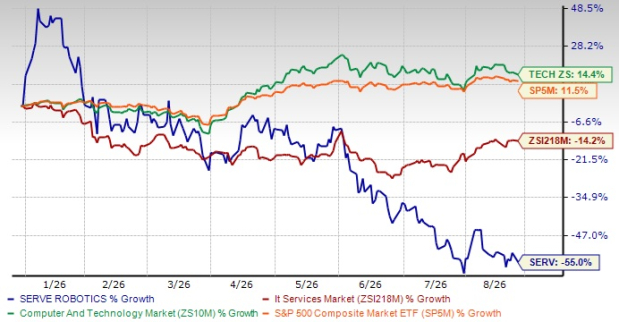
Image Source: Zacks Investment Research
Let us take a closer look at the factors weighing on Serve Robotics’ prospects.
Key Challenges Weighing on SERV Stock
Serve Robotics’ revised 2026 revenue outlook remains a key concern for the stock. The company lowered its revenue guidance to $9-$10 million from $26 million previously, after the delivery volume growth expected in the second half failed to materialize. The change also reflects the decline in delivery volumes during the second quarter, making the revised outlook a more important measure of near-term revenue visibility.
The Uber partnership adds to the uncertainty. Delivery volumes through Uber declined during the second quarter after growing for 17 consecutive quarters. Serve Robotics attributed the change mainly to differences in the operating model and integration between the two companies. The company currently does not expect to renew the agreement after it expires in early 2027 unless the operating model improves. This could put greater importance on other delivery channels and direct merchant opportunities.
Profitability remains another challenge as the company continues to invest in its robotics platform. The company reported a gross loss of about $8.8 million in the second quarter, while non-GAAP operating expenses stood at about $40.4 million. Although Serve Robotics is tightening spending, stronger robot utilization and revenue growth will remain important for improving the financial model.
SERV’s Valuation Trend
SERV stock is currently trading at a premium compared with the industry peers, with a forward 12-month price-to-sales (P/S) ratio of 13.31, as evidenced by the chart below.

Image Source: Zacks Investment Research
EPS Trend of SERV
Serve Robotics’ bottom-line estimates for 2026 and 2027 indicate losses per share of $2.71 and $2.22, respectively, which have widened over the past 30 days. The revised estimated figures for 2026 imply a year-over-year decline of 66.3%, while the same for 2027 indicates growth of 18.2%.

Image Source: Zacks Investment Research
Despite the near-term challenges, Serve Robotics is making progress in broadening its business beyond food delivery. Software and recurring revenues are expanding, while hospital robotics is adding a more stable revenue stream. The company is also seeing traction with other delivery channels, including DoorDash, and is pursuing new partnerships and direct merchant relationships. Continued investments in autonomy, artificial intelligence and fleet capabilities, along with a broader commercial footprint, could create additional opportunities for revenue growth and improve robot utilization over time.
Let us take a closer look at the factors shaping Serve Robotics stock’s prospects.
Diversified Revenue Base Expands Serve Robotics’ Growth Opportunities
Serve Robotics is broadening its revenue base across delivery, advertising and hospital robotics, reducing reliance on a single channel. Software revenues were nearly $1 million in the second quarter, while recurring revenues accounted for more than 50% of total revenues. The healthcare business is also generating contracted, multi-year revenues at attractive margins.
The broader mix is creating multiple monetization opportunities beyond food delivery. Advertising is contributing a meaningful share of robotic food delivery revenues, while hospital robotics adds a recurring revenue stream. This diversification could improve revenue quality and provide greater stability as the company expands its robotics platform.
New Delivery Partnerships Could Improve Fleet Utilization
Serve Robotics is expanding its delivery network through additional marketplace partnerships as it seeks to improve robot utilization. Deliveries through DoorDash grew nearly 50% sequentially in the quarter, while the company expects to announce another major delivery marketplace partner. New commercial programs are also being developed to support denser order allocation and higher utilization.
A broader partner base could reduce reliance on individual delivery platforms and allow the company to deploy its existing fleet across more demand channels. The focus on higher utilization and better unit economics could also improve the value generated from each robot as the network expands.
Merchant Integration Expands Serve Robotics’ Addressable Market
Serve Robotics is working to reduce merchant integration barriers that have limited access to its robotic delivery network. The company is developing Beacon, a standalone device that can connect restaurants directly with Serve Robotics without relying on existing internet or point-of-sale systems.
This could allow the company to work with more restaurants, including merchants that are not connected to third-party delivery platforms. Easier integration could expand direct merchant access and create more opportunities to improve robot utilization across the existing fleet.
Serve Robotics vs. C3.ai, NVIDIA & Symbotic: AI Robotics Race
Although Serve Robotics, C3.ai, Inc. AI, NVIDIA Corporation NVDA and Symbotic Inc. SYM all operate within the automation industry, their business models are very different. C3.ai provides enterprise AI software for commercial and government organizations, while NVIDIA provides AI computing infrastructure and software for AI and robotics applications. Symbotic focuses on large-scale warehouse automation for retailers and distributors. Serve Robotics, on the other hand, is building autonomous robots for last-mile delivery while expanding into healthcare robotics, giving it exposure to multiple real-world service applications.
What sets Serve Robotics apart is that its technology is already operating at commercial scale on public streets. A growing fleet integrated with Uber Eats and DoorDash allows the company to collect real-world operating data, improve autonomous performance and increase fleet utilization over time. This creates advantages that differ from C3.ai's enterprise software business and NVIDIA's broader AI infrastructure position. At the same time, Symbotic holds a stronger position in warehouse automation, supported by a large deployment pipeline, recurring software revenues, a sizable backlog and established customer relationships.
Overall, Serve Robotics stands out as a differentiated player in autonomous delivery with an expanding presence in service robotics. While Symbotic remains the leader in warehouse automation because of its scale and financial strength, Serve Robotics offers more direct exposure to autonomous delivery than C3.ai and NVIDIA through its commercial fleet, strategic partnerships and growing real-world robotics platform.
Should You Hold SERV Stock Amid Near-Term Uncertainty?
Serve Robotics faces several near-term challenges, including the sharp reduction in 2026 revenue guidance, lower delivery volumes and widening losses. The premium valuation and continued earnings losses also limit the near-term upside potential.
At the same time, software and recurring revenues are expanding, while hospital robotics and new delivery partnerships are broadening the business. DoorDash growth and the Beacon device could further improve fleet utilization and expand merchant access. Given the mixed outlook, the Zacks Rank #3 (Hold) appears appropriate as investors await clearer signs of stronger utilization, revenue growth and profitability. You can see the complete list of today’s Zacks #1 Rank (Strong Buy) stocks here.
Radical New Technology Could Hand Investors Huge Gains
Quantum Computing is the next technological revolution, and it could be even more advanced than AI.
While some believed the technology was years away, it is already present and moving fast. Large hyperscalers, such as Microsoft, Google, Amazon, Oracle, and even Meta and Tesla, are scrambling to integrate quantum computing into their infrastructure.
Senior Stock Strategist Kevin Cook reveals 7 carefully selected stocks poised to dominate the quantum computing landscape in his report, Beyond AI: The Quantum Leap in Computing Power.
Kevin was among the early experts who recognized NVIDIA's enormous potential back in 2016. Now, he has keyed in on what could be "the next big thing" in quantum computing supremacy. Today, you have a rare chance to position your portfolio at the forefront of this opportunity.
See Top Quantum Stocks Now >>Want the latest recommendations from Zacks Investment Research? Today, you can download 7 Best Stocks for the Next 30 Days. Click to get this free report
Serve Robotics Inc. (SERV): Free Stock Analysis Report
NVIDIA Corporation (NVDA): Free Stock Analysis Report
C3.ai, Inc. (AI): Free Stock Analysis Report
Symbotic Inc. (SYM): Free Stock Analysis Report
This article originally published on Zacks Investment Research (zacks.com).