RGNX Stock Slumps 25% on FDA Clinical Hold for RGX-121 Gene Therapy
REGENXBIO stock plunges 25% after the FDA places a clinical hold on RGX-121 for MPS II, following asymptomatic spine MRI findings in five participants.
REGENXBIO RGNX stock plunged 24.9% on Monday after the FDA placed a clinical hold on its investigational one-time gene therapy, RGX-121, for the treatment of boys with Mucopolysaccharidosis Type II (MPS II), also known as Hunter syndrome. The action followed the discovery of asymptomatic spine magnetic resonance imaging (MRI) findings in five participants in the phase I/II/III CAMPSIITE study that evaluated the candidate for the MPS II indication.
The findings involved either a small nodule or a small cystic mass identified in spine MRIs of five participants who had received RGX-121 through intracisternal or intraventricular administration approximately three to six years earlier. All five participants were reported to be clinically well, with overall stability to improvement on neurocognitive and neurobehavioral assessments. Investigators considered the findings nonserious, whereas radiologists believed they were likely benign. However, there is currently no clinical or pathological evidence establishing their nature or causation. No brain nodules or masses were identified on any brain MRIs.
The FDA's clinical hold therefore introduces a significant new hurdle for a program that had already faced an earlier regulatory setback.
RGNX's Rocky Ride in the MPS II Gene-Therapy Regulatory Process
REGENXBIO’s latest regulatory setback for the MPS II program follows a complete response letter (CRL) issued by the FDA in February 2026 against the company’s biologics license application (BLA) for RGX-121 seeking accelerated approval in MPS II. The FDA cited uncertainty around the CAMPSIITE study eligibility criteria for distinguishing neuronopathic from attenuated disease, the comparability of the natural-history external control population with the study population and whether cerebrospinal fluid heparan sulfate disaccharide D2S6 was an appropriate surrogate endpoint reasonably likely to predict clinical benefit. The agency outlined potential paths that included a new study, additional patients, longer-term follow-up and an untreated control arm.
Year to date, REGENXBIO shares have plunged 44.1% against the industry’s 11% growth.
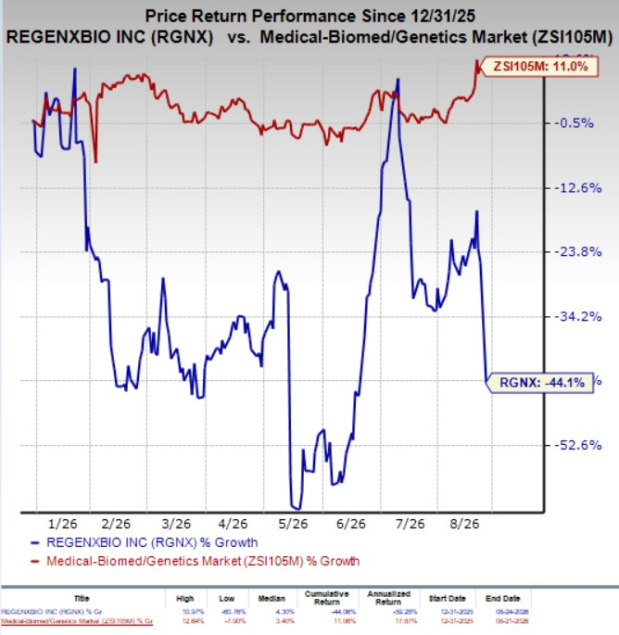
Image Source: Zacks Investment Research
The regulatory outlook improved in June 2026, when FDA discussions indicated that the existing clinical data could support an accelerated approval and that additional enrollment or studies, including an untreated control arm, would not be required for BLA resubmission. A subsequent Type A meeting in July reaffirmed that no additional studies were needed, with REGENXBIO and the FDA aligning on the requirements for BLA resubmission. At the time, RGNX expected to resubmit the BLA in the third quarter of 2026.
That plan has now been materially pushed back. Following the clinical hold, REGENXBIO does not expect to resubmit the RGX-121 BLA in the near term. The company and NS Pharma are evaluating additional patient imaging and longer-term follow-up data and will incorporate FDA feedback, including the full clinical hold letter once received, into the next steps for RGX-121.
Other RGNX Pipeline Opportunities Beyond the MPS II Program
With the outlook for RGX-121 now clouded by the FDA clinical hold, attention is likely to shift toward REGENXBIO’s other pipeline programs. RGX-202, an investigational gene therapy for ambulatory patients aged 1 to 11 years with Duchenne muscular dystrophy (DMD), stands out as a near-term catalyst. In May 2026, the phase III AFFINITY DUCHENNE study of the candidate met its primary endpoint, with 93% of patients achieving microdystrophin expression above 10%. The company also reported a statistically significant correlation between microdystrophin expression and functional improvement, supporting the validity of the surrogate endpoint. Based on these results, REGENXBIO plans to submit a BLA seeking accelerated approval of RGX-202 for the DMD indication in the third quarter of 2026, targeting potential FDA approval in the second half of 2027.
REGENXBIO is also developing ABBV-RGX-314 (sura-vec) in collaboration with AbbVie ABBV for wet age-related macular degeneration (wet AMD). The pivotal ATMOSPHERE and ASCENT studies of the candidate for the above indication have completed enrollment, with top-line results expected in the fourth quarter of 2026 and global regulatory submissions anticipated in 2027. In diabetic retinopathy, sura-vec is being evaluated in the phase IIb/III NAAVIGATE study, which dosed its first patient in June 2026, triggering a $100 million milestone payment from AbbVie, which was received in July. Following an interim analysis of the phase IIb portion of the NAAVIGATE study, REGENXBIO and AbbVie expect to expand the program into phase III, which includes the second part of the U.S. NAAVIGATE study and a parallel global study led by AbbVie.
Another investigational one-time gene therapy candidate, RGX-111, is being developed for MPS I in a phase I/II study. Development of the program was previously paused as part of RGNX’s strategic pipeline prioritization. Efforts to continue development of RGX-111 in collaboration with Nippon Shinyaku are ongoing. However, the FDA placed the program on partial clinical hold in January 2026 after an intraventricular central nervous system tumor was identified in an asymptomatic participant who had been treated with RGX-111 four years earlier.

Zacks Rank and Stocks to Consider
REGENXBIO currently carries a Zacks Rank #3 (Hold).
Some better-ranked stocks in the biotech sector are Amneal Pharmaceuticals AMRX and AC Immune ACIU, each carrying a Zacks Rank #2 (Buy) at present. You can see the complete list of today’s Zacks #1 (Strong Buy) Rank stocks here.
Over the past 60 days, earnings estimates for Amneal Pharmaceuticals have increased from $1 to $1.02 for 2026. Over the same period, earnings estimates increased from $1.12 to $1.21 for 2027. AMRX shares have risen 41.1% year to date.
Amneal Pharmaceuticals beat earnings in each of the trailing four quarters, delivering an average surprise of 32.82%.
Over the past 60 days, estimates for AC Immune’s 2026 loss per share have narrowed from 84 cents to 60 cents. Over the same period, earnings estimates for 2027 remained unchanged at 17 cents. ACIU shares have lost 8.9% year to date.
AC Immune’s earnings beat estimates in each of the trailing four quarters, with the average surprise being 33.25%.
Radical New Technology Could Hand Investors Huge Gains
Quantum Computing is the next technological revolution, and it could be even more advanced than AI.
While some believed the technology was years away, it is already present and moving fast. Large hyperscalers, such as Microsoft, Google, Amazon, Oracle, and even Meta and Tesla, are scrambling to integrate quantum computing into their infrastructure.
Senior Stock Strategist Kevin Cook reveals 7 carefully selected stocks poised to dominate the quantum computing landscape in his report, Beyond AI: The Quantum Leap in Computing Power.
Kevin was among the early experts who recognized NVIDIA's enormous potential back in 2016. Now, he has keyed in on what could be "the next big thing" in quantum computing supremacy. Today, you have a rare chance to position your portfolio at the forefront of this opportunity.
See Top Quantum Stocks Now >>Want the latest recommendations from Zacks Investment Research? Today, you can download 7 Best Stocks for the Next 30 Days. Click to get this free report
REGENXBIO Inc. (RGNX): Free Stock Analysis Report
AbbVie Inc. (ABBV): Free Stock Analysis Report
AC Immune (ACIU): Free Stock Analysis Report
AMNEAL PHARMACEUTICALS, INC. (AMRX): Free Stock Analysis Report
This article originally published on Zacks Investment Research (zacks.com).