IEEE Study Presents a Compact Spectrometer for Optical Coherence Tomography Imaging
The linear-in-wavenumber spectrometer combines a high-dispersion grating with optimized optics to reduce system size and cost
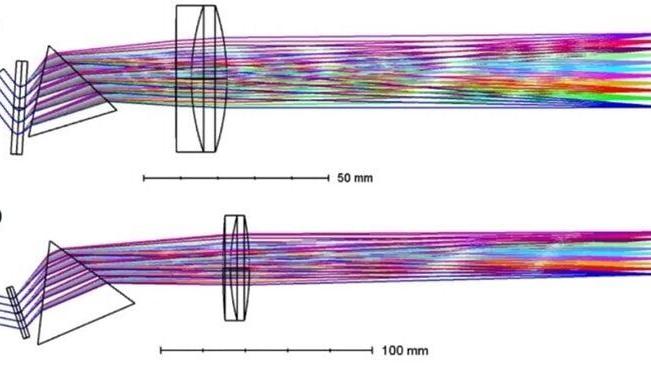
High-dispersion grating enables a smaller OCT spectrometer
The linear-in-wavenumber spectrometer combines a high-dispersion grating with optimized optics to reduce system size and cost
PISCATAWAY, N.J., Sept. 22, 2026 /PRNewswire/ -- Optical Coherence Tomography (OCT) is a non-invasive imaging technique that produces cross-sectional images of biological tissue, such as the retina. It reconstructs the internal structure of tissue by analyzing the interference of light reflected from the sample and a reference beam. A linear-in-wavenumber spectrometer simplifies image reconstruction by directly acquiring the interference spectrum with uniform sampling in the wavenumber domain (k-space), eliminating the interpolation and resampling steps normally required before image reconstruction. However, current designs still require bulky, expensive optical components to achieve greater imaging depth.
In a study published in Volume 32, Issue 4 of the IEEE Journal of Selected Topics in Quantum Electronics on December 31, 2025, researchers led by Associate Professor Xiao Zhang from Beijing Institute of Technology, China, developed a compact, high-linearity linear-in-wavenumber spectrometer for Spectral-Domain OCT (SD-OCT) that employs a 1,800 lines/mm Volume Phase Holographic diffraction grating.
"The stronger dispersion of the higher groove-density grating is the key factor, enabling a more compact optical layout with a focal length of 120 mm, compared to 200 mm for the conventional design," says Dr. Zhang.
In a linear-in-wavenumber spectrometer, a diffraction grating separates light into its different wavelengths, a prism compensates for nonlinear dispersion, and a line camera records the interference spectrum. The stronger dispersion of the 1,800 lines/mm grating enables the same imaging depth with a shorter focal-length lens and smaller optical components, resulting in a more compact and cost-effective design.
The proposed spectrometer achieved a theoretical imaging depth of 4.8 mm over a 76 nm spectral detection range. Compared with a conventional 1,200 lines/mm design, it reduced the optical length from 325 mm to 190 mm and the input beam diameter from 11 mm to 7.2 mm. The design also accounts for lens aberrations to improve the linearity of spectral sampling in the wavenumber domain.
The researchers demonstrated the spectrometer's performance through in vivo imaging of human nailfolds and palm skin, revealing layered tissue structures, sweat glands, and microvessels without requiring interpolation or resampling steps used in conventional SD-OCT systems. Together, these improvements enable a more compact and cost-effective spectrometer for SD-OCT systems used in biomedical imaging.
Reference
Title: A Compact Linear-in-Wavenumber Spectrometer With a 1,800 Lines/mm Grating for 4.8 mm Imaging Depth in SD-OCT
Journal: IEEE Journal of Selected Topics in Quantum Electronics
DOI: https://doi.org/10.1109/JSTQE.2025.3649911
Media contact:
Press Release Source: IEEE Photonics Society
Media Contact First Name: Kristen
Media Contact Last Name: Amoroso
Media Contact Email: 423116@email4pr.com
State of Origin: New Jersey, United States
Telephone: +1(732) 562-6694
 View original content to download multimedia:https://www.prnewswire.com/news-releases/ieee-study-presents-a-compact-spectrometer-for-optical-coherence-tomography-imaging-302885884.html
SOURCE IEEE Photonics Society
