Zambia voters weigh Hichilema's economic record
Zambians flocked to the polls on Thursday for a vote focused on economic hardships in the copper-rich nation, where President Hakainde Hichilema is seeking a second term.

The main opposition candidate is a former minister in the previous government, Brian Mundubile

President Hakainde Hichilema is seeking a second and final term

The government has announced tightened security for voting day

He embraced the youth catchphrase "Salt Sana", or "more salt", urging voters to "add more flavour" by electing him

President Hakainde Hichilema is seeking a second term to govern copper-rich Zambia

More than 70 percent of its population of 22 million lives on less than three US dollars a day

Former government minister Brian Mundubile has emerged as the main opposition presidential candidate

President Hakainde Hichilema is seeking a second term

Official presidential results were expected on Monday

Zambians went to the polls with economic hardships a key factor

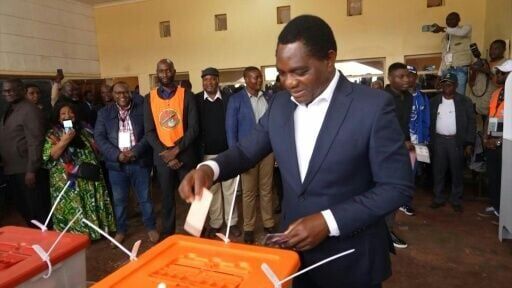
Hichilema has headed the United Party for National Development party since 2006
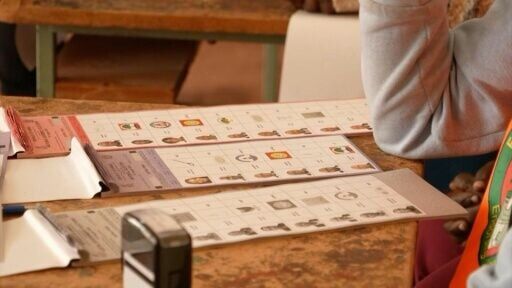
Zambians flocked to the polls on Thursday for a vote focused on economic hardships in the copper-rich nation, where President Hakainde Hichilema is seeking a second term.
Most polling stations closed as scheduled at 6:00 pm (1600 GMT), with counting expected to begin the same night and results in the presidential vote due by Monday.
"I voted to feel good, to feel like I took part in selecting the best for this country," said 29-year-old Mary Banda, among the last to vote in central Lusaka.
"At the end of the day, these politicians are all the same and promise big things but never deliver," the unemployed chemist told AFP.
As polling stations closed, electoral officials said voters still in line or at venues that opened late would still be allowed to cast their ballots.
The election was a test of Hichilema's first five years in office, during which the economy returned to growth that critics say has yet to translate into better living standards for ordinary households.
His government also faces charges of narrowing the space for dissent, with claims that opposition figures were detained before voting day.
"After doing the heavy lifting, such as debt restructure, restoring the mining sector, now we want a step change in the growth so that we can take care of society," Hichilema, 64, said after casting his ballot.
"We have embarked on reforms that have delivered results even under challenges such as drought, debt burden," he said. "There is a lot more to be done."
- Continuity -
Africa's second-largest copper producer, Zambia defaulted on its sovereign debt in 2020.
Since then, the government has secured a debt restructuring, completed an IMF-supported programme and set an ambitious 2031 target to triple production of copper, crucial to the green-energy transition.
While inflation fell to 6.8 percent in April and the kwacha currency has strengthened, many face high food and energy costs, and unemployment stands at around 10 percent.
More than 70 percent of Zambia's 22 million people live on less than three dollars a day, according to World Bank data.
"For me it was about the continuity of what is currently happening. I am very pleased with the current president," 36-year-old secondary school teacher Bwalya Chanda told AFP, citing Hichilema's free education policy.
- 'Divided nation' -
The president's main challenger in a field of 13 other hopefuls is Brian Mundubile, a 55-year-old former minister in the previous Patriotic Front (PF) government.
He entered the race in May, injecting uncertainty into a contest that had appeared to be Hichilema's to lose.
"It's the start of a new beginning for Zambia, a beginning of a free Zambia, a united Zambia," he said after voting.
"I expect to win this election," he said. "The people of Zambia are ready for change."
Backed by an alliance of opposition parties, Mundubile is running under the newly formed NRPUP which draws much of its political base from the PF.
In an interview with AFP on Wednesday, he described Zambia as deeply divided and alleged the government had restricted his party's campaigning.
In a statement days before the vote, Amnesty said the authorities "have intensified their crackdown on the rights to freedom of peaceful assembly, association, expression and media freedom".
The government announced Wednesday the arrests of several people, including three former senior government officials, over an alleged plot to interfere with the electoral system.
The Zambia Human Rights Commission said the same day it was concerned about reports of the detention of political candidates, opposition supporters and journalists.
- 'Predictable leader' -
Some 8.7 million voters were registered to vote, with turnout in the last election in 2021 at 70 percent.
They are also electing 226 seats in parliament, which is being expanded from the previous 156.
Voters are likely to stick with the stability of Hichilema, said Patience Mususa, senior researcher at the Nordic Africa Institute.
"Despite criticism of his slow progress in addressing government inefficiencies and corruption, and concerns about his prioritisation of corporate interests, he is seen as a more predictable leader," she said.
ho/br/jc/jj