Trees 'giving up': climate change hammers historic English gardens
At Hampton Court Palace, head gardener Graham Dillamore strode across the burnt beige grass in the spectacular formal gardens southwest of London, laid out in the 17th century.

Britain's record summer heatwave has burnt the grass at Hampton Court Palace
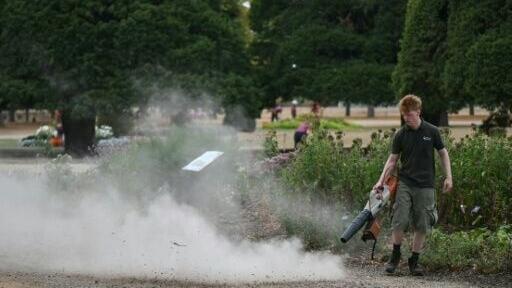
Gardeners at the historic site are worried about the long-term effects of hotter summers
At Hampton Court Palace, head gardener Graham Dillamore strode across the burnt beige grass in the spectacular formal gardens southwest of London, laid out in the 17th century.
"If we have a summer like this next year, by God, it's going to be a struggle," said Dillamore, who has spent more than 20 years tending the gardens of the Baroque and Tudor red-brick palace where King Henry VIII once caroused.
Created by master designers such as Lancelot "Capability" Brown and William Kent, the gardens of stately homes such as Hampton Court, Blenheim Palace, and Chatsworth House are among England's top visitor attractions.
But their historic style of planting and ancient trees are being hammered by climate change -- including record heatwaves and drought this summer.
Gardeners told AFP they were not embarrassed by straw-like lawns -- feeling visitors, also facing water restrictions, are understanding -- but the concern is for the long-term consequences and keeping the spirit of their gardens alive.
Mature trees that take decades to establish are drooping, and some have leaves turning brown in August in a stress reaction to excessive heat.
"Some of these trees have actually given up. They're not going to come back, they're finished," said Dillamore, who also oversees gardens at Kensington Palace, the official London residence of Prince William and his wife, Catherine.
"We're losing mature tree stock and that's tragic in a historic garden."
"We've already lost trees," said Rosie Fyles, head of gardens at Chiswick House in west London, whose Kent-designed shady lawns dotted with statues and cedars of Lebanon date back to the 18th century.
Suffering most are trees "we really associate with an English garden or an English landscape", she said: oaks, sycamores, birch, limes.
"I think there's only so much stress they can withstand," said the gardener, who tends 1,800 trees.
It is not practicable to water mature trees, gardeners explained.
At Chiswick, staff were watering drooping camellias and lilacs, shrubs that normally thrive in sun.
The garden has boosted its capacity to harvest rainwater, but its stocks ran out several months ago.
"There's only so much we can intervene and control," said Fyles, admitting this was hard to accept as a professional gardener.
"It's sobering. It means that we're having to think about what we plant going forward, what trees will be sustainable going forward in the future climate."
"I get the feeling we're in uncharted territory," said Dillamore.
"I've never felt so uncertain about the future in historic gardens and landscapes as I do now."
- 'On the front line' -
Staff at historic gardens surveyed by the National Lottery Heritage Fund earlier this year all said climate change was having an impact -- not just drought, but also heavy storms and excessive rain in winter that spawns fungus and bugs.
Historic gardens are "really on the front line of climate change", said Drew Bennellick, the Heritage Fund's head of lands, seas and nature policy, and "the changes are happening actually quite quickly now".
"We've seen sites that lost 80 percent of their tree cover," he told AFP.
Climate modelling by researchers at the Royal Botanic Gardens at Kew, a UNESCO World Heritage site, predicted that by 2090, 50 percent of their trees will be at risk of death.
Historic gardens "must be protected and preserved", said Dillamore.
"But they've also got to change over the next few years -- otherwise we're going to lose them."
And this calls for "some very, very difficult decisions", he admitted.
Some are shifting to Mediterranean plants, Bennellick said, "more grasses, more herbaceous perennials that can survive the drought conditions".
At Hampton Court, Dillamore pointed to vibrant pink flowers with bright green foliage.
Garden designer Ann-Marie Powell created test beds of long-lived plants happy in high temperatures, including Siskiyou Pink plants, native to the southern United States.
Planted in April, they look vigorous despite no automatic irrigation, as do other flowers such as daisy-like echinaceas from US prairies.
Dillamore said he was happy with the result.
Hampton Court and Chiswick have also stopped digging over flowerbeds and relaxed about weeds.
The Royal Horticultural Society gardening charity announced this month it is considering moving some of its heat-stressed hydrangea collection from Surrey, southwest of London, to other regions of England.
"The gardens tell the story of Hampton Court just as much as the palace, so I can't pack this garden up and move it," said Dillamore.
"We've got to retain that feel, the spirit of the place."
am/jkb/jhb