Indonesia's main airport suspends operations after volcanic eruption
More than 150,000 passengers were left stranded on Sunday as Indonesia shuttered its main international airport and seven others, cancelling hundreds of flights after Mount Anak Krakatoa spewed a plume of volcanic ash and lava from more than 150 kilometres away.
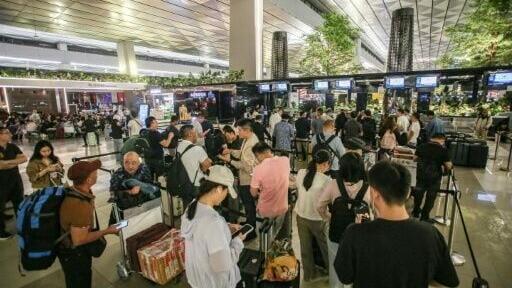
Indonesia halted operations at its main international airport outside Jakarta after ash spewed from the Anak Krakatoa
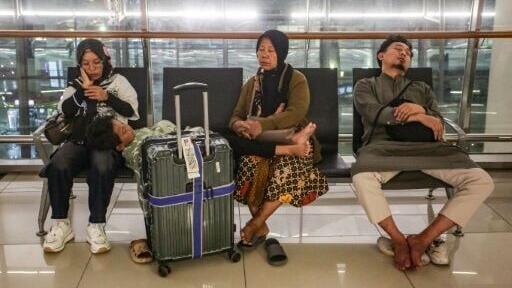
The suspension was later extended by four hours "due to increased eruptive activity", the airport said on social media
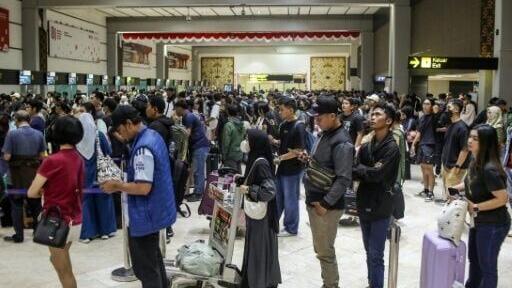
More than 22,000 passengers have been impacted by the suspension
More than 150,000 passengers were left stranded on Sunday as Indonesia shuttered its main international airport and seven others, cancelling hundreds of flights after Mount Anak Krakatoa spewed a plume of volcanic ash and lava from more than 150 kilometres away.
Mount Anak Krakatoa erupted on Saturday, producing a fountain of lava and booming sounds that could be heard up to a few hundred kilometres away, the geology agency said in a statement.
Two new eruptions were recorded on Sunday, the volcanology agency warned.
Ash from the volcano was detected in the airspace surrounding Soekarno-Hatta International Airport, prompting authorities to initially suspend operations from 1:30 am on Sunday (Saturday 1830 GMT) to 5:30 am.
The suspension was extended several times, with the latest set to end at 9:30 pm on Sunday, the local airport authority said in a social media post.
Operations have also been suspended at seven other airports including the Husein Sastranegara airport in Bandung and Radin Inten II airport near Bandar Lampung on Sumatra, the transportation ministry said in a statement.
"From the closures, it is known that more than 150,000 passengers were stranded, with 467 flights affected, consisting of 58 international flights and 409 domestic flights," the ministry said.
Several airports in cities including Semarang and Surabaya have been prepared as "alternatives for landing," Transportation Minister Dudy Purwagandhi said.
- Passengers scrambling -
The disruption left some passengers scrambling to find alternative flights.
Henny Yensan, 44, who had hoped to go back to her hometown with her mother, said "everybody was disappointed".
"No one flew into a rage because after all, this is due to natural disaster," the businesswoman who had to reschedule her flight to Tuesday, told AFP.
Samuel Guiberteau, a Danone executive on a business trip to Lombok since Friday, said "nothing is certain for the moment", as he searched for alternative flights back to the capital.
"I had found another flight on Citilink, but it was also cancelled," the 47-year-old told AFP by phone, adding that he had no alternative but to stay in Lombok for the time being.
Volcanic ash had also reached the city of Bandar Lampung in the southern tip of Sumatra, blanketing parked cars and roadsides.
"I'm worried it could seriously affect the lungs and cause a lung infection," Andre Bayu Saputra, 25, told AFP on Sunday.
Schools across Jakarta will be closed on Monday as classes will move online, the city said in a statement, without specifying how long the measure will be in place.
- Hazard warning -
Anak Krakatoa, which means Child of Krakatoa, sits in a strait that separates the islands of Java and Sumatra.
Ships passing through the strait were asked to increase vigilance for possible disruption to navigation safety due to volcanic activities.
Vessels are prohibited from approaching an exclusion zone of three kilometres radius from the volcano, local port authorities said in a statement.
The volcano has been sporadically active since it emerged from the sea at the beginning of last century in the caldera that formed after the 1883 eruption of Mount Krakatoa.
That disaster was one of the deadliest and most destructive in history with an estimated 35,000 people killed.
Geology agency head Lana Saria said "seismic activity indicates the movement or release of volcanic fluids within the volcanic system".
"However, the timing, magnitude, and nature of the next eruption cannot be precisely predicted," Lana added.
Lana warned against approaching Anak Krakatoa, saying materials ejected from the volcano could endanger those within the exclusion zone.
She said the most recent series of eruptions do not have the potential to trigger a tsunami at this time.
A 2018 tsunami triggered by a collapse of parts of Anak Krakatoa killed 429 people and left thousands displaced.
Indonesia, a Southeast Asian archipelago nation, sits on the Pacific Ring of Fire, where the meeting of continental plates causes high volcanic and seismic activity.
mrc-ebe/lga