In wildfire town, PM says UK must 'face up to climate change'
Prime Minister Andy Burnham said Friday that Britain must face up to the changing climate and accelerate its move to clean energy as he visited a town where a wildfire gutted homes.

Britain's Prime Minister Andy Burnham and West Midlands Mayor Richard Parker meet firefighters and staff members of the West Midlands Fire Service, dealing with wildfires in the area
Three firefighters were hospitalised fighting that blaze southwest of Birmingham

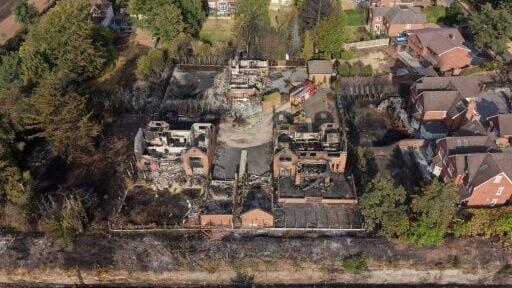
UK firefighters douse the smoldering ruins of a fire-damaged house, outside the central town of Stourbridge
Prime Minister Andy Burnham said Friday that Britain must face up to the changing climate and accelerate its move to clean energy as he visited a town where a wildfire gutted homes.
In Stourbridge near the UK's second largest city of Birmingham, smoke rose from smouldering ruins of several roofless houses as firefighters sprayed water on the wreckage Friday.
The West Midlands Fire Service said 19 houses were completely destroyed and 18 others damaged in the town.
Meeting firefighters there after viewing the scene, Burnham said the "combustible situation" was related to climate change and showed the need for a more rapid clean energy transition.
"I've never seen scenes like this in Britain, where you just see a whole house gutted, smouldering," he said.
"We have to face up to the changing climate ... there's no point denying where we are. We need to face up to it. We need more clean energy."
Burnham -- who took power last month -- has faced some criticism for not directly referencing climate change sooner, as Britain has grappled for weeks with widespread drought, extreme heat and wildfires.
- 'Tinderbox' -
The UK has set a target to consume zero-carbon electricity by 2030 and is aiming to reach net-zero greenhouse gas emissions by 2050 to combat climate change.
Describing Britain as "a tinderbox" with 37 blazes nationwide on Friday, the prime minister warned against lighting fires outdoors, as the government introduced a ban on selling disposable barbecue equipment.
People across England and Wales began receiving a rare emergency alert on their phones from 7:00 pm (1800 GMT) warning them not to light "anything that could spark a fire, including barbecues, campfires, and fireworks".
Residents of Stourbridge were evacuated and some were treated for smoke inhalation after the fire there spread Thursday, the UK's hottest day of the year so far.
One firefighter was hospitalised and five others suffered minor injuries, the fire service confirmed, with crews continuing to extinguish "hotspots" in open grassland, along a railway and in gardens.
Six other firefighters farther north in Staffordshire were taken to hospital suffering from smoke inhalation and heat exhaustion battling similar blazes there, the fire service said.
The ambulance service in the West Midlands region, including Stourbridge and Staffordshire, said it had treated 68 people Thursday with symptoms such as smoke inhalation, 25 of whom were hospitalised.
- 'Extensive devastation' -
Emergency services said some of the blazes around Stourbridge were set deliberately in grasslands before spreading.
"This has been one of the most significant incidents that West Midlands Fire Service has ever attended," chief fire officer Simon Tuhill told a press conference late Thursday.
He blamed the rapid spread on "tinder dry" conditions and said the "devastation is extensive".
So far this summer, firefighters have mainly battled wildfires in rural areas and moorland across the country.
Burnham promised to convene a summit with fire services, acknowledging the government had not supplied enough resources to deal with wildfires.
And he revealed plans to commission firefighting planes, of the types used to douse flames in Europe and the United States.
"Firefighters have been on the front line of climate change for a number of years," Phil Garrigan, of the National Fire Chiefs Council, told BBC Radio.
"They're doing their absolute best to protect communities and properties."
The Council has warned investment was falling short and urged the government to boost support, noting "the risk is growing faster than our collective capacity to respond".
"Climate change, prolonged periods of extreme heat and changing land use are creating more frequent, larger and more complex wildfires," it said.
bur-jj/rmb