The True Cost of Renting in America’s Most Student-Driven Markets
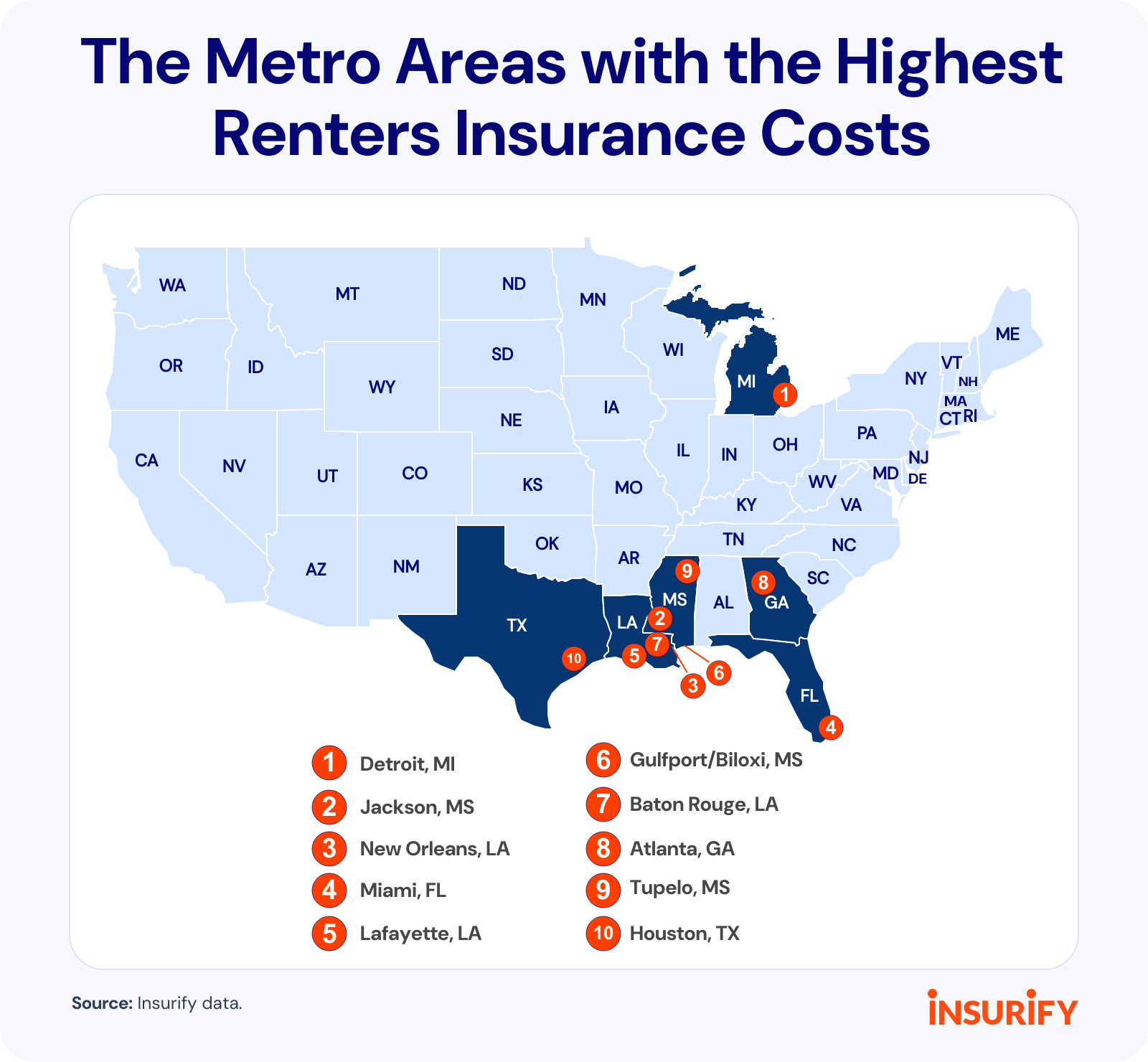
The metro areas with the highest renters insurance premiums are largely in Southern and Gulf states, with higher claims risk from severe weather, Insurify’s report found.
In many so-called “college towns,” students contribute significantly to a city’s culture and feel, taking over parks and filling downtown cafes on weekends. But their presence also usually shows up in the local rental market, as increased housing demand drives up rents.
An Insurify analysis of U.S. Census Bureau housing and college enrollment data found that college students affect rental markets in some metropolitan areas more than others. And, while that increased seasonal demand does influence housing affordability, it doesn’t cause sky-high rents across the board. The cost of living remains a major factor in housing prices.
Renters insurance represents a relatively small part of the total cost of renting, with a national average of $23 per month, or $277 per year, according to Insurify data. But it provides important protections, especially for college students who may struggle financially to replace expensive belongings they need for school, like a laptop or electric scooter. Renters can customize limits for personal property, liability, and loss of use coverage, creating a policy that offers just the protection they need should the worst happen.
To assess college students’ effect on metro area housing, Insurify created a weighted Student Market Impact Score based on five factors: the number of college students per 100 renter households, the college student share of the population, the number of enrolled college students, the total renter share of occupied units, and the multifamily share of renter-occupied housing. A higher score indicates that students have a greater influence on the local rental market.
Key findings
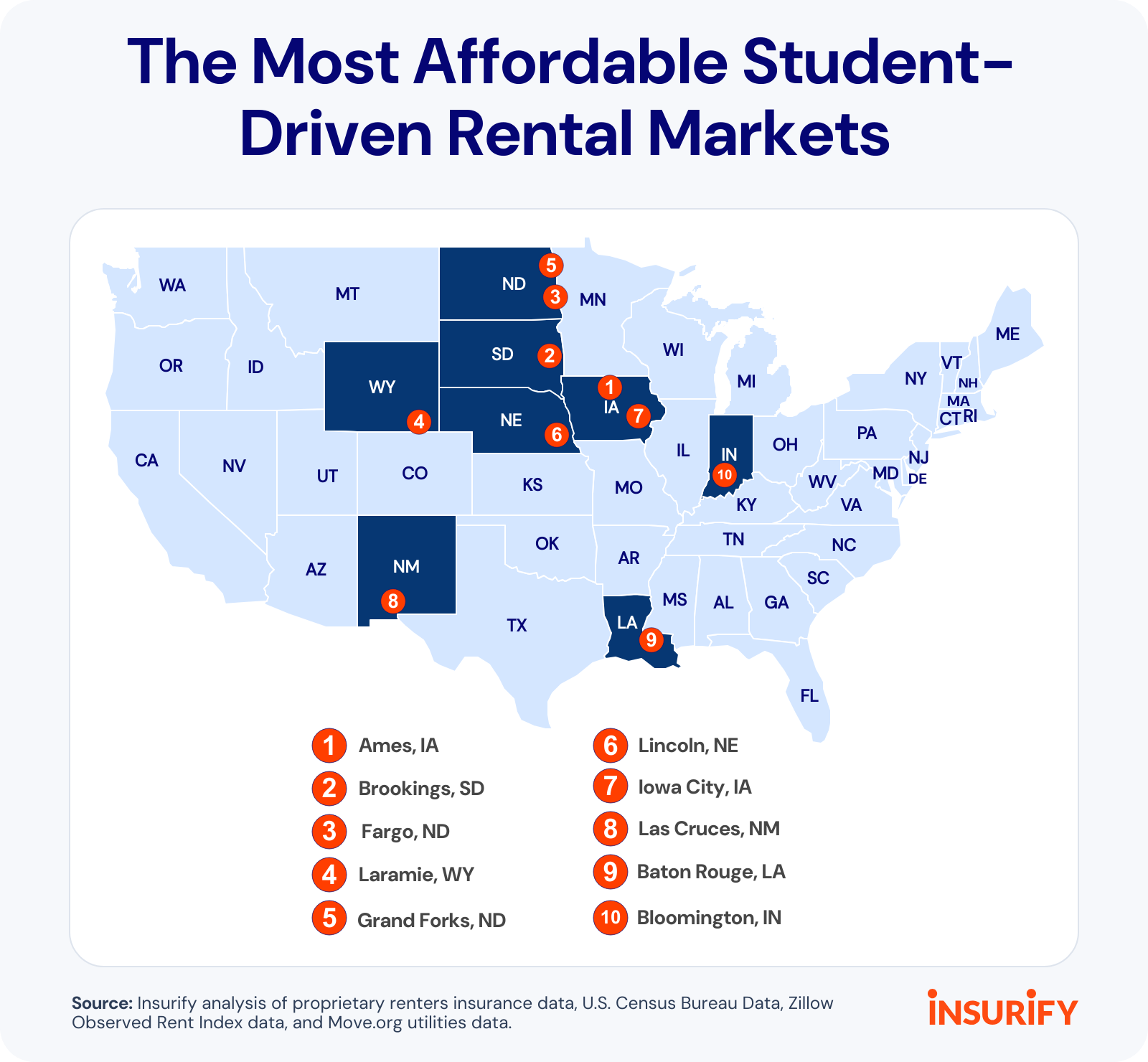
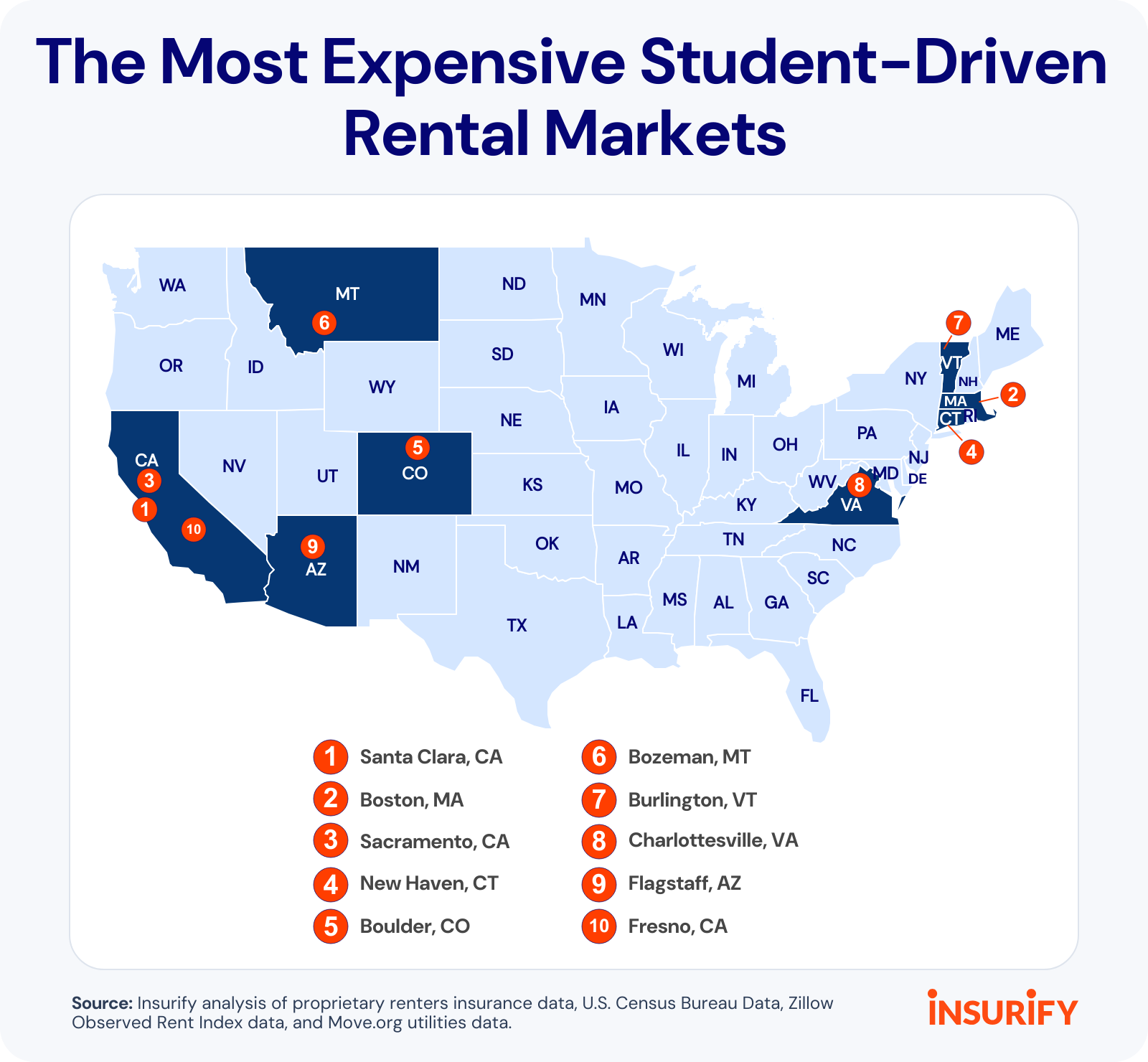
Ames, Iowa; Brookings, South Dakota; and Fargo, North Dakota, are the most affordable student-driven rental markets, according to Insurify’s analysis. Santa Clara, California; Boston, Massachusetts; and Sacramento, California are the most expensive.
The cheapest student-driven markets for renters are largely in the Midwest, while metros in California, Massachusetts, Connecticut, and Colorado count among the most expensive.
Detroit, Michigan, is the most expensive city for renters insurance, at more than $68 per month for coverage, according to Insurify data. It’s the only metro area among the 10 most expensive not in the Southern U.S.
In Laramie, Wyoming, home to the University of Wyoming and the Wyoming Technical Institute, college students make up nearly 28% of the metro area’s population over the age of 3, according to the 2024 American Community Survey 5-Year Estimates.
The most affordable student-driven rental markets
The average cost of renting in the U.S. is $2,266 per month, including rent, standard utilities, and renters insurance, according to Insurify’s analysis. Although student housing demand influences the rental market, these metro areas have lower-than-average rent costs. Among the 10 most affordable student-driven rental markets, the average total cost of renting is $1,552 per month.
The three metro areas with the highest Student Market Impact scores — Ames, Iowa; Bloomington, Indiana; and Iowa City, Iowa — are among the 10 most affordable student-driven rental markets. Students may have a significant influence on rent costs in these smaller markets, indicating that housing prices may be even lower without the market pressure from student renters.
1. Ames, Iowa
Average monthly total cost of renting per housing unit: $1,303
Student Market Impact Score: 85.4/100
Average annual renters insurance premium: $253
Largest local college or university: Iowa State University
Iowa State University is the dominant source of rental demand in Ames. College students make up 24.3% of the metro area’s population age 3 and older, according to 2024 American Community Survey data. And 39.1% of all occupied housing units are renter-occupied.
Rental costs in Ames are lower than in Iowa’s bigger cities like Iowa City and Cedar Rapids, and the state’s cost of living index is among the lowest in the country, according to the Missouri Economic Research and Information Center (MERIC).[1] Still, the city’s 2024–2025 annual report shows that increasing housing supply and creating affordable housing are municipal priorities.[2]
Ames’ renters insurance costs are a little below the national average, according to Insurify data. The metro’s theft rate is low, which could help reduce costs.
2. Brookings, South Dakota
Average monthly total cost of renting per housing unit: $1,413
Student Market Impact Score: 80.0/100
Average annual renters insurance premium: $191
Largest local college or university: South Dakota State University
Home to South Dakota State University, Brookings is a small city with a large student population. College students account for 21.9% of the population age 3 and older. It’s also a city of renters. Nearly half (42.8%) of its occupied housing units are renter-occupied, and its relatively low rental costs reflect a lower cost of living.
But Brookings has long been aware of, and working to address, the increasing need for affordable housing. In its final report in 2017, the Brookings Affordable Housing Task Force noted students’ influence on housing, especially how their tolerance for spending “a disproportionately higher amount of their income on housing while pursuing a degree” can affect the market.[3]
3. Fargo, North Dakota
Average monthly total cost of renting per housing unit: $1,423
Student Market Impact Score: 71.4/100
Average annual renters insurance premium: $205
Largest local college or university: North Dakota State University (Main Campus)
Fargo’s housing market is diverse enough that its student population has a less pronounced influence on rentals, as shown by the metro area’s 71.4 Student Market Presence Score, the lowest among the top five. Healthcare professionals and students drive demand, which sustains rental costs.
Renters make up a particularly high share of multifamily units: 85.2% of Fargo’s multifamily units are renter-occupied, the third-highest share after the Boston and New York City metro areas, according to the 2024 American Community Survey. Overall, 44.7% of all occupied housing units are renter-occupied, and renting is especially common near the university campus.[4]
Fargo’s low cost of living keeps rents relatively low, and its moderate theft and severe weather risk may contribute to its below-average renters insurance costs.
4. Laramie, Wyoming
Average monthly total cost of renting per housing unit: $1,467
Student Market Impact Score: 81.3/100
Average annual renters insurance premium: $186
Largest local college or university: University of Wyoming
Laramie is a renter- and student-dominated city. Renters inhabit 50% of all occupied housing units. Among the metro areas Insurify analyzed, Laramie has the highest share of college students, at 27.8% of the population age 3 and older, according to 2024 American Community Survey data. But the university may be taking steps to reduce student influence on the housing market. In 2025, the University of Wyoming completed its first residence hall project in nearly 60 years, adding more than 900 beds.[5]
Laramie is also one of the cheapest cities in the country for renters insurance, according to Insurify data. The county faces few climate risks that can increase the likelihood that a renter will file a claim, which may contribute to its lower premiums.
5. Grand Forks, North Dakota
Average monthly total cost of renting per housing unit: $1,477
Student Market Impact Score: 76.4/100
Average annual renters insurance premium: $191
Largest local college or university: University of North Dakota
Like Fargo, Grand Forks is a college town with a more diverse housing demand than Ames or Laramie. For example, while it’s a renter-heavy metro area, with renters in 42.7% of all occupied units, college students make up 14.1% of the population age 3 and older, according to the 2024 American Community Survey. So, while students may influence costs in university-adjacent neighborhoods, varied demand and a low cost of living keep rents down.
Further reducing housing costs, Grand Forks is among the least expensive cities for renters insurance. The comparative savings may reflect the metro area’s moderate theft rate and the county’s relatively low severe weather risk index, according to the Federal Emergency Management Agency (FEMA).
Metros in Nebraska, New Mexico, Louisiana, and Indiana also rank high for affordability
Several other college-town markets pair comparatively low rent costs with strong student housing demand.
For example, Bloomington’s affordable housing strategy mentions how a “large and growing student population affects housing costs and availability, particularly with rental prices among the highest in the state and pressures on owner-occupied housing neighborhoods.”[6] That growing student population has made it challenging to “provide a range of housing options for non-students, especially those at low and moderate income levels.”
A 2020 housing study found Bloomington would need to add 2,592 non-student housing options by 2030 to accommodate projected population growth.[7] And, for Fall 2025, Indiana University’s Bloomington campus welcomed a record number of students.[8]
The most expensive student-driven rental markets
Metro areas in states with a higher cost of living, like California, Massachusetts, and Connecticut, rank among the 10 most expensive student-driven rental markets, according to Insurify’s analysis. The average cost of renting among the top 10 is $2,722 per month
Boulder, Colorado, and Flagstaff, Arizona, have the highest Student Market Impact Scores among the top 10. In larger metro areas, even a significant student presence may have less influence on rental costs, given other market factors. Across the top five, strong student demand, limited housing availability and production, and competition from higher-income professionals drive up rental costs.
1. Santa Clara, California
Average monthly total cost of renting per housing unit: $3,945
Student Market Impact Score: 76.1/100
Average annual renters insurance premium: $230
Largest local college or university: San Jose State University
Student demand is just one part of the cost equation in the Santa Clara and San Jose metropolitan area. Around 20 local colleges and universities attract tens of thousands of students to the area each year. But students make up just 8.4% of the population age 3 and older, so they’re far from the only reason rents are high.
Besides the fact that California ranks third-highest for cost of living, according to MERIC, Silicon Valley is a particularly expensive area. All the high-paying technology jobs create intense housing competition among high-income earners. Housing costs and availability are already creating displacement pressures, according to Santa Clara’s 2023–2031 Housing Element.[9]
2. Boston, Massachusetts
Average monthly total cost of renting per housing unit: $3,579
Student Market Impact Score: 76.7/100
Average annual renters insurance premium: $261
Largest local college or university: Boston University
The Boston metro area, which includes Cambridge and other parts of eastern Massachusetts and southern New Hampshire, is home to dozens of colleges and universities. More than 39,000 students, about half undergraduates and half grad students, live in just the city of Boston, according to Boston’s 2024 Student Housing Report.[10]
The metro area’s strong biotech, finance, and healthcare industries also bring high-income earners to an already competitive, supply-constrained urban market. That demand drives up costs for families and lower-income earners. For example, 86.7% of multifamily units are renter-occupied, according to 2024 American Community Survey data.
3. Sacramento, California
Average monthly total cost of renting per housing unit: $2,601
Student Market Impact Score: 75.3/100
Average annual renters insurance premium: $266
Largest local college or university: University of California - Davis
Housing demand in Sacramento, like in many parts of California, continues to outpace supply, creating a housing crisis and driving unaffordability, according to the city of Sacramento’s 2021–2029 Housing Element.[11] Sacramento State’s record enrollment for Fall 2025 shows the school may be contributing to a growing rental base in the city.[12] But in the broader metro area, employment in government, healthcare, and agriculture, as well as research opportunities at UC Davis, drives housing demand.
The metro’s near-average renters insurance costs may be due to its moderate theft rates and the county’s higher risk of severe disaster events, such as earthquakes and inland flooding.
4. New Haven, Connecticut
Average monthly total cost of renting per housing unit: $2,548
Student Market Impact Score: 75.1/100
Average annual renters insurance premium: $256
Largest local college or university: Yale University
Yale University is New Haven’s largest employer, so its students and staff drive housing demand throughout the city.[13] For example, while the university runs Yale-owned off-campus housing, it also operates an off-campus housing marketplace for students, underscoring the university’s reliance on local housing stock.
New Haven’s higher rents reflect competition for housing between students and healthcare workers at local facilities, as well as the costs of the coastal market. Though its renters insurance rates are below average, the New Haven area has a high FEMA risk index for coastal flooding and hurricane damage, which may influence costs.
5. Boulder, Colorado
Average monthly total cost of renting per housing unit: $2,517
Student Market Impact Score: 80.1/100
Average annual renters insurance premium: $228
Largest local college or university: University of Colorado Boulder
Students are a major cohort in Boulder: 13.7% of the population age 3 and older are enrolled in a local college or university, according to 2024 American Community Survey data. And renters live in 38% of occupied housing throughout the city.
Students and university staff, aerospace and technology workers, and people attracted by nearby amenities drive housing competition in Boulder, contributing to higher rents.[14] Like Yale, CU Boulder also maintains a site for off-campus housing listings to support students, again showing how university housing needs affect the local rental market.
Metros in Montana, Vermont, Virginia, and Arizona also rank among the most expensive college towns for renters
Coastal metros aren’t the only places with expensive, student-driven rental markets. Cities in Montana, Vermont, Virginia, and Arizona also made the top 10 list. For example, Montana State University students and staff significantly affect the rental market in Bozeman, where broader economic growth is also reinforcing housing demand, Insurify’s analysis found.
Bozeman is a growing job and lifestyle destination for its strong healthcare, technology, retail, and tourism industries, as well as its proximity to Yellowstone National Park and various Rocky Mountain attractions. Montana State University is also a major employer and hit record highs in enrollment and research spending in 2025.[15] [16] To bring down costs and create more affordable housing, the city has been focusing on residential development and rezoning to accommodate growth.[17]
The metros with the highest renters insurance premiums
Several factors affect the cost of renters insurance, typically severe weather risk and theft risk. Detroit, Michigan, is the most expensive metro area for renters insurance, but the rest of the top 10 most expensive metros are in the Gulf states, Insurify’s analysis found.
Detroit’s high larceny rate likely contributes to its high renters insurance costs. It ranks third-highest among U.S. cities for larceny, according to a 2024 Citizens Research Council of Michigan report.[18] And, while building age and condition typically don’t affect renters insurance costs, Detroit’s aging housing stock and infrastructure, coupled with its climate risks, may drive up premiums.
Detroit’s housing stock is exceptionally old: 86% of residential structures predate 1970, and just 1% date from 2010 or later, according to the Detroit Housing and Revitalization Department.[19] The county also has very high risk indices for cold waves, ice storms, lightning, strong winds, and tornadoes, according to FEMA. Frozen pipes and electrical fires can lead to extremely costly damage and loss-of-use claims.
In the Southeast, hurricanes, hailstorms, and windstorms can lead to expensive claims, from a broken window letting in rain and causing water damage to building damage that displaces tenants for a month. In Jackson, Mississippi, for example, very high weather risks of hail, ice storms, and strong winds could increase claims risk for renters insurance.
The metro areas with the cheapest renters insurance costs
Three of the five cheapest metro areas for renters insurance are in Wyoming, according to Insurify’s analysis. Though all three are in counties facing lower severe weather risks than the most expensive metro areas, insurer territory and state-level loss experience may influence costs more than crime or weather in some regions. Wyoming is a relatively affordable market for home and auto insurance, too, with premiums well below national averages for both, according to Insurify data.
In Virginia, a dense, affluent market in Arlington may create a different renters insurance claim profile. Moderate to lower theft rates could also contribute to the low renters insurance costs.
Tips: How to choose the right renters insurance policy
Renters insurance premiums vary by state and city, but in many parts of the U.S., premiums represent a relatively small proportion of the total cost of renting, according to Insurify’s analysis. But in terms of the protection it offers, renters insurance punches above its weight.
To get the right protection, college students and renters can start by estimating the value of replacing their belongings, which is how they’ll determine how much personal property coverage they need. It’s generally a good rule of thumb to have enough to replace at least the important, big-ticket items, but the smaller stuff can add up, too.
Liability coverage usually starts at a $100,000 limit, but increasing the limit to $300,000 adds extra safety for renters concerned about accidental injury or property damage in their unit. For loss of use coverage, consider how expensive it could be to live elsewhere for a few months if the apartment needed repairs to be habitable. For example, in many college towns, where competition has driven prices a little higher, $10,000 is likely a reasonable limit for loss of use coverage.
Once renters determine their ideal coverage limits, they can get to shopping around for the right policy. Getting quotes from multiple insurers helps maximize savings, and using an online comparison site like Insurify can make the process a lot faster than visiting each insurer’s website. Renters who also drive a car could secure extra savings by bundling policies or seeking out other discounts.
Methodology
Insurify data scientists analyzed thousands of quotes from more than a dozen national renters insurance companies. Rates span all 50 states and Washington, D.C., and quote averages represent the median price for a given coverage level and geographic area. Unless otherwise specified, quoted rates reflect the median cost for 35-year-old tenants with no prior claims, no pets, and an apartment in a low-rise building with 5 or more units, equipped with standard safety features like smoke detectors and deadbolts.
Renters insurance rates represent the average cost of a policy with the following coverage limits: $30,000 in personal property, $100,000 in liability, $6,000 in loss of use, and a $500 deductible. Though renters insurance is often bundled with pet or car insurance, the rates in this article don’t reflect a bundled premium cost.
To determine the total cost of renting by metro area, Insurify used two other data sources. For rental values per housing unit, analysts used the Zillow Observed Rent Index (ZORI) Smoothed All Homes Plus Multifamily Time Series dataset by metros (or, where unavailable, by county). Insurify used data from the “Breakdown of average utility costs by state” table on Move.org’s analysis of utility bills. For this article, Insurify used only the sum of electricity, gas, and internet bills to reflect renters’ basic utility costs.
To create the Student Market Impact Score, Insurify analyzed three datasets for “All Metropolitan/Micropolitan Statistical Areas” from the 2024 American Community Survey 5-Year Estimates:
B14007: School Enrollment by Detailed Level of School for the Population 3 Years and Over
B25003: Tenure
B25032: Tenure by Units in Structure
From this, Insurify calculated five data points, converted them to a percentile, and applied weights to get a final score. Those data points are (weights in parentheses):
College students per 100 renter households (60%)
College student share of population age 3 and older (10%)
Total undergraduate and graduate college or university enrollment (15%)
Renter share of all occupied housing units (10%)
Multifamily share of renter-occupied housing (5%)
Insurify filtered out any metro areas with a Student Market Impact Score below 70 and then ranked by rental costs to determine affordability.
Insurify analyzed Fall 2023 enrollment data from the Integrated Postsecondary Education Data System, part of the National Center for Education Statistics, to determine the largest college or university in each metropolitan area.