KKR vs. T. Rowe Price: Which Asset Manager Stock Has More Upside?
Does TROW offer better value than KKR, with a lower P/E, higher dividend yield and growing exposure to alternatives? Let us find out.
T. Rowe Price TROW and KKR & Co. Inc. KKR are well-positioned to benefit from the asset management industry’s favorable yet rapidly evolving backdrop in 2026. Strong capital markets, robust demand for private-market investments and expanding retail access to alternatives continue to support fundraising and assets under management (AUM) growth. At the same time, geopolitical uncertainty, volatile interest rates, stretched valuations and emerging private-credit risks remain key concerns.
Against this backdrop, both TROW and KKR are leveraging their diversified alternative-investment platforms and strong fundraising capabilities. So, which of these asset management stocks currently offers greater upside potential? To answer that, we need to examine their fundamentals more closely.
The Case for KKR
KKR has been expanding its platform through acquisitions to enhance its investment capabilities and drive asset growth. In May 2026, the company acquired Arctos Partners, an investment firm managing approximately $16 billion in AUM, expanding its capabilities across sports investing, GP solutions and secondaries. In July 2025, KKR acquired a majority stake in HealthCare Royalty Partners, adding nearly $3 billion to its AUM and expanding its healthcare-focused investment capabilities. These initiatives have supported KKR's efforts to scale its alternative investment platform, diversify revenue streams and accelerate AUM growth, positioning the company well for long-term expansion.
Building on these initiatives, KKR's AUM balance has grown steadily over the years, reflecting the strength of its diversified investment platform. The company's expanding presence across private equity, credit, infrastructure, real estate and insurance has supported AUM growth, while fundraising and capital deployment activity have been healthy. A growing perpetual capital base and continued expansion of investment capabilities are expected to support future asset growth. Management's goal of reaching at least $1 trillion in AUM by 2030 further underscores confidence in the company's long-term growth prospects.
Organic growth also remains a key strength for KKR. The company continues to benefit from the expansion of its traditional private equity and third-party businesses while adding capabilities across infrastructure, real estate, growth and core investing strategies. These efforts have increased deal activity and broadened KKR's revenue base over time. Continued expansion across these investment platforms is expected to support revenue growth and earnings generation over the long term.
Nevertheless, an elevated expense base remains a headwind for KKR. Higher commission, reinsurance and employee compensation expenses have increased costs, while continued fundraising activity is expected to drive higher placement fees. This could pressure the company's near-term earnings growth.
The Case for TROW
T. Rowe Price’s diversified AUM across asset classes, client types and geographies supports earnings through different market environments. AUM rose from $1.78 trillion at the end of 2025 to $1.89 trillion as of June 30, 2026, as $138 billion in market appreciation more than offset $20.2 billion in first-half net outflows. Fixed income, multi-asset and alternatives each generated positive net flows for the quarter ending June 30, 2026, partly offsetting continued equity outflows. Management expects consistent and sustained fixed-income net flows, and continued momentum in alternatives, providing additional avenues to diversify the firm’s flow profile.
The company continues to expand its investment capabilities through partnerships, acquisitions and internally developed products. Its collaboration with Goldman Sachs advanced in July 2026 with the launch of the T. Rowe Price Goldman Sachs Private Markets Fund, while a second public-private equity interval fund is expected later in 2026. As the company is committed to diversifying its revenue streams and meeting customer needs, we believe that such endeavors will likely support its long-term prospects.
The company’s focus on fortifying its business by enhancing investment capabilities, broadening distribution reach and investing in new product offerings will support revenue growth. In March 2026, it introduced the T. Rowe Price OHA Flexible Credit Income Fund (OFLEX) in partnership with OHA to expand its alternative credit offerings. In 2023, it also launched T. Rowe Price OHA Select Private Credit Fund (OCREDIT) to provide private credit investment solutions for income-oriented individual investors. The company's shifting focus toward international growth funds is also expected to help increase both its revenues and investment management margin.
Nonetheless, the company’s bottom-line growth continues to suffer from high costs, driven by ongoing investments in technology, distribution and employee compensation.
How Do Earnings Estimates Compare for TROW & KKR?
The Zacks Consensus Estimate for TROW’s 2026 sales and earnings implies a year-over-year rise of 4.3% and 5.5%, respectively. Earnings estimates for 2026 have been revised upward over the past month.
Estimate Revision Trend

Image Source: Zacks Investment Research
The Zacks Consensus Estimate for KKR’s 2026 sales and earnings implies a year-over-year rise of 29.4% and 20.7%, respectively. Earnings estimates for 2026 have been revised upward over the past month.
Estimate Revision Trend

Image Source: Zacks Investment Research
TROW & KKR: Price Performance, Valuations & Other Comparisons
Over the past year, KKR shares have declined 21.8%, while TROW shares have gained 3.8% against the industry’s fall of 8.7%.
Price Performance
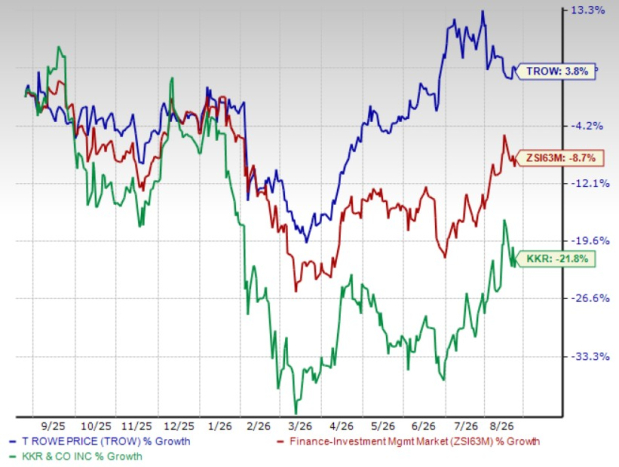
Image Source: Zacks Investment Research
From a valuation standpoint, TROW is currently trading at a forward 12-month price-to-earnings (P/E) multiple of 11.02X, while KKR is currently trading at a forward 12-month P/E multiple of 16.8X. TROW stock is cheaper than KKR.
Price-to-Earnings F12M

Image Source: Zacks Investment Research
Meanwhile, both T. Rowe Price and KKR reward their shareholders handsomely. TROW raised its dividend six times over the past five years. It has a dividend yield of 4.7%. Similarly, KKR raised its dividend five times over the past five years. It has a dividend yield of 0.7%.
TROW or KKR: Which Stock Offers More Value?
While KKR offers stronger earnings growth prospects and significant long-term opportunities to expand its alternative-asset platform, T. Rowe Price appears to offer a more compelling value proposition at current levels. TROW trades at a discount compared with KKR, offering investors a more attractive entry point. Its higher dividend yield, coupled with six dividend hikes over the past five years, enhances its appeal for income-focused investors.
TROW also benefits from a diversified AUM base, an expanding presence in alternatives and continued efforts to strengthen its private-market capabilities. Although persistent net outflows and elevated operating expenses remain key concerns, initiatives to broaden its product lineup, expand distribution and deepen its exposure to higher-growth investment categories should support its longer-term prospects.
KKR, meanwhile, remains well-positioned to capitalize on growing demand for alternative investments. Its robust earnings-growth outlook, expanding AUM base and diversified investment platform make it an attractive growth-oriented investment. However, its relatively higher valuation and lower dividend yield make the stock less compelling from a value and income standpoint at present.
Considering valuation, shareholder returns, diversification and income potential, T. Rowe Price appears to offer better value than KKR at current levels. TROW’s lower earnings multiple and substantially higher dividend yield provide a more favorable risk-reward proposition, while its strategic expansion into alternatives and private markets offers additional avenues for long-term growth.
At present, both TROW and KKR carry a Zacks Rank #3 (Hold). You can see the complete list of today’s Zacks #1 Rank (Strong Buy) stocks here.
Beyond Nvidia: AI's Second Wave Is Here
The AI revolution has already minted millionaires. But the stocks everyone knows about aren't likely to keep delivering the biggest profits. AI’s second wave is moving from infrastructure to implementation and these companies are at the forefront of this transition, positioned to become what Amazon and Google were to the internet era.
See Stocks Now >>Want the latest recommendations from Zacks Investment Research? Today, you can download 7 Best Stocks for the Next 30 Days. Click to get this free report
T. Rowe Price Group, Inc. (TROW): Free Stock Analysis Report
KKR & Co. Inc. (KKR): Free Stock Analysis Report
This article originally published on Zacks Investment Research (zacks.com).