Goldman vs. Citigroup: Which Bank Stock Is the Better Buy Now?
Does GS's earnings momentum, fee-driven strategy and growth visibility give it the edge over C despite a higher valuation? Let us find out.
The Goldman Sachs Group, Inc. GS and Citigroup, Inc. C have long been pillars of the Wall Street heavyweights. Goldman is sharpening its focus on high-margin businesses, such as investment banking, trading and wealth management, while Citigroup is executing a sweeping restructuring aimed at simplifying its global footprint and improving profitability.
With interest rates, capital markets activity and economic conditions continuing to shape the banking landscape, investors are asking a key question: which stock offers the stronger opportunity for now? Let us take a closer look and evaluate the potential of each bank.
The Case for GS
Goldman has long maintained a leading position in mergers and acquisitions, trading, and capital markets. Under CEO David Solomon, the company has undertaken a deliberate transformation to exit non-core consumer banking operations and concentrate resources on businesses wherein it holds clear competitive advantages, particularly investment banking (IB), trading, and asset and wealth management (AWM).
Goldman has also been actively reshaping its portfolio through targeted acquisitions and divestitures. This month, GS entered an agreement to acquire LCN Capital Partners, which will strengthen its AWM business by adding a specialized platform focused on sale-leaseback, build-to-suit and triple-net-lease investments. The company has also agreed to acquire NEOS Investments, further expanding its presence in options-based ETFs.
In April 2026, Goldman acquired Innovator Capital Management, enhancing its active ETF capabilities and supporting its broader strategy of building durable, fee-based revenues through diversified asset and wealth management offerings. During the same month, it completed the divestiture of its Polish asset management business, Goldman Sachs TFI, to ING Bank Slaski, further streamlining its operations. Collectively, these initiatives align with Goldman’s multi-year strategy to focus on institutional and wealth-led businesses, expand recurring fee revenues and reduce earnings volatility associated with non-core activities.
Artificial intelligence (AI) is emerging as another important driver of efficiency and growth for Goldman. The firm is deploying AI across trading, investment banking, asset management and internal operations to enhance productivity, improve client service and generate greater operating leverage. Over time, these investments could strengthen Goldman’s data-driven capabilities, improve margins and support growth in higher-fee businesses.
GS is also expanding aggressively in private markets. Its Asset Management unit aims to increase private credit assets to $300 billion by 2029 while broadening its presence across Europe, the U.K. and Asia. Together, these initiatives should strengthen Goldman’s alternative asset management franchise, diversify fee-based revenues and enhance the durability of its long-term earnings.
The Case for C
Citigroup, by contrast, is far more sweeping. Under CEO Jane Fraser, the company is advancing its multi-year strategy to streamline operations and focus on its core businesses. Since announcing plans in April 2021 to exit consumer banking in 14 markets across Asia and EMEA, the company has completed exits in nine countries.
Citigroup has moved closer to completing its multi-year exit from non-core international consumer banking. The sale of the Polish consumer business in June 2026 marked the final international consumer divestiture apart from remaining wind-downs of Banamex. The company also sold an additional 22.6% stake in Banamex in the second quarter after selling 25% in late 2025. The remaining Banamex deconsolidation and IPO are planned for early 2027, with management expecting the transaction to free up $5 billion in capital. These efforts are designed to free resources for faster-growing businesses, such as wealth management and investment banking. C expects revenues to see a 4-5% compound annual growth rate through 2026 and is targeting a 10-11% return on tangible common equity.
Cost-cutting remains another major pillar of Citigroup’s growth strategy. As part of its restructuring program, the company remains on track to eliminate 20,000 positions by the end of 2026. Its total headcount declined to 219,000 as of June 30, 2026, from 230,000 a year earlier. In the first half of 2026, the bank incurred more than $800 million in severance costs, reflecting upfront investments to achieve sustainable operating efficiencies.
Beyond workforce optimization, management is driving efficiency through process simplification, platform consolidation and increased automation, reducing manual touchpoints across operations. At the same time, the company continues to invest in technology and artificial intelligence to strengthen operational resilience, improve productivity and support revenue growth. To accelerate these initiatives, Citigroup plans to invest an incremental $5 billion between 2026 and 2028, with spending focused on technology modernization, marketing, front-office talent and branch renovations. Driven by such initiatives, C expects to generate $2-$2.5 billion in annualized cost savings by 2026. The company targets a full-year efficiency ratio of 60%.
Citigroup is also expanding deeper into private markets and alternative investments through partnerships with major asset managers. In recent years, the bank has launched private credit and customized portfolio initiatives with BlackRock, Carlyle Group and Apollo Global Management to diversify revenue streams and strengthen client engagement.
GS & C: Price Performance, Valuation & Other Comparisons
Over the past year, shares of Goldman and Citigroup have risen 38.4% and 37.6%, respectively, compared with the industry’s growth of 22%.
Price Performance

Image Source: Zacks Investment Research
In terms of valuation, Goldman is currently trading at a 12-month forward price-to-earnings (P/E) of 14.58X. Meanwhile, Citigroup’s stock is trading at a 12-month forward P/E of 10.68X.
Price-to-Earnings F12M
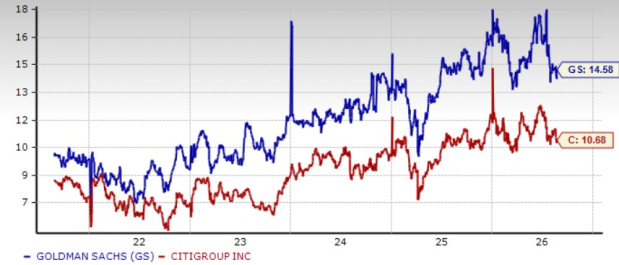
Image Source: Zacks Investment Research
C is trading at a discount compared with the industry average of 13.97X. However, the GS stock is trading at a premium.
C and GS reward their shareholders handsomely. Following the Federal Reserve’s 2026 stress test, GS increased its quarterly common stock dividend by 11% to $5 per share beginning in the third quarter of 2026. Similarly, Citigroup announced a 12% quarterly dividend increase beginning in the third quarter, subject to board approval.
Including dividends, C’s total return over the past five years has been 115.6% compared with Goldman’s average of 183.6%
Total Return Performance
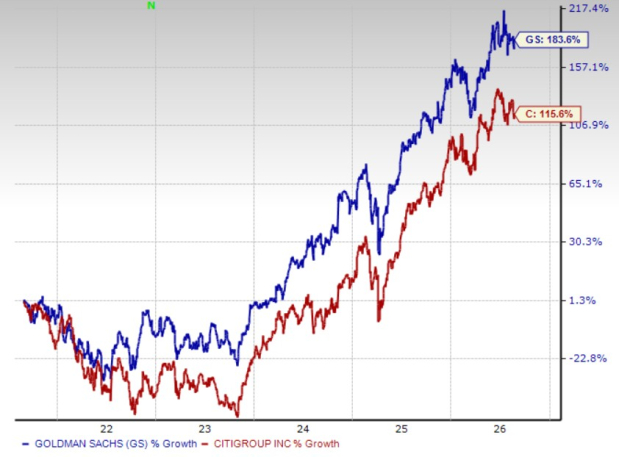
Image Source: Zacks Investment Research
How Do Estimates Compare for GS & C?
The Zacks Consensus Estimate for GS’s 2026 and 2027 earnings indicates increases of 34.2% and 4.9%, respectively. Over the past month, earnings estimates for both years have been revised upward.
Estimate Revision Trend

Image Source: Zacks Investment Research
The Zacks Consensus Estimate for C’s 2026 and 2027 earnings indicates 40.5% and 15.5% growth, respectively. Over the past month, the earnings estimate for 2026 has been unchanged, while that for 2027 has been revised upward.
Estimate Revision Trend

Image Source: Zacks Investment Research
GS or C: Which Stock Offers the Stronger Investment Case
Both Goldman and Citigroup have favorable growth catalysts, but the risk-reward profile currently tilts more convincingly toward Goldman. This is also consistent with their Zacks rankings, with Goldman sporting a Zacks Rank #1 (Strong Buy) compared with Citigroup’s Zacks Rank #2 (Buy). You can see the complete list of today’s Zacks #1 Rank stocks here.
The key differentiator is earnings visibility. Goldman is benefiting from stronger estimate revisions for both 2026 and 2027, reflecting improving expectations for investment banking, trading and asset and wealth management. Its strategic shift toward fee-generating businesses, particularly alternatives and wealth management, should also make its revenue mix more durable over time. At the same time, investments in AI and technology could support productivity gains and operating leverage as revenues expand.
Citigroup offers a different investment case. Its restructuring, cost reductions and relatively inexpensive valuation create meaningful upside potential if management delivers on its profitability targets. However, a larger portion of that upside remains dependent on successful execution of its transformation, including expense discipline, business simplification and improved returns. This makes Citigroup’s earnings trajectory comparatively more execution-sensitive.
Valuation is the principal argument in Citigroup’s favor, as Goldman commands a higher multiple. Yet the premium appears warranted, given GS’ stronger franchise positioning, better earnings momentum and more visible growth drivers. In contrast, Citigroup’s valuation discount partly reflects the uncertainty surrounding the timing and magnitude of returns from its restructuring.
Thus, while Citigroup remains an attractive turnaround story, Goldman offers a stronger combination of earnings momentum, business quality and growth visibility. Hence, GS stock appears a better investment option for now.
Radical New Technology Could Hand Investors Huge Gains
Quantum Computing is the next technological revolution, and it could be even more advanced than AI.
While some believed the technology was years away, it is already present and moving fast. Large hyperscalers, such as Microsoft, Google, Amazon, Oracle, and even Meta and Tesla, are scrambling to integrate quantum computing into their infrastructure.
Senior Stock Strategist Kevin Cook reveals 7 carefully selected stocks poised to dominate the quantum computing landscape in his report, Beyond AI: The Quantum Leap in Computing Power.
Kevin was among the early experts who recognized NVIDIA's enormous potential back in 2016. Now, he has keyed in on what could be "the next big thing" in quantum computing supremacy. Today, you have a rare chance to position your portfolio at the forefront of this opportunity.
See Top Quantum Stocks Now >>Want the latest recommendations from Zacks Investment Research? Today, you can download 7 Best Stocks for the Next 30 Days. Click to get this free report
The Goldman Sachs Group, Inc. (GS): Free Stock Analysis Report
Citigroup Inc. (C): Free Stock Analysis Report
This article originally published on Zacks Investment Research (zacks.com).