Gen 2 VPD Boosts VICR's Power Management Prospects Against TXN & ADI
Vicor's Gen 2 VPD targets higher AI power density, while licensing, customer programs and added capacity could expand its data-center opportunity.
Vicor VICR is strengthening its AI infrastructure prospects through its second-generation Vertical Power Delivery (VPD) technology, which addresses the rising compute-density and power-delivery requirements of artificial intelligence (AI) data centers. AI hyperscalers and original equipment manufacturers (OEMs) increasingly need VPD to meet compute-density and AI-performance requirements. Vicor’s Gen 2 VPD targets current gains above 40 and current density of up to 5 amps per square millimeter (mm²), potentially strengthening its competitive position against broader power-management players such as Analog Devices ADI and Texas Instruments TXN.
The technology could become increasingly relevant as hyperscalers and OEMs seek denser and more efficient processor-power architectures. Vicor has completed an initial chipset delivering about 3 amps per square millimeter for a lead customer and is developing demonstration systems for additional customers. Strong signal integrity and thermal-management capabilities further support Vicor’s differentiation as AI power architectures migrate toward lower operating voltages.
Vicor’s opportunity extends beyond customers adopting a complete Gen 2 VPD architecture. Vicor has been approached by a couple of companies seeking to use its technology alongside integrated voltage regulators (IVRs). Vicor can provide current-multiplication technology alongside IVRs, allowing it to capture content even when customers select alternative architectures. Its Factorized Power System offers significantly higher current density and efficiency, while IVR-based approaches can involve roughly 10-15% insertion losses.
Customer engagement and licensing could provide additional growth avenues. Vicor expects to engage with a hyperscaler and a couple of OEMs during the remainder of 2026, with these programs potentially moving into production in the third or fourth quarter of 2027. Its 1.5-millimeter package and thermal-management capabilities could help meet increasingly demanding AI packaging requirements. Vicor expects future relationships to combine intellectual property (IP) licensing with product sourcing related to second-generation VPD, creating opportunities to generate both royalty and product revenues.
Strong demand is supporting manufacturing expansion. Backlog reached roughly $380 million in the second quarter of 2026, rising 26% sequentially, with management noting that the latest licensing agreement contributed relatively little to the increase. Vicor’s first ChiP fab is approaching full capacity utilization, prompting plans for a second facility that could initially roughly double capacity and provide further expansion flexibility. The company expects revenues to increase nearly 10% sequentially in the third quarter of 2026 and exceed $600 million for the full year, supported by planned double-digit sequential growth in Advanced Products product revenues. The additional capacity should help support future VPD ramps while advancing Vicor’s longer-term objective of $2.5 billion in revenues and a 70% gross margin.
VICR Faces Tough Competition
ADI represents a notable challenge through its expanding high-density processor-power portfolio. Its intermediate-to-core solutions target next-generation processors operating at up to 6,000 amps and below 1 volt. The Empower Semiconductor acquisition allows ADI to take power directly into the processor package, while ADI believes its architecture can reduce compute power consumption and temperature by roughly 10-15%. Data-center power revenues grew more than 100% year over year in the third quarter of fiscal 2026.
TXN challenges VICR through its broad AI data-center power-tree portfolio and manufacturing scale. The company says many of its chips are used in the data-center power tree, while its ability to supply from dependable capacity is becoming an advantage as the market expands. Data-center revenues doubled year over year in the second quarter of 2026, and TXN says its investments in inventory and capacity, along with available clean-room space, position it to support continued growth.
VICR’s Share Price Performance, Valuation & Estimates

Image Source: Zacks Investment Research
Shares of Vicor have appreciated 73.3% year to date compared with the broader Zacks Computer and Technology sector’s 14.4% growth.
VICR Stock’s Price Performance
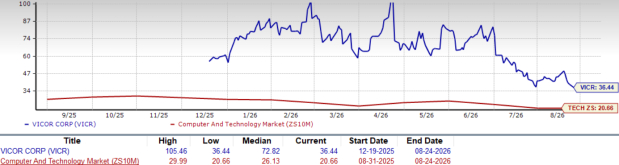
Image Source: Zacks Investment Research
The VICR stock is trading at a premium, with a forward 12-month price-to-earnings ratio of 36.44X compared with the broader sector’s 20.66X. Vicor has a Value Score of F.
VICR’s Valuation
The Zacks Consensus Estimate for Vicor’s 2026 earnings is currently pegged at 71 cents per share, unchanged over the past 30 days, suggesting 12.70% year-over-year growth.
Vicor Corporation Price and Consensus

Vicor Corporation price-consensus-chart | Vicor Corporation Quote
Vicor currently has a Zacks Rank #2 (Buy). You can see the complete list of today’s Zacks #1 Rank (Strong Buy) stocks here.
Radical New Technology Could Hand Investors Huge Gains
Quantum Computing is the next technological revolution, and it could be even more advanced than AI.
While some believed the technology was years away, it is already present and moving fast. Large hyperscalers, such as Microsoft, Google, Amazon, Oracle, and even Meta and Tesla, are scrambling to integrate quantum computing into their infrastructure.
Senior Stock Strategist Kevin Cook reveals 7 carefully selected stocks poised to dominate the quantum computing landscape in his report, Beyond AI: The Quantum Leap in Computing Power.
Kevin was among the early experts who recognized NVIDIA's enormous potential back in 2016. Now, he has keyed in on what could be "the next big thing" in quantum computing supremacy. Today, you have a rare chance to position your portfolio at the forefront of this opportunity.
See Top Quantum Stocks Now >>Want the latest recommendations from Zacks Investment Research? Today, you can download 7 Best Stocks for the Next 30 Days. Click to get this free report
Vicor Corporation (VICR): Free Stock Analysis Report
Analog Devices, Inc. (ADI): Free Stock Analysis Report
Texas Instruments Incorporated (TXN): Free Stock Analysis Report
This article originally published on Zacks Investment Research (zacks.com).