U.S. Food Manufacturing Employment Over Time
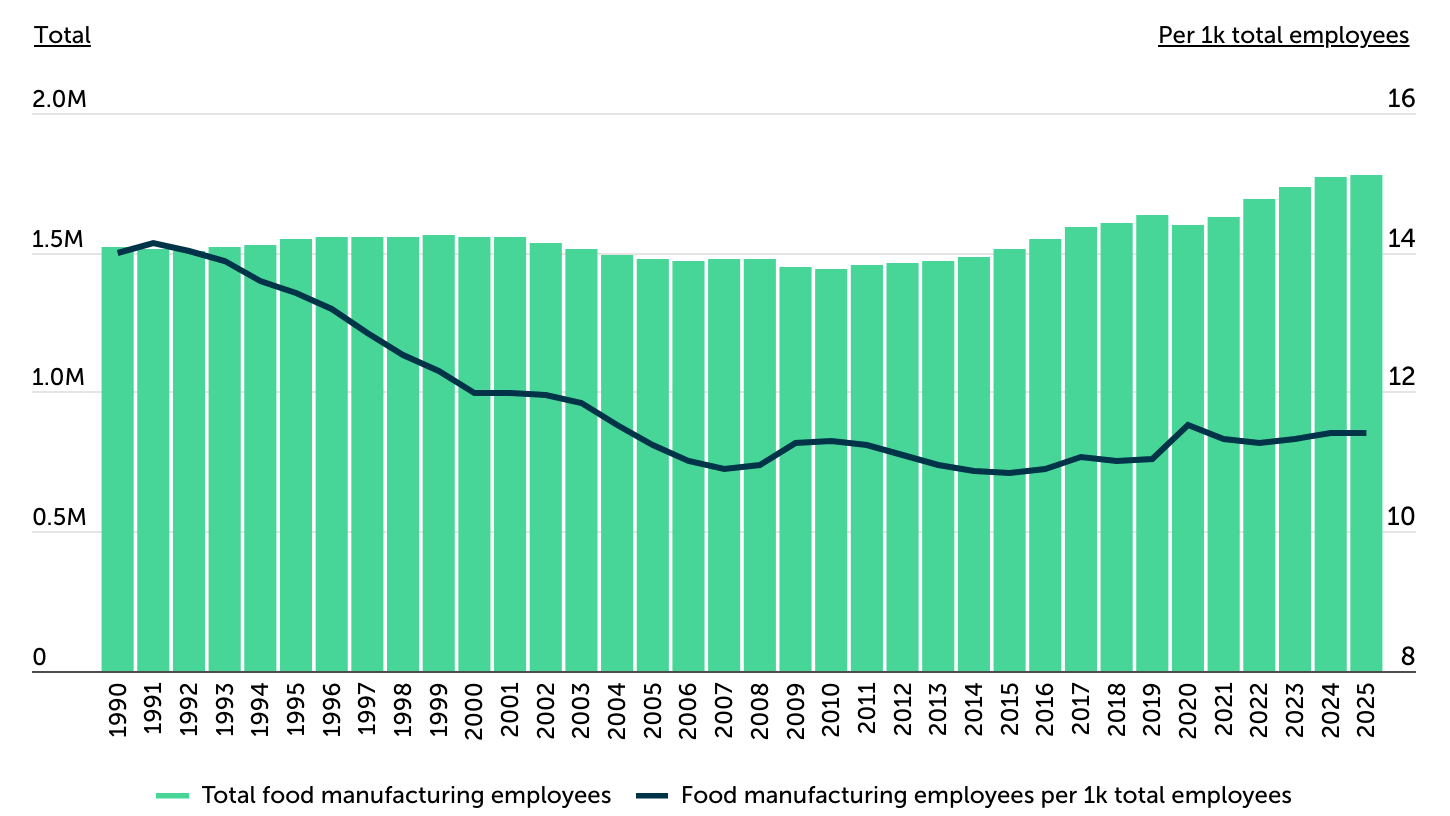
Despite recent growth, the share of overall employment in food manufacturing is near historic lows
Source: Trace One analysis of U.S. Bureau of Labor Statistics data
Food manufacturing was one of the few industries deemed essential during the COVID-19 pandemic, allowing factories to continue operating while much of the U.S. economy slowed or shut down. But remaining open did not mean business as usual. As restaurants curtailed operations and millions of Americans prepared more meals at home, demand shifted rapidly toward grocery stores, meal kits, and other retail food products. Food manufacturers responded by ramping up production while navigating workforce shortages, new safety protocols, and supply chain disruptions. After employment dipped from 1.63 million workers in 2019 to 1.60 million in 2020, the industry recovered steadily, reaching a record 1.77 million employees in 2025—an increase of nearly 11% from the pandemic low.
Even as total employment has reached a historic high, food manufacturing represents a smaller share of the U.S. workforce than it did a generation ago. The industry employed 14.0 workers per 1,000 U.S. employees in 1990, compared to just 11.4 per 1,000 in 2025, a decline of nearly 19%. Rather than reflecting weaker demand for domestically manufactured food, the trend largely mirrors faster employment growth elsewhere in the economy alongside persistent labor shortages within food manufacturing. Food manufacturing is an inherently labor-intensive sector, and to maintain output with limited staffing, manufacturers have increasingly turned to automation, software to manage the increasingly complicated product lifecycle, and other process improvements.
“Every product on a grocery shelf carries a documentation trail behind it. Ingredients, allergens, packaging, labeling. That trail grows every year, and managing it well is now part of how food manufacturers compete.” — Saida Ait, VP Global Marketing, Trace One
As featured on
