Fed's Hawkish Pause Puts JPMorgan in Focus: Buy, Sell or Hold?
Does JPM's rising 2026 NII outlook, diversified revenues and solid capital base make it well suited for the Fed's higher-for-longer rate stance? Let's find out.
The Federal Reserve’s inflation focus has strengthened expectations that rates will remain elevated. At its July 29 meeting, the central bank held the federal funds rate at 3.50-3.75%, extending its pause. Inflation remains above the 2% target amid supply-driven pressures, including higher energy costs. With three policymakers favoring a 25-basis-point hike, further tightening remains possible if inflation stays persistent.
While an additional rate increase is not certain, the Fed’s hawkish stance suggests that meaningful monetary easing may remain distant. Against this backdrop, JPMorgan JPM appears well-positioned to navigate elevated rates, supported by its vast deposit franchise, diversified revenue streams and strong balance sheet.
Higher Rates Support JPM’s Net Interest Income (NII)
A higher-for-longer interest-rate environment will benefit JPMorgan by maintaining yields on loans and other interest-earning assets. The bank’s large exposure to credit cards, commercial loans and other variable-rate products allows asset yields to adjust as market rates remain elevated.
JPMorgan’s underlying NII continued to expand during the first half of 2026 despite the impact of earlier rate reductions. This was driven by higher deposit balances, increased revolving credit-card balances and growth in wholesale loans.
Management also raised its full-year NII outlook. JPMorgan now expects 2026 NII to reach approximately $105.5 billion, up from its earlier projection of $103 billion. Management attributed the improved outlook primarily to stronger balances, while noting that rates were also modestly higher than assumed previously. Likewise, Bank of America BAC and Citigroup C project an increase in NII for this year.
If the Fed maintains rates at current levels or raises them later in the year, JPMorgan could continue generating attractive yields on its interest-earning assets. However, the benefit will depend on the extent to which deposit and other funding costs increase.
JPMorgan’s broad deposit base provides stable, diversified funding and limits reliance on costly wholesale financing. Although higher rates may push customers toward higher-yielding products and raise deposit costs, JPMorgan’s scale and customer relationships should help contain margin pressure.
JPM’s Diversified Operations Drive Strong Results
JPMorgan’s investment appeal is not solely dependent on interest rates. Its commercial and investment banking (IB), markets, payments, credit card and asset management businesses provide multiple sources of earnings.
The company generated first-half net income of $37.65 billion, supported by broad-based strength across its business segments. However, second-quarter results also benefited from sizable gains related to Visa shares and certain equity investments.
The Commercial & Investment Bank delivered particularly strong results. The first six months' revenues advanced 23% year over year to $48.2 billion, while IB fees climbed 29%. Markets revenues increased 27%, aided by a 49% surge in equities revenues. Management stated that the IB pipeline remained robust and expected activity levels to stay healthy, subject to market conditions.
Similarly, Asset & Wealth Management also performed well, with revenues rising 15% and assets under management reaching $5.1 trillion as of June 30, 2026. Strong net inflows and higher market levels supported management fees, providing another source of income that is less directly tied to lending spreads.
JPMorgan’s Capital Strength Supports Shareholder Returns
JPMorgan ended the second quarter with a standardized common equity Tier 1 ratio of 14.1%, underscoring its capacity to absorb potential economic or credit-related stress. The company has authorized a new $50 billion share repurchase program, which became effective July 1. The board also intends to increase the quarterly dividend by 10% to $1.65 per share beginning in the third quarter.
Similarly, Bank of America increased its quarterly dividend by 14% to 32 cents per share. Also, Citigroup raised the same by 11.7% to 67 cents per share.
Coming back to JPM, its capital strength enables it to return funds to shareholders while continuing to invest in technology, branches, bankers and other growth initiatives. Management raised its adjusted expense forecast to approximately $107.5 billion, mainly because stronger business volumes and revenues are generating higher related expenses. Although elevated spending could constrain operating leverage, management believes these investments will strengthen the franchise and support future returns.
Credit and Economic Risks Remain for JPMorgan
Higher interest rates are not entirely favorable for JPMorgan. Prolonged borrowing cost pressure could weaken demand for mortgages, corporate credit and other loans. It may also strain consumers and businesses, increasing delinquencies and credit losses.
JPMorgan’s credit quality metrics have been improving this year, with provisions for credit losses declining 18% year over year and net charge-offs (NCOs) falling 1%. Further, consumer credit trends were better than management previously expected, prompting the bank to lower its projected 2026 card NCO rate to approximately 3.2% from 3.4% previously targeted.
Despite this, management remains cautious about underwriting standards and the possibility of a future credit cycle. Therefore, a renewed Fed rate hike could support NII initially but may ultimately increase credit risk if restrictive policy materially slows economic activity. Bank of America and Citigroup face similar credit-quality risks.
How to Approach JPM Amid the Fed’s Higher-for-Longer Policy?
After a subdued start to the year, U.S. markets have rebounded impressively despite shifting AI expectations, sticky inflation, oil shock and geopolitical tensions. This year, shares of JPMorgan have gained 8.8% compared with a 6.6% rise for the S&P 500 Index. The stock has fared worse than Bank of America and Citigroup in the same time frame.
YTD Price Performance
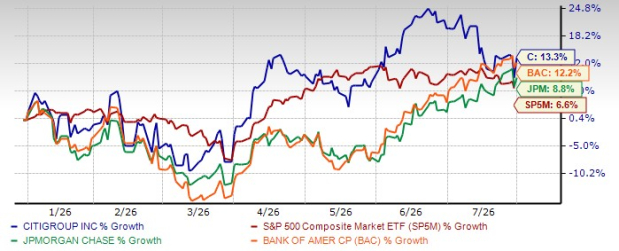
Image Source: Zacks Investment Research
JPMorgan stock currently trades at a discount to the industry. The stock is trading at a price-to-tangible book (P/TB) of 3.27X, below the industry’s 3.30X.
JPM’s P/TB

Image Source: Zacks Investment Research
If we compare JPM’s current valuation with that of Bank of America and Citigroup, it appears expensive. At present, Bank of America has a P/TB of 2.17X, and Citigroup is trading at a P/TB of 1.34X.
Analysts are bullish on JPMorgan’s prospects, with earnings estimates for 2026 and 2027 revised upward over the past month. The Zacks Consensus Estimate for JPM’s 2026 and 2027 earnings implies a 22.6% and 0.3% year-over-year increase, respectively.
Earnings Estimates

Image Source: Zacks Investment Research
Strong first-half results demonstrate that JPMorgan can generate robust earnings across different market cycles. Its improving NII outlook, expanding deposit base, resilient consumer trends and momentum in IB, trading and asset management provide several avenues for growth.
The higher-for-longer rate environment should preserve attractive asset yields, while JPMorgan’s funding advantage and diversified business model can help offset rising deposit costs and potential credit normalization. Its strong capital position, planned dividend increase and continued investments in long-term growth further enhance shareholder value.
Though economic uncertainty, rising expense base and credit risks warrant monitoring, JPMorgan’s scale, profitability and competitive positioning make it one of the banking industry’s best-equipped institutions for the prevailing monetary policy environment. Hence, the Fed’s hawkish stance, combined with upward estimate revisions and broad-based operating momentum, suggests that this is an opportune time to buy JPMorgan stock.
At present, JPMorgan sports a Zacks Rank #1 (Strong Buy). You can see the complete list of today’s Zacks #1 Rank stocks here.
Zacks' Research Chief Names "Stock Most Likely to Double"
Our team of experts has just released the 5 stocks with the greatest probability of gaining +100% or more in the coming months. Of those 5, Director of Research Sheraz Mian highlights the one stock set to climb highest.
This top pick is a little-known satellite-based communications firm. Space is projected to become a trillion dollar industry, and this company's customer base is growing fast. Analysts have forecasted a major revenue breakout in 2025. Of course, all our elite picks aren't winners but this one could far surpass earlier Zacks' Stocks Set to Double like Hims & Hers Health, which shot up +209%.
Free: See Our Top Stock And 4 Runners UpWant the latest recommendations from Zacks Investment Research? Today, you can download 7 Best Stocks for the Next 30 Days. Click to get this free report
JPMorgan Chase & Co. (JPM): Free Stock Analysis Report
Bank of America Corporation (BAC): Free Stock Analysis Report
Citigroup Inc. (C): Free Stock Analysis Report
This article originally published on Zacks Investment Research (zacks.com).