Which States Have Lost the Most International Students?
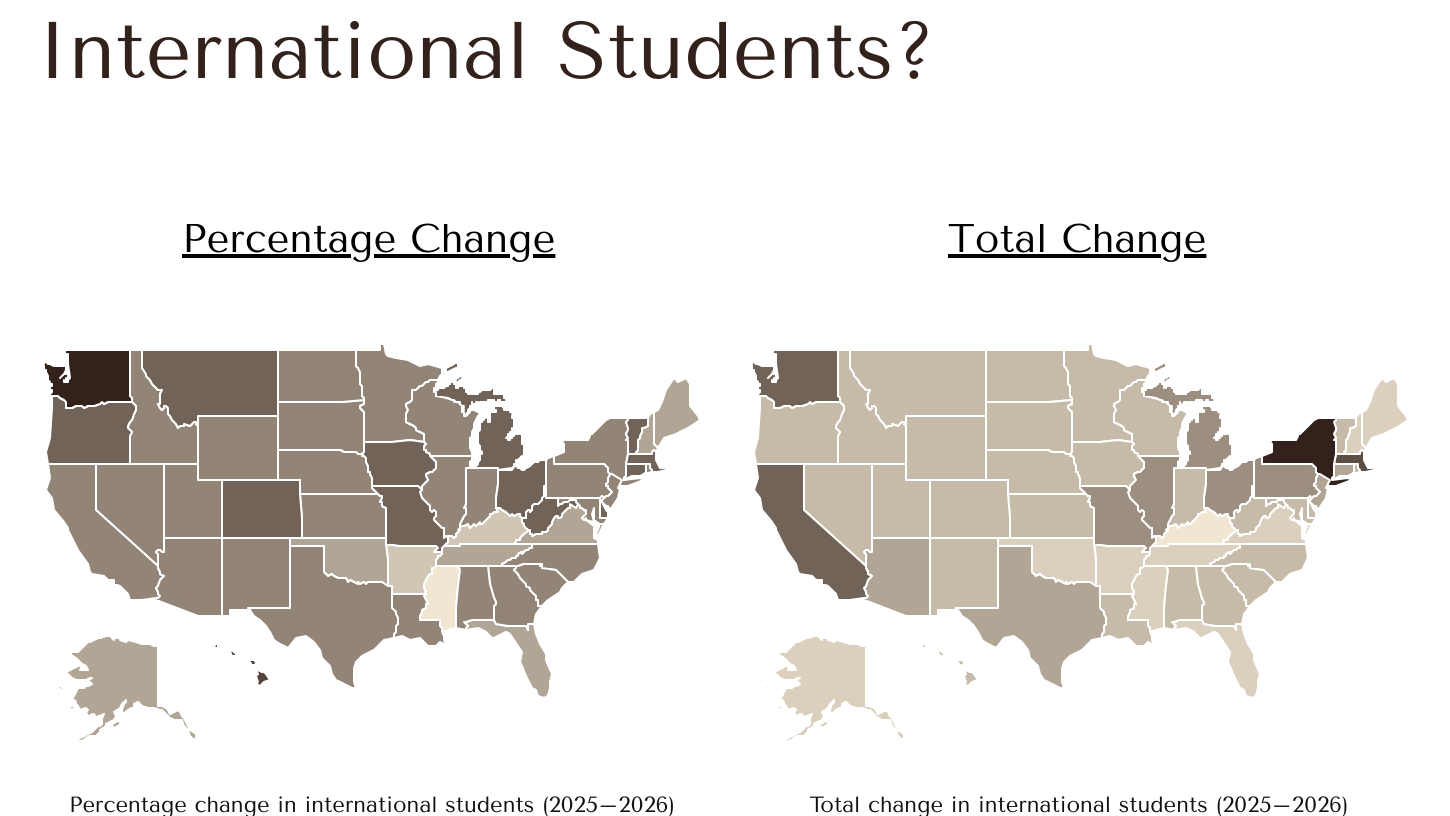
Washington and Hawaii saw more than 10% declines year-over-year
Source: Manifest Law analysis of U.S. Department of Homeland Security data | Image Credit: Manifest Law
Recent declines in international student enrollment have not been evenly distributed across the United States, with several states experiencing sharper contractions than others. The steepest declines are concentrated in parts of the West and smaller-state markets. Washington recorded the largest year-over-year drop, with international student enrollment falling by 15.8% between March 2025 and 2026, followed by Hawaii at -10.5% and Montana at -9.9%. Other states with notable declines include Missouri (-7.4%), Ohio (-7.3%), and Delaware (-6.8%), suggesting that losses are occurring across a mix of geographic regions rather than being isolated to a single part of the country.
Several factors may help explain why certain states are experiencing more pronounced declines. States like Washington and Hawaii have a higher reliance on students from key source countries in Asia, particularly China, making them more sensitive to shifts in visa issuance, geopolitical tensions, and changing student preferences. At the same time, smaller or less diversified higher education markets—such as Vermont with 1,481 international students, or Montana with just 816—may be more vulnerable to enrollment swings, as even modest changes in international inflows can translate into larger percentage declines.
In terms of absolute numbers, coastal states known for their top-tier higher education institutions saw the largest declines. Home to globally recognized institutions like New York University (NYU) and Columbia University, New York State saw the largest losses, with a decline of 7,431 international students from March 2025 to March 2026. Massachusetts, which hosts massive international cohorts at Northeastern University and Boston University, experienced the second-largest decrease, losing 5,021 students. California, anchored by heavyweights like the University of Southern California (USC), followed closely behind with a loss of 4,741 students. Finally, Washington rounded out the hardest-hit states, shedding 4,330 active records over the same one-year period despite the traditional draw of the University of Washington.
Losing out on international students could create challenges for these universities. Because international students typically do not receive scholarships, they pay out of pocket for their tuition. This revenue goes toward funding programs and research that benefit the university’s students as a whole.
The analysis provides insights into which states are seeing the largest declines in international student enrollments. For more information on how the analysis was conducted, see the methodology section. For complete results, see The U.S. States Losing the Most International Students on Manifest Law.
What’s Next for F-1 and M-1 Visas?
Looking ahead, the trajectory of F-1 and M-1 visa issuance will likely be defined by the tension between global educational demand and tightening domestic immigration policy. As the U.S. labor market evolves and the pathway from a student visa (F-1) to a dual-intent work visa (H-1B) remains highly competitive and heavily backlogged, prospective students will increasingly scrutinize the long-term return on investment of a U.S. degree. Immigration agencies are expected to maintain rigorous vetting and interview processes, and any future regulatory changes to post-graduation work authorizations—most notably Optional Practical Training (OPT)—will heavily influence international enrollment. If the transition from a student visa into the U.S. workforce becomes more restrictive or expensive, the recent plateau in international student numbers could solidify into a longer-term contraction.
In response to these headwinds, U.S. educational institutions will be forced to adapt their global recruitment strategies. With Chinese enrollments continuing to soften amid geopolitical friction and Indian enrollments heavily concentrated in specific graduate-level STEM and business programs, universities are expected to aggressively diversify their international pipelines to avoid over-reliance on just two nations. Over the next few years, emerging markets in Sub-Saharan Africa, Latin America, and Southeast Asia will likely become critical battlegrounds for global talent. Ultimately, while the United States remains a premier destination for international education, sustaining its historic dominance will require navigating an increasingly competitive global market and a complex, shifting domestic immigration landscape.
As featured on
