Where Are International Students Coming From?
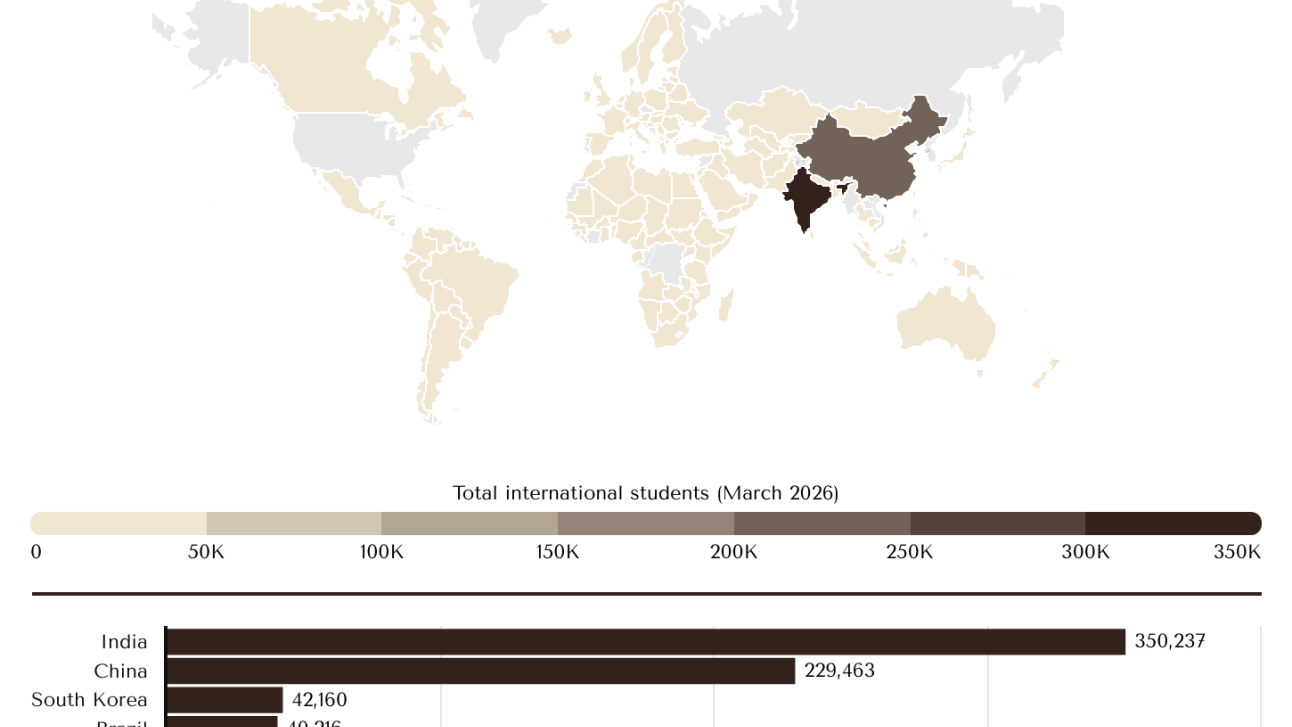
Nearly half of all international students in the U.S. are citizens of India or China
Source: Manifest Law analysis of U.S. Department of Homeland Security data | Image Credit: Manifest Law
While international students in the United States are largely concentrated in postsecondary education, they also come from a relatively concentrated set of countries. India and China account for the largest shares by a wide margin. As of March 2026, 350,237 international students were citizens of India, while 229,463 were from China. Combined, these two countries represent nearly half of all international students in the U.S.
Several structural factors help explain why students from these countries disproportionately enroll in U.S. institutions. In both India and China, access to top-tier universities is highly constrained, with far more qualified applicants than available seats. Students who do not secure admission to these institutions often face a choice between attending lower-tier domestic universities or pursuing education abroad. In this context, U.S. institutions—across a wide range of selectivity levels—offer a combination of academic specialization and access to labor market opportunities and wages that can be difficult to replicate domestically. Many international students, particularly from India, enroll in graduate-level STEM and business programs that are closely tied to employment pathways.
These advantages persist despite growing policy headwinds. Increased visa scrutiny, expanded screening requirements, and rising costs associated with employment-based visas have introduced new friction into the system. Even so, the combination of educational access and potential career outcomes continues to sustain strong demand from key source countries.
Beyond India and China, the distribution becomes significantly more diffuse. South Korea (42,160 students), Brazil (40,216), and Canada (36,961) are the next largest countries of origin, followed by a long tail of countries each contributing smaller numbers of students. This pattern reflects a mix of regional proximity, bilateral education ties, and varying levels of access to U.S. study and work pathways.
As featured on
