Coca-Cola vs. PepsiCo: Which Stock Deserves the Top Spot in Beverages?
KO's beverage ecosystem, global reach, brand strength and earnings growth highlight its fundamentals, while PEP's diversified drinks and foods portfolio supports consumer reach.
A few rivalries in the consumer world have matched the intensity and longevity of the battle between The Coca-Cola Company KO and PepsiCo Inc. PEP. For decades, the two beverage giants have competed for consumer preference, shelf space and global market dominance, with each building powerful brands that have become deeply embedded in everyday consumption habits. While Coca-Cola remains synonymous with carbonated beverages and boasts one of the world’s most recognizable drink portfolios, PepsiCo has expanded beyond beverages into a broader food-and-snacking powerhouse through brands spanning drinks, convenient foods and nutrition products.
The competition between the two companies today extends far beyond the traditional “cola wars.” Coca-Cola’s strength lies in its focused beverage ecosystem, extensive global distribution network and leadership across categories such as sparkling beverages, hydration and ready-to-drink options. PepsiCo, meanwhile, has created a diversified business model combining its beverage portfolio with iconic snack brands, giving it exposure to multiple consumer occasions.
As shifting consumer preferences, health trends and evolving beverage categories reshape the industry landscape, the question is no longer just about which cola sells more; it is about which company holds the stronger market position and business advantage for the future.
The Case for KO
Coca-Cola’s investment case is built on one of the world’s most valuable beverage ecosystems, supported by a globally recognized brand portfolio, unmatched distribution reach and deep consumer connections. Operating across more than 200 countries and territories, Coca-Cola leverages a global yet locally adaptive system to capture growth across multiple beverage categories. The company’s broad portfolio includes flagship brands such as Trademark Coca-Cola, along with fast-growing offerings like fairlife, Powerade, FRESCA, Gold Peak, smartwater and Simply. In the second quarter of 2026, Coca-Cola gained both value and volume share in North America, highlighting its ability to strengthen its competitive position in a highly mature beverage market.
Coca-Cola’s strategy centers on becoming more consumer-centric, expanding category participation and using digital capabilities to deepen engagement. The company is focused on delivering the right brand, package and price point for different consumer occasions, allowing it to address both affordability needs and premiumization opportunities. Its FIFA World Cup activation showcased the power of its digital and marketing engine, generating more than 25 million first-party data points and more than 9 billion views through digital and social media initiatives. These insights are helping Coca-Cola personalize consumer interactions and improve future campaigns.
Financial performance further strengthens the investment thesis. Coca-Cola delivered broad-based momentum, with organic revenue growth of 6%, unit case volume growth of 5%, margin expansion and double-digit earnings growth in the quarter. The company also reported comparable earnings per share growth of 11% and a free cash flow of $6.9 billion, reflecting the resilience of its asset-light business model and strong brand investments.
With continued innovation across beverages, strong emerging-market opportunities and a focus on digital-led consumer engagement, Coca-Cola remains positioned as a dominant global beverage leader.
The Case for PEP
PepsiCo’s investment case is anchored by a uniquely diversified consumer portfolio that combines global beverage strength with a leadership position in convenient foods. Unlike traditional beverage-focused peers, PepsiCo reaches consumers across multiple daily occasions through brands spanning snacks, hydration, energy and functional nutrition.
Its international business remains a key growth engine, with developing and emerging markets contributing approximately 80% to international net revenues. The company’s global beverage franchise and convenient foods portfolio continue to expand their reach, with international beverages representing more than 60% of global beverage volume and international convenient foods accounting for about 70% of global convenient foods volume.
PepsiCo’s strategy focuses on evolving its portfolio to match changing consumer preferences, including greater demand for hydration, protein, fiber, energy and zero-sugar options. The company is strengthening its market position through functional beverage brands such as Gatorade and Propel, while expanding zero-sugar offerings across carbonated beverages. Gatorade gained both value and volume share following innovation in lower-sugar products, while Propel continued to gain share in enhanced water.
PepsiCo is also leveraging digital and experiential marketing through global platforms such as Pepsi Football Nation and World Cup activations that connect brands with consumers through social content and fan experiences.
Financial performance highlights the resilience of PepsiCo’s business model. The company delivered 6.4% net revenue growth in the second quarter, supported by organic revenue growth, pricing actions and portfolio investments. International operations remained a major contributor, generating 7% organic revenue growth, while productivity initiatives, automation and digitalization are helping improve operating leverage. With iconic brands, strong consumer reach and continued innovation across beverages and foods, PepsiCo maintains a powerful position in the global consumer staples landscape.
Price Performance & Valuation of PEP & KO
Shares of Coca-Cola have rallied 33.8% in the past year against PepsiCo’s decline of 1.6%. Coca-Cola’s stronger stock performance highlights investor preference for its consistent execution, resilient earnings profile and powerful brand equity.

Image Source: Zacks Investment Research
From a valuation standpoint, PEP currently trades at a lower forward price-to-earnings (P/E) multiple of 16.35X compared with Coca-Cola’s 26.72X, making it more attractively priced, driven by its earnings and diversified revenue stream.
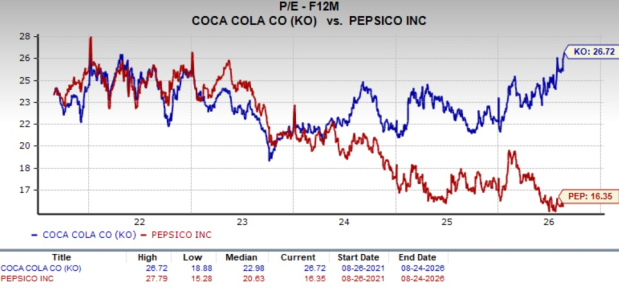
Image Source: Zacks Investment Research
PepsiCo’s lower valuation suggests value appeal, supported by its diversified food and beverage portfolio. While Coca-Cola commands a premium multiple for stability, PepsiCo offers a more balanced risk-reward opportunity through its broader revenue base.
How Does Zacks Consensus Estimate Compare for PEP & KO?
Coca-Cola’s EPS estimates for 2026 and 2027 have moved up 0.9% and 1.1%, respectively, in the past 30 days. KO’s 2026 revenues and EPS are expected to increase 4% and 9.7% year over year to $49.8 billion and $3.29 per share, respectively.

Image Source: Zacks Investment Research
PepsiCo’s EPS estimate for 2026 and 2027 edged down by a penny each in the last 30 days. PEP’s 2026 revenues and EPS are projected to increase 5.4% and 5.3% year over year to $99 billion and $8.57 per share, respectively.

Image Source: Zacks Investment Research
PEP vs. KO: Which Has the Edge?
Coca-Cola emerges as the stronger contender based on its superior stock performance, resilient business model and improving earnings outlook. The company’s stronger one-year return reflects investor confidence in its ability to navigate changing consumer trends while delivering consistent growth. Upward revisions in Coca-Cola’s earnings estimates signal growing optimism around its future profitability and execution.
While PepsiCo’s diversified portfolio and attractive valuation provide meaningful investment appeal, Coca-Cola’s brand strength, focused beverage leadership and positive earnings momentum give it an edge in the race for the top spot. Both PEP and KO currently carry a Zacks Rank #3 (Hold).
You can see the complete list of today’s Zacks #1 Rank (Strong Buy) stocks here.
Radical New Technology Could Hand Investors Huge Gains
Quantum Computing is the next technological revolution, and it could be even more advanced than AI.
While some believed the technology was years away, it is already present and moving fast. Large hyperscalers, such as Microsoft, Google, Amazon, Oracle, and even Meta and Tesla, are scrambling to integrate quantum computing into their infrastructure.
Senior Stock Strategist Kevin Cook reveals 7 carefully selected stocks poised to dominate the quantum computing landscape in his report, Beyond AI: The Quantum Leap in Computing Power.
Kevin was among the early experts who recognized NVIDIA's enormous potential back in 2016. Now, he has keyed in on what could be "the next big thing" in quantum computing supremacy. Today, you have a rare chance to position your portfolio at the forefront of this opportunity.
See Top Quantum Stocks Now >>Want the latest recommendations from Zacks Investment Research? Today, you can download 7 Best Stocks for the Next 30 Days. Click to get this free report
CocaCola Company (The) (KO): Free Stock Analysis Report
PepsiCo, Inc. (PEP): Free Stock Analysis Report
This article originally published on Zacks Investment Research (zacks.com).