Cameco vs. Denison: Which Uranium Stock Has an Edge Right Now?
CCJ offers scale, stable production and long-term contracts, while DNN brings higher-risk, higher-reward potential.
Cameco Corporation CCJ and Denison Mines Corp. DNN are Canada-based uranium companies, both currently operating at very different stages of the nuclear fuel value chain.
Cameco is one of the world’s largest uranium producers with an integrated business spanning mining, milling and fuel services. The company owns interests in world-class assets such as McArthur River and Cigar Lake and benefits from established production, long-term contracts and strong operating cash flows.
Denison is primarily an exploration and development-focused company, with its flagship Wheeler River project in the Athabasca Basin representing one of the largest undeveloped high-grade uranium assets in the world. Denison is advancing Phoenix toward first production in 2028. The company’s interests in Saskatchewan also include a 22.5% ownership interest in the McClean Lake Joint Venture.
With uranium demand supported by the global push toward clean energy and energy security, investors often weigh Denison’s high-growth development potential against Cameco’s established production scale, cash flow stability and operational maturity. To determine which stock currently offers the stronger opportunity, it is important to compare their fundamentals, growth prospects and key risks.
The Case for CCJ
Cameco remains one of the largest and most established uranium producers globally. Its tier-one mining and milling operations are capable of producing more than 30 million pounds of uranium concentrates annually (its share). Cameco accounted for 15% of global uranium production in 2025. Beyond mining, the company has a diversified presence across the nuclear fuel cycle, including refining, conversion and fuel services. Its strategic stakes in Westinghouse and Global Laser Enrichment add long-term optionality tied to reactor deployment and enrichment technologies.
In the second quarter of 2026, Cameco’s total revenues were down 7% to CAD 814 million ($588 million) due to weaker performance in both segments. Uranium sales volumes fell 18% to 7.1 million pounds, reflecting normal quarterly delivery timing and Cameco's disciplined contracting strategy, which calls for lower planned deliveries in 2026.
Lower volumes were offset by a 15% increase in the Canadian dollar average realized price to CAD 93.13 per pound, leading to a 7% year-over-year decline in Cameco’s uranium revenues to CAD 659 million ($469 million). Fuel Services revenues fell 6% to CAD 152 million ($108 million) as a 13% increase in realized prices offset an 18% decline in volumes.
Higher purchased material costs, product-loan impacts and the Cigar Lake maintenance shutdown pushed uranium-segment costs up about 3%. Fuel Services costs increased 1%, with higher unit costs offset by lower volumes.
Adjusted earnings fell 75% year over year to CAD 0.18 per share (13 cents), primarily due to lower uranium sales volumes and a sharp decline in Cameco’s equity earnings from Westinghouse. The year-ago quarter benefited from significant Westinghouse revenues related to the Czech Republic’s Dukovany nuclear project.
Cameco’s adjusted earnings plunged 75% year over year to CAD 0.18 per share, or 13 cents, due to lower revenues and a sharp reduction in equity earnings from Westinghouse. In the prior-year quarter, Westinghouse recognized significant revenues from its participation in the Czech Republic's Dukovany nuclear project, contributing roughly $170 million to Cameco's share of Westinghouse's revenues and adjusted EBITDA.
Cameco maintained its uranium production projection between 19.5 million pounds and 21.5 million pounds for 2026. Production guidance for the fuel services segment is 13-14 million kgUs.
The company expects 2026 uranium deliveries of 29-32 million pounds and uranium revenues of CAD 2.7-2.9 billion, based on a higher realized-price assumption of CAD 91-96 per pound. At the midpoint, uranium revenues would decline about 2% from 2025 because of lower deliveries. Fuel Services revenues are projected at CAD 610-650 million, implying roughly 12% growth.
Overall, Cameco expects total 2026 revenues of CAD 3.32-3.57 billion. The midpoint represents about a 1% decline from 2025.
Cameco also has strong long-term contract visibility, with commitments to deliver an average of about 28 million pounds annually over the next five years. It is investing to expand production, extend Cigar Lake’s mine life to 2036 and increase McArthur River and Key Lake output toward their licensed capacity of 25 million pounds on a 100% basis. Cameco also recently raised its ownership in Cigar Lake to 57.418%.
The Case for DNN
Denison’s long-term investment case is centered on its portfolio of four prospective, low-cost uranium development assets: Phoenix, Gryphon, Midwest and THT/Waterbury. Phoenix and Gryphon are both located in the Wheeler project.
Denison achieved a major milestone in February 2026 when the Phoenix project received all regulatory approvals required to begin construction. Since then, the company has aggressively advanced critical site preparation activities, with first uranium production targeted for mid-2028. The project is underpinned by a high-quality resource base, with an estimated 70.5 million pounds of uranium grading approximately 11.4%. It is expected to be among the lowest-cost uranium operations globally.
Denison’s second-quarter 2026 revenues declined 44% year over year to CAD 0.72 million ($0.52 million), attributed to lower production. DNN’s revenues include a draw-down of deferred toll milling revenues, the rate of which fluctuates due to the timing of uranium processing at the McClean Lake mill, as well as changes to the estimated mineral resources of the Cigar Lake mine. In the quarter, the mill processed 2.9 million pounds of uranium, a 43% decline from the year-ago quarter.
The decline in revenues combined with higher exploration, mine development and general and administrative expenses led to an adjusted loss of CAD 0.03 per share (loss of two cents) in the quarter. Denison had reported earnings of one cent per share in the year-ago-quarter.
Denison sold 750,000 pounds of uranium and generated more than CAD 90 million ($67 million) in proceeds, and a 233% realized gain compared with the original purchase price. As of June 30, 2026, the company held 950,000 pounds in physical uranium and 145,926 pounds of uranium concentrate inventory from its share of McClean Lake production, for total uranium holdings of approximately 1.1 million pounds. The company plans to monetize its physical uranium holdings to help fund Phoenix construction and also establish long-term supply agreements to facilitate the sale of future uranium production from its uranium mining projects.
Backed by its unique combination of physical uranium holdings, active mine production from McClean Lake and large-scale expected future mine production from the Phoenix and Gryphon deposits, Denison has already secured firm uranium sales commitments for more than 8 million pounds. It is negotiating contracts for another 7 million pounds. These agreements include several major North American nuclear utilities operating more than 50 reactors collectively.
Denison also remains active in exploration. During the first half of 2026, it completed more than 50,000 meters of drilling across 10 properties and conducted geophysical surveys on 14 properties. Exploration covered 18 properties, with notable uranium mineralization reported across several projects.
With an extensive portfolio of 100%-owned and joint venture exploration properties, covering more than 450,000 hectares, Denison has been one of the most active explorers in the Athabasca Basin region. Its strategy of advancing a diversified pipeline of mining, development and exploration assets places it in a strong position to benefit from favorable long-term market dynamics. However, near-term earnings are expected to remain under pressure due to ongoing development spending, which is typical for a company transitioning from development to production.
How do Estimates Compare for CCJ & DNN?
The Zacks Consensus Estimate for Cameco’s 2026 earnings of $1.27 per share indicates year-over-year growth of 23.3%. The consensus estimate for 2027 earnings per share is $2.15, with projected growth of 69.4%.
The Zacks Consensus Estimate for Denison’s earnings for 2026 is pegged at a loss of 11 cents per share, wider than the 2025 loss of five cents per share. The 2027 estimate for earnings is pegged at a loss of five cents.
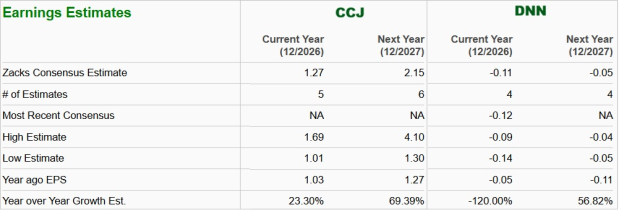
Image Source: Zacks Investment Research
Earnings estimates for 2026 for CCJ have moved down over the past 60 days, while the same for 2027 have moved up.
In the past 60 days, earnings estimates for Denison have moved up for 2026 and remained stable for 2027.

Image Source: Zacks Investment Research
Cameco & Denison: Price Performance & Valuation
Cameco shares have declined 15.3% in the past six months, whereas DNN shares have fallen 18.6%.

Image Source: Zacks Investment Research
Cameco is trading at a price/book multiple of 8.67X. Meanwhile, DNN’s forward price-to-book multiple sits at 15.18X.
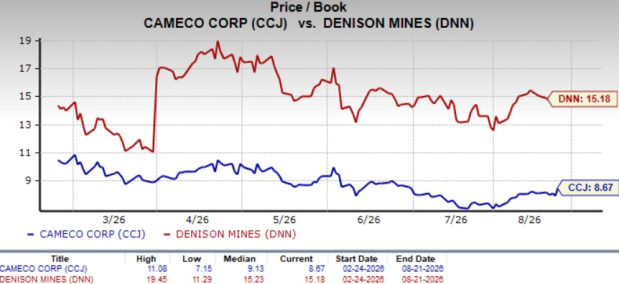
Image Source: Zacks Investment Research
CCJ or DNN: Which is the Better Investment Option?
Cameco offers the advantages of scale, established production, diversified nuclear fuel-cycle exposure and strong long-term contracts. While near-term growth could soften due to lower delivery guidance, the company remains one of the safest and most reliable ways to gain exposure to the uranium market.
Denison, meanwhile, represents a higher-risk, higher-reward opportunity. Its world-class high-grade assets, low-cost ISR mining strategy and visible path toward first production in 2028 give it substantial upside potential. However, the company is still pre-production, earnings remain negative and the stock already trades at a premium valuation. Cameco seems to be the safer bet currently.
Cameco currently carries a Zacks Rank #3 (Hold) while Denison carries a Zacks Rank #4 (Sell).
You can see the complete list of today’s Zacks #1 Rank (Strong Buy) stocks here.
Beyond Nvidia: AI's Second Wave Is Here
The AI revolution has already minted millionaires. But the stocks everyone knows about aren't likely to keep delivering the biggest profits. AI’s second wave is moving from infrastructure to implementation and these companies are at the forefront of this transition, positioned to become what Amazon and Google were to the internet era.
See Stocks Now >>Want the latest recommendations from Zacks Investment Research? Today, you can download 7 Best Stocks for the Next 30 Days. Click to get this free report
Cameco Corporation (CCJ): Free Stock Analysis Report
Denison Mine Corp (DNN): Free Stock Analysis Report
This article originally published on Zacks Investment Research (zacks.com).