Brokers Suggest Investing in Ouster (OUST): Read This Before Placing a Bet
According to the average brokerage recommendation (ABR), one should invest in Ouster (OUST). It is debatable whether this highly sought-after metric is effective because Wall Street analysts' recommendations tend to be overly optimistic. Would it be worth investing in the stock?
When deciding whether to buy, sell, or hold a stock, investors often rely on analyst recommendations. Media reports about rating changes by these brokerage-firm-employed (or sell-side) analysts often influence a stock's price, but are they really important?
Before we discuss the reliability of brokerage recommendations and how to use them to your advantage, let's see what these Wall Street heavyweights think about Ouster, Inc. (OUST).
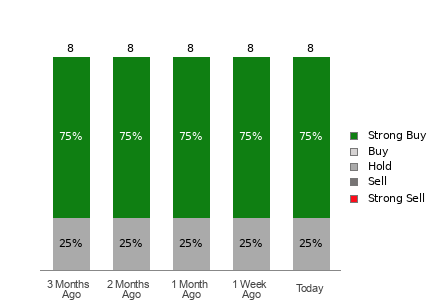
Ouster currently has an average brokerage recommendation (ABR) of 1.50, on a scale of 1 to 5 (Strong Buy to Strong Sell), calculated based on the actual recommendations (Buy, Hold, Sell, etc.) made by eight brokerage firms. An ABR of 1.50 approximates between Strong Buy and Buy.
Of the eight recommendations that derive the current ABR, six are Strong Buy, representing 75% of all recommendations.
Brokerage Recommendation Trends for OUST
Check price target & stock forecast for Ouster here>>>
The ABR suggests buying Ouster, but making an investment decision solely on the basis of this information might not be a good idea. According to several studies, brokerage recommendations have little to no success guiding investors to choose stocks with the most potential for price appreciation.
Are you wondering why? The vested interest of brokerage firms in a stock they cover often results in a strong positive bias of their analysts in rating it. Our research shows that for every "Strong Sell" recommendation, brokerage firms assign five "Strong Buy" recommendations.
This means that the interests of these institutions are not always aligned with those of retail investors, giving little insight into the direction of a stock's future price movement. It would therefore be best to use this information to validate your own analysis or a tool that has proven to be highly effective at predicting stock price movements.
Zacks Rank, our proprietary stock rating tool with an impressive externally audited track record, categorizes stocks into five groups, ranging from Zacks Rank #1 (Strong Buy) to Zacks Rank #5 (Strong Sell), and is an effective indicator of a stock's price performance in the near future. Therefore, using the ABR to validate the Zacks Rank could be an efficient way of making a profitable investment decision.
Zacks Rank Should Not Be Confused With ABR
In spite of the fact that Zacks Rank and ABR both appear on a scale from 1 to 5, they are two completely different measures.
Broker recommendations are the sole basis for calculating the ABR, which is typically displayed in decimals (such as 1.28). The Zacks Rank, on the other hand, is a quantitative model designed to harness the power of earnings estimate revisions. It is displayed in whole numbers -- 1 to 5.
It has been and continues to be the case that analysts employed by brokerage firms are overly optimistic with their recommendations. Because of their employers' vested interests, these analysts issue more favorable ratings than their research would support, misguiding investors far more often than helping them.
In contrast, the Zacks Rank is driven by earnings estimate revisions. And near-term stock price movements are strongly correlated with trends in earnings estimate revisions, according to empirical research.
In addition, the different Zacks Rank grades are applied proportionately to all stocks for which brokerage analysts provide current-year earnings estimates. In other words, this tool always maintains a balance among its five ranks.
Another key difference between the ABR and Zacks Rank is freshness. The ABR is not necessarily up-to-date when you look at it. But, since brokerage analysts keep revising their earnings estimates to account for a company's changing business trends, and their actions get reflected in the Zacks Rank quickly enough, it is always timely in indicating future price movements.
Is OUST a Good Investment?
In terms of earnings estimate revisions for Ouster, the Zacks Consensus Estimate for the current year has declined 3.9% over the past month to -$1.05.
Analysts' growing pessimism over the company's earnings prospects, as indicated by strong agreement among them in revising EPS estimates lower, could be a legitimate reason for the stock to plunge in the near term.
The size of the recent change in the consensus estimate, along with three other factors related to earnings estimates, has resulted in a Zacks Rank #4 (Sell) for Ouster. You can see the complete list of today's Zacks Rank #1 (Strong Buy) stocks here >>>>
Therefore, it could be wise to take the Buy-equivalent ABR for Ouster with a grain of salt.
Radical New Technology Could Hand Investors Huge Gains
Quantum Computing is the next technological revolution, and it could be even more advanced than AI.
While some believed the technology was years away, it is already present and moving fast. Large hyperscalers, such as Microsoft, Google, Amazon, Oracle, and even Meta and Tesla, are scrambling to integrate quantum computing into their infrastructure.
Senior Stock Strategist Kevin Cook reveals 7 carefully selected stocks poised to dominate the quantum computing landscape in his report, Beyond AI: The Quantum Leap in Computing Power.
Kevin was among the early experts who recognized NVIDIA's enormous potential back in 2016. Now, he has keyed in on what could be "the next big thing" in quantum computing supremacy. Today, you have a rare chance to position your portfolio at the forefront of this opportunity.
See Top Quantum Stocks Now >>Want the latest recommendations from Zacks Investment Research? Today, you can download 7 Best Stocks for the Next 30 Days. Click to get this free report
Ouster, Inc. (OUST): Free Stock Analysis Report
This article originally published on Zacks Investment Research (zacks.com).