BetterHelp Has the Demand: Can Teladoc Build the Capacity?
TDOC's BetterHelp faces a capacity crunch as insurance demand surges, putting therapist recruitment and credentialing at the center.
Teladoc Health, Inc.’s TDOC lower revenue outlook may look alarming at first glance, but the underlying BetterHelp story is different. Demand has not disappeared; it has just shifted. Around 70% of prospective users prefer insurance over paying out of pocket, reaching as much as 80% in certain markets, creating a sharp increase in demand for covered therapy.
The problem is provider capacity. Insurance requires therapists to be credentialed with specific payers and available in the right states, making supply harder to scale than cash pay. As demand shifted faster than capacity, cash-pay revenues declined more rapidly than expected, while insurance revenues were not yet sufficient to offset the decline.
The company is prioritizing therapist recruitment, retention and credentialing, with more than 8,000 mental health professionals already credentialed. Company-wide advertising and marketing spending fell 12.2% in the first half of 2026 as resources shifted toward insurance. Meanwhile, insurance revenues reached $22 million in the second quarter of 2026, up roughly $9 million sequentially, while insurance users grew more than 70% sequentially.
The next phase depends on how quickly Teladoc can convert this demand into completed therapy visits. The company expects the insurance business to reach an annualized revenue run rate of nearly $140 million by the end of the fourth quarter of 2026, with further growth anticipated in 2027. If capacity catches up with demand, BetterHelp could reduce its reliance on costly customer acquisition, while the insurance model could support more durable economics and make customer lifetime value more reflective of patient need.
How Are Competitors Faring?
Some of Teladoc’s key peers across digital health include Hims & Hers Health, Inc. HIMS and American Well Corporation AMWL
Hims & Hers Health operates a consumer-centric digital healthcare model, with mental health offered alongside a broader range of cash-pay wellness and personalized treatments. By relying heavily on direct-to-consumer engagement and marketing, HIMS provides a useful benchmark for customer acquisition efficiency, digital consumer access and the economics of cash-pay healthcare.
American Well takes a more enterprise-oriented approach, partnering with employers, and health systems to deliver digital care infrastructure. With exposure to behavioral health and insurance-covered care, AMWL provides a useful reference point for payer integration, clinical network scaling, and the economics of in-network virtual care.
Teladoc Health’s Price Performance, Valuation & Estimates
Shares of TDOC have lost 16.7% over the past year compared to the industry’s 13.3% growth.
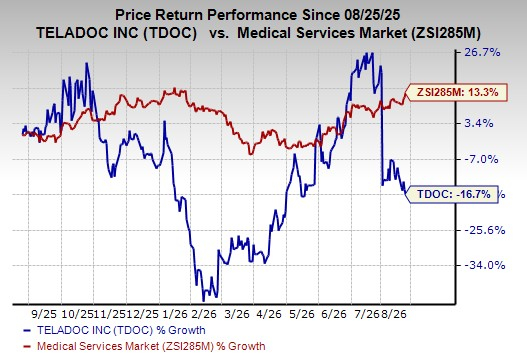
Image Source: Zacks Investment Research
From a valuation standpoint, TDOC trades at a forward price-to-sales ratio of 0.48X, down from the industry average of 0.54X. TDOC carries a Value Score of B.

Image Source: Zacks Investment Research
The Zacks Consensus Estimate for TDOC’s 2026 loss is pegged at 89 cents per share,implying a 21.9% increase from the year-ago period’s level.

Image Source: Zacks Investment Research
The stock currently carries a Zacks Rank #3 (Hold). You can see the complete list of today’s Zacks #1 Rank (Strong Buy) stocks here.
Beyond Nvidia: AI's Second Wave Is Here
The AI revolution has already minted millionaires. But the stocks everyone knows about aren't likely to keep delivering the biggest profits. AI’s second wave is moving from infrastructure to implementation and these companies are at the forefront of this transition, positioned to become what Amazon and Google were to the internet era.
See Stocks Now >>Want the latest recommendations from Zacks Investment Research? Today, you can download 7 Best Stocks for the Next 30 Days. Click to get this free report
Teladoc Health, Inc. (TDOC): Free Stock Analysis Report
American Well Corporation (AMWL): Free Stock Analysis Report
Hims & Hers Health, Inc. (HIMS): Free Stock Analysis Report
This article originally published on Zacks Investment Research (zacks.com).