Bear of the Day: GoPro (GPRO)
GoPro, the pioneering action camera brand, continues to struggle as the core business slows and the stock craters.
GoPro (GPRO) was once one of the most recognizable growth brands in consumer electronics, but the business has been in structural decline for years. Despite repeated attempts to diversify beyond its core action-camera franchise, revenue continues to contract, camera volumes are falling and profitability remains elusive.
The latest results offered little evidence that the trend is reversing. Second quarter revenue fell 31% year over year to $105 million, while camera sell-through (Sell-through measures the percentage of inventory a retailer sells compared to the total stock shipped to them by the manufacturer) declined 38% to approximately 291,000 units. GoPro posted a $51 million GAAP net loss, compared with a $16 million loss a year earlier, while adjusted EBITDA deteriorated to negative $29 million.
Those numbers follow a difficult 2025, when full-year revenue declined 19% and camera sell-through dropped 20%. Subscription revenue has provided some stability, but it has not been nearly large enough to offset deterioration in the core hardware business.
More concerning is how GoPro is financing itself while attempting another turnaround.
Earlier this year, the company entered into an agreement with Yorkville for as much as $50 million of convertible debt, explicitly creating the potential for dilution as those securities are converted into common stock.
Then in July, founder and CEO Nicholas Woodman provided another $20 million through senior secured notes accompanied by warrants to purchase roughly 25.7 million shares of Class B stock. GoPro also amended its revolving credit facility, including increased borrowing costs and lender waivers.
Woodman's willingness to provide capital certainly demonstrates confidence in the company he founded. But from an investor's perspective, the broader financing picture is difficult to ignore. When a shrinking business is funding continued losses with secured debt, convertible securities and warrants, existing shareholders face both balance-sheet risk and potential dilution.
GoPro's board has also initiated a review of strategic alternatives, another indication that the company recognizes the need for a more significant change in direction.

Image Source: Zacks Investment Research
GoPro Earnings Estimates Collapse
The deteriorating fundamental picture is showing up clearly in analyst expectations. GoPro currently carries a Zacks Rank #5 (Strong Sell), reflecting a dramatic downward shift in earnings estimates.
Over the last 60 days, the analyst covering GPRO has meaningfully lowered forecasts. The current quarter estimate has fallen from a profit of $0.01 per share to a loss of $0.14. Next quarter estimates have moved from positive $0.05 to a $0.02 loss. The full year estimate has collapsed from positive $0.05 to a loss of $0.72 per share and next year estimates have moved from positive $0.05 to a $0.01 loss.
The consensus outlook has moved from modest profitability to substantial losses in a very short period.
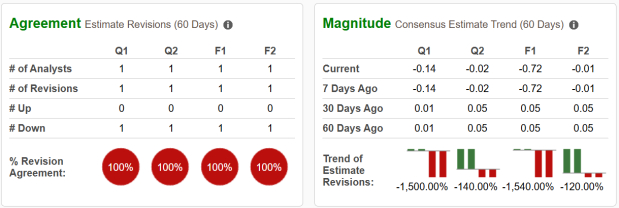
Image Source: Zacks Investment Research
The revisions also follow another disappointing earnings report. In Q2, GoPro generated $105 million in revenue, down from $153 million a year earlier, while adjusted EBITDA swung from a $6 million loss to a $29 million loss.
The company is finding some success in subscriptions, where revenue increased 11% and subscriber attach rates reached a record 69%. But that remains a relatively small bright spot within a much larger business experiencing severe volume declines.
For the stock to recover sustainably, GoPro needs more than cost cutting or incremental subscription growth. It ultimately needs to demonstrate that it can stabilize the top line and build a profitable business around its brand. So far, the numbers are moving in the opposite direction.
Should Investors Avoid GPRO Stock?
At less than $1 per share, GoPro may look tempting as a turnaround or acquisition speculation. The company still owns a globally recognized brand, continues to develop new products and is actively reviewing strategic alternatives.
However, those potential catalysts need to be weighed against a very difficult financial reality.
Revenue and unit sales continue to decline, losses are widening and earnings expectations are moving sharply lower. At the same time, the company has increasingly relied on secured debt, convertible financing and warrants to maintain liquidity, creating additional risk for existing shareholders.
A strategic transaction could change the story, and GoPro's brand may ultimately have value to another company. But betting on an acquisition is very different from investing in a healthy underlying business.
Until there is clear evidence that sales have stabilized and the company can generate sustainable positive cash flow without continued reliance on potentially dilutive financing, GoPro remains a difficult stock to own.
Radical New Technology Could Hand Investors Huge Gains
Quantum Computing is the next technological revolution, and it could be even more advanced than AI.
While some believed the technology was years away, it is already present and moving fast. Large hyperscalers, such as Microsoft, Google, Amazon, Oracle, and even Meta and Tesla, are scrambling to integrate quantum computing into their infrastructure.
Senior Stock Strategist Kevin Cook reveals 7 carefully selected stocks poised to dominate the quantum computing landscape in his report, Beyond AI: The Quantum Leap in Computing Power.
Kevin was among the early experts who recognized NVIDIA's enormous potential back in 2016. Now, he has keyed in on what could be "the next big thing" in quantum computing supremacy. Today, you have a rare chance to position your portfolio at the forefront of this opportunity.
See Top Quantum Stocks Now >>Want the latest recommendations from Zacks Investment Research? Today, you can download 7 Best Stocks for the Next 30 Days. Click to get this free report
GoPro, Inc. (GPRO): Free Stock Analysis Report
This article originally published on Zacks Investment Research (zacks.com).