Are Costco's July Sales Solid Enough to Justify Its Premium Valuation?
Costco's July sales show resilient demand, strong digital momentum and membership strength, but investors question if the premium valuation is justified.
Costco Wholesale Corporation COST continues to command one of the richest valuations in the retail sector. This makes its monthly sales updates particularly important for investors to assess whether the company’s growth momentum can support its premium multiple. July’s results once again highlighted resilient consumer demand, solid comparable sales growth and strong digital momentum. The key question is whether these trends are strong enough to justify Costco’s elevated valuation.
A Closer Look at Costco's July Sales
For a retailer trading at a premium multiple, the quality and consistency of growth matter as much as the pace. Costco’s July report offered encouraging evidence on both fronts. Net sales increased 10.7% year over year to $23.12 billion during the four weeks ended Aug. 2, 2026 compared with growth of 10.6% in June and 14.5% in May. While growth has moderated from May’s pace, July’s performance remained broadly steady with June, pointing to sustained spending momentum.
Comparable sales provided further evidence of healthy underlying demand. Companywide comparable sales rose 8.9% compared with growth of 8.8% in June and 12.5% in May. Adjusted comparable sales, excluding gasoline price and foreign exchange impacts, advanced 6.6% in July. The solid adjusted increase suggests that Costco’s growth was supported by underlying business momentum rather than external factors alone.
Digital performance added another layer of strength. Costco’s digitally enabled comparable sales climbed 17.7% on a reported basis and 18.2% after adjusting for fuel and currency effects. Sustained digital growth of this magnitude complements the company’s warehouse-driven model and demonstrates its ability to capture spending across channels while preserving the value proposition at the core of its business.
Beyond July Sales: What Supports Costco’s Premium Valuation?
July’s sales performance strengthens the case for Costco’s premium, but it is only part of the story. The company’s membership-based business model remains a key competitive advantage, providing a recurring revenue stream while fostering customer loyalty and repeat traffic. Its growing Executive Membership base further strengthens this advantage, as these members tend to shop more frequently and spend more per visit.
Membership fee income increased 10.7% year over year to $1.37 billion in the third quarter of fiscal 2026. Renewal rates remained strong at 92.2% in the United States and Canada and 89.7% worldwide, underscoring the stickiness of Costco’s membership model. The company continues to attract shoppers through its low-price strategy, high-quality merchandise and carefully curated product assortment, helping it deepen customer loyalty and gain market share.
These structural advantages help explain why Costco has historically commanded a higher valuation than many of its retail peers. The question, however, is whether the current premium leaves enough room for further upside.
Costco’s Rich Valuation Raises the Bar
Costco trades at a forward 12-month price-to-earnings ratio of 42.54, well above the industry’s ratio of 31.58. The premium reflects investors' confidence in the company's membership-driven business model, recurring fee income, resilient sales growth and disciplined execution. Even so, the multiple remains below its 12-month median of 45.85, indicating that valuation has moderated from historical levels.
The premium becomes even more pronounced when compared with other mass-merchandise retailers. Costco’s forward 12-month P/E is well above those of Dollar General Corporation DG at 15.88 and Target Corporation TGT at 17.67. While Costco’s superior business quality and growth profile arguably warrant a higher multiple, such a wide valuation gap raises the bar for continued execution.

Image Source: Zacks Investment Research
Costco Stock performance
Costco shares have dropped 6.8% over the past three months against the industry's 2.8% rise. The stock’s recent performance suggests that investors have become more cautious about paying that premium. Over the same period, shares of Dollar General have gained 18.8%, while Target has advanced 24.8%.

Image Source: Zacks Investment Research
How Are Costco's Earnings Estimates Trending?
The Zacks Consensus Estimate for Costco’s current financial-year sales and earnings per share implies year-over-year growth of 9.7% and 13.5%, respectively. For the next fiscal year, the consensus estimate indicates a 7.8% rise in sales and 10.2% growth in earnings.
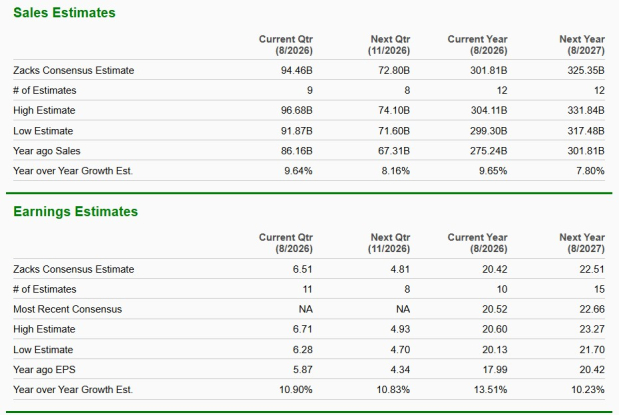
Image Source: Zacks Investment Research
Can Costco Continue to Command a Premium?
Costco’s July sales once again reinforced the strength of its membership-driven business model, supported by healthy comparable sales growth and continued digital momentum. Healthy earnings growth further supports the company’s growth outlook. However, given the stock’s significant premium to the industry, Costco will need to sustain strong execution and deliver consistent growth to justify its elevated valuation and drive the shares higher.
Costco currently carries a Zacks Rank #3 (Hold). You can see the complete list of today’s Zacks #1 Rank (Strong Buy) stocks here.
7 Best Stocks for the Next 30 Days
Just released: Experts distill 7 elite stocks from the current list of 220 Zacks Rank #1 Strong Buys. They deem these tickers "Most Likely for Early Price Pops."
Since 1988, the full list has beaten the market more than 2X over with an average gain of +23.9% per year. So be sure to give these hand picked 7 your immediate attention.
See them now >>Want the latest recommendations from Zacks Investment Research? Today, you can download 7 Best Stocks for the Next 30 Days. Click to get this free report
Costco Wholesale Corporation (COST): Free Stock Analysis Report
Target Corporation (TGT): Free Stock Analysis Report
Dollar General Corporation (DG): Free Stock Analysis Report
This article originally published on Zacks Investment Research (zacks.com).